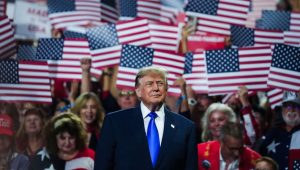
The words came not from a fringe figure or an unaccountable militant, but from the president of the United States — the commander-in-chief of the most powerful military in the world. In a series of posts on Truth Social, Donald Trump issued an extraordinary warning to Iran. “Tuesday will be Power Plant Day, and Bridge Day… Open the F***in’ Strait… or you’ll be living in Hell,” he wrote.
He then escalated further, declaring that “a whole civilization will die tonight, never to be brought back again,” adding almost casually, “I don’t want that to happen, but it probably will.”
It is difficult to overstate the gravity of such language. This was not strategic ambiguity or calculated deterrence. It was a direct and public contemplation of annihilation — expressed in terms so stark that they shattered long-standing norms of presidential restraint. The office of the presidency has always carried an implicit obligation: that its immense power be matched by discipline in word as well as deed. In this instance, that discipline appeared absent.
Had Iran’s leadership issued an equivalent threat against the US, it would almost certainly have been branded as an extreme provocation, if not outright terrorism. Yet when such rhetoric originates from Washington, it is often absorbed into the logic of power politics. That asymmetry underscores a broader unease about the rules governing international conduct — rules that appear flexible when applied to the most powerful.
More troubling still is what the language suggests about presidential temperament. The remarks were not measured, nor were they framed as part of a coherent strategic message. They were volatile, erratic, and alarmingly casual in their invocation of mass death. For critics, they reinforced a persistent concern: that the world’s most lethal military capability is being directed by a leader whose judgment can veer unpredictably, with potentially catastrophic consequences.

The context in which these statements were made only deepens the concern. The US, alongside Israel, had already launched a military assault on Iran that many analysts and observers describe not as a defensive war, but as an act of aggression against a sovereign state. There has been no publicly demonstrated evidence that Iran posed an imminent threat sufficient to justify such escalation. Diplomatic negotiations were still underway. Channels for de-escalation remained open. Yet the decision was made to strike.
The consequences have been severe and far-reaching. Civilian infrastructure has been damaged or destroyed, and the human toll has been significant, with thousands reported killed across Iran and parts of the wider region. Among the victims were civilians with no connection to the state or its military apparatus, as well as foreign nationals caught in the wider fallout of the conflict. Reports of migrant workers, including six Bangladeshis, killed far from the immediate war zone illustrate how such actions reverberate beyond borders, affecting lives with no direct stake in the conflict. These deaths and the scale of destruction were not inevitable; they were, by many accounts, avoidable.
The conflict has also highlighted the growing normalisation of targeted killings as an instrument of state policy. Strikes aimed at senior Iranian officials may be presented as tactical successes, but they set a dangerous precedent. When political and military leaders become routine targets, the boundaries of warfare shift in ways that invite escalation and retaliation. Even more concerning is the fact that civilians have been killed in such operations — people who neither shaped policy nor participated in hostilities. If this becomes an accepted norm, the distinction between combatant and non-combatant risks further erosion.



At the same time, the international response has been marked by a striking lack of decisive action. Statements of concern have been issued, but meaningful intervention has been limited. For many observers, this amounts to a form of silent acquiescence, particularly given the central role of the US in shaping global responses. The involvement of Israel, acting in concert with Washington, has reinforced perceptions of a strategic alignment that operates with limited accountability, especially in the Middle East.
The issue of nuclear weapons has once again exposed deep inconsistencies. Iran’s nuclear programme has been cited as a central justification for sustained pressure and military action. Yet Israel, widely believed to possess a nuclear arsenal, remains outside the Nuclear Non-Proliferation Treaty and largely beyond the scope of international scrutiny. This disparity undermines the credibility of global non-proliferation efforts and raises fundamental questions about whether international rules are applied uniformly or selectively.
Despite the escalation, a dramatic shift occurred at the last moment. Just hours before a deadline for further strikes, Trump announced that the United States and Iran were close to a “definitive” agreement and declared a two-week ceasefire to allow negotiations to proceed. The arrangement, contingent on Iran halting hostilities and ensuring the free flow of shipping through the Strait of Hormuz, provided immediate, if fragile, relief. Markets stabilised, oil prices eased, and there was a cautious sense that the worst might have been averted.
Yet the ceasefire also served a more immediate political function. Having publicly threatened catastrophic destruction, the president faced a stark choice: follow through and risk uncontrollable escalation, or step back and undermine his own credibility. The temporary truce offered a way out of that dilemma without fully resolving it. It was less a resolution than a reprieve.
The administration has portrayed this outcome as a success, claiming that its objectives have been met. However, that narrative is far from universally accepted, even within the US. A senior Republican senator warned that pursuing such escalation would have been a “huge mistake,” reflecting unease that extends beyond partisan lines. Other lawmakers rejected the very premise of threatening the destruction of a civilisation, arguing that such rhetoric is fundamentally incompatible with the values the country claims to uphold.
On the ground, the situation remains deeply uncertain. Key questions about Iran’s nuclear programme remain unresolved, as do broader issues concerning regional influence and long-term security arrangements. Iran’s own conditions for a lasting settlement — including sanctions relief and strategic concessions — present significant challenges. The ceasefire, while significant, does not constitute a durable peace. It is a pause in a conflict whose underlying tensions remain intact.
Even if a permanent agreement emerges, the longer-term consequences of this episode may extend beyond immediate geopolitics. Trump’s remarks have already altered the tone of international discourse. They have lowered the threshold of what is considered acceptable rhetoric for a global leader and introduced a level of unpredictability that complicates diplomacy. Allies must now account for volatility; adversaries may test it.
For decades, the US positioned itself as a stabilising force in the international system, projecting an image of power tempered by responsibility. That image is now under strain. In its place is a perception of a superpower willing to wield both its words and its weapons with a degree of unpredictability that unsettles even its partners.
The central question that emerges is not only about policy, strategy, or even this particular conflict. It is about judgment. When a leader entrusted with unparalleled military capability openly contemplates the destruction of an entire civilisation — and does so in language that appears impulsive rather than deliberate — it raises profound concerns about the direction of global leadership.
For now, the immediate crisis has eased. The strikes have paused, the threats have subsided, and negotiations have resumed. But the memory of those words lingers. And in international politics, words of that magnitude do not simply disappear.