

Prices of several essential toiletries have continued to rise in Bangladesh despite the FY2026-27 national budget introducing no major new taxes on most consumer care products, prompting renewed concerns over the cost of living.
A recent market review showed that prices increased across several categories of toiletries during the first six months of the year.
Data compiled by the country’s largest retail chain Shwapno showed that while the overall increases were relatively modest, several product categories recorded noticeable price hikes between January and June 2026.
Among the major categories, toothpaste recorded the highest average increase at 2.4 per cent, followed by hand wash and sanitiser (2.2 per cent), soap (1.3 per cent) and detergent (1.2 per cent). In contrast, shampoo prices remained largely stable, declining slightly by 0.1 per cent overall.
The data also revealed that price movements varied significantly across different price segments.

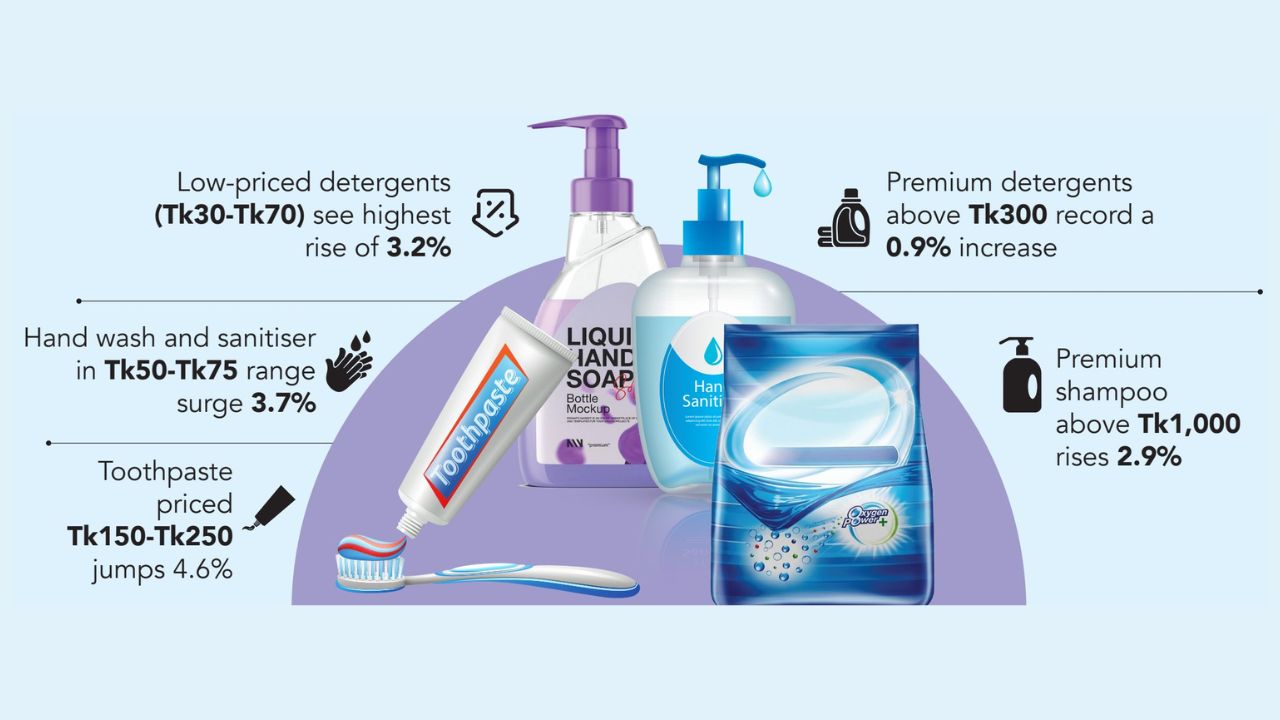
For detergents, products priced between Tk30 and Tk70 recorded the highest increase of 3.2 per cent, while premium products priced above Tk300 rose by 0.9 per cent.
In the toothpaste category, the sharpest increase was observed among products priced between Tk150 and Tk250, where prices increased by 4.6 per cent. Toothpaste priced between Tk250 and Tk350 also posted a significant 3.9 per cent rise.
Hand wash and sanitiser products in the Tk50-75 price range experienced the highest increase at 3.7 per cent, followed by products below Tk50, which rose 3.1 per cent.




Soap prices increased most in the Tk150-250 segment, recording a 3.2 per cent rise, while lower-priced soaps remained relatively stable.
Meanwhile, shampoo prices showed mixed trends. Premium products priced above Tk1,000 increased by 2.9 per cent, whereas several lower-priced categories registered slight declines, resulting in an overall marginal decrease.
The latest figures come at a time when consumers have been expecting greater price stability after the new national budget. However, manufacturers have previously argued that production costs remain under pressure due to higher global commodity prices, exchange-rate volatility, increased logistics expenses and rising domestic utility costs.
Consumer rights advocates have repeatedly urged stronger market monitoring to ensure that price adjustments reflect actual cost increases rather than opportunistic mark-ups.
Officials said the government would continue monitoring the toiletries market to assess whether recent price changes are justified and whether further intervention is required to protect consumers.
Consumer Association of Bangladesh (CAB) Vice President SM Nazer Hossain said the recent increase in toiletries prices appears to have no reasonable justification. According to him, the current national budget did not introduce any significant measures that would warrant such price hikes. Instead, he attributed the situation to weak market oversight and a lack of effective monitoring by the relevant authorities.
“The Ministry of Commerce, the Directorate of National Consumer Rights Protection and BSTI should strengthen market monitoring. Businesses are taking advantage of the situation to raise prices, while there appears to be a degree of inaction on the part of the government,” he said.
Asked whether legal action could be taken against companies over such price increases, Nazer Hossain said the production cost of a product and a reasonable profit margin should remain within acceptable limits. “If a company charges excessively high prices to earn abnormal profits without a valid justification, legal action can be taken against it under the Consumer Rights Protection Act,” he added.
Director General of the Directorate of National Consumer Rights Protection AHM Safiquzzaman said the recent increase in toiletries prices appears to lack a clear justification, noting that neither current market conditions nor the national budget provide sufficient grounds for such price adjustments.
“At this stage, the price hike appears to be driven more by businesses taking advantage of the situation than by any genuine increase in costs,” he said.
Safiquzzaman stressed the need for stronger market oversight, urging the Directorate of National Consumer Rights Protection, the Bangladesh Standards and Testing Institution (BSTI), and the Ministry of Commerce to intensify monitoring to ensure that businesses comply with market regulations.
He said the government has the authority to intervene where necessary by examining a product’s production cost and the level of profit being earned. “There should be a reasonable limit to profit margins. If any business is found to be charging excessive prices or earning unjustified profits, legal action can be taken under the Consumer Rights Protection Act and other applicable laws,” he added.