


In a push to boost international employability and higher education prospects, third language education will be introduced across 50 universities in Bangladesh by December this year.
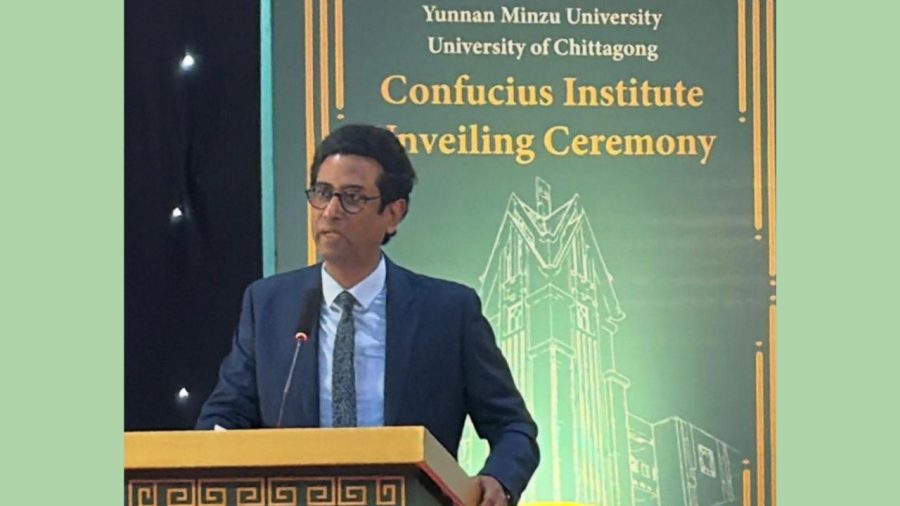
University Grants Commission (UGC) member Professor Abdullah Al Mamun announced this on Saturday while speaking as a special guest at the inauguration of the Confucius Institute at the University of Chittagong, jointly established with China’s Yunnan Minzu University at Bashundhara International Convention City in Dhaka.
Professor Mamun revealed that the initiative aligns directly with the BNP’s 2026 election manifesto’s focus on expanding proficiency in Mandarin, Japanese, German, Korean, and Arabic.
He emphasised that in an increasingly interconnected global economy, acquiring an additional language vastly expands students’ academic horizons, sharpens cross-cultural communication, and unlocks lucrative overseas career pathways.

To ensure equitable access, the UGC plans to establish language centres across every divisional region, leveraging established institutions like the newly launched Confucius Institute as key operational partners.
Professor Mamun noted that the ambitious rollout requires a steady supply of local and international language experts alongside high-quality instructional materials. Consequently, the commission will collaborate closely with foreign diplomatic missions, placing high priority on the Chinese Embassy given the emphasis on Mandarin.



Learning a third language will enable Bangladeshi graduates to access lucrative exchange schemes, scholarships, joint academic ventures, research fellowships, summer schools, and faculty exchanges, ultimately advancing the UGC’s broader vision of establishing Bangladesh as a dynamic regional hub for higher education through dual-degree and joint-degree frameworks.
Highlighting the profound link between language skills and global employability, Professor Mamun pointed out that Bangladesh’s expanding economic ties with China span vital sectors such as manufacturing, infrastructure, artificial intelligence, logistics, engineering, and information technology.
Graduates who pair domain expertise with language fluency and cross-cultural competence will enjoy a sharp competitive edge in the international job market. Beyond employment, he stressed that academic partnerships with Chinese institutions should extend into cutting-edge fields like climate change, biotechnology, agriculture, and public health, with the Confucius Institute serving as a institutional bridge.
Professor Mamun also advocated shifting from a narrative of “brain drain” to “brain circulation” by engaging non-resident Bangladeshi academics and researchers abroad through visiting faculty roles, joint supervision, and collaborative research networks.
Describing language as an essential gateway to societal understanding, Professor Mamun expressed confidence that the Confucius Institute at the University of Chittagong will evolve beyond basic language instruction into a vibrant platform for academic exchange, research innovation, and bilateral cultural immersion.
The event was attended by Communist Party of China Yunnan Provincial Standing Committee Member Zhao Junmin as chief guest, alongside Chinese Ambassador Yao Wen, University of Chittagong Vice-Chancellor Professor Mohammad Al-Forkan, Yunnan Minzu University unit CPC Secretary Ruan Chaoqi, and BKSP Director General Brigadier General Mohammad Saif Ullah.