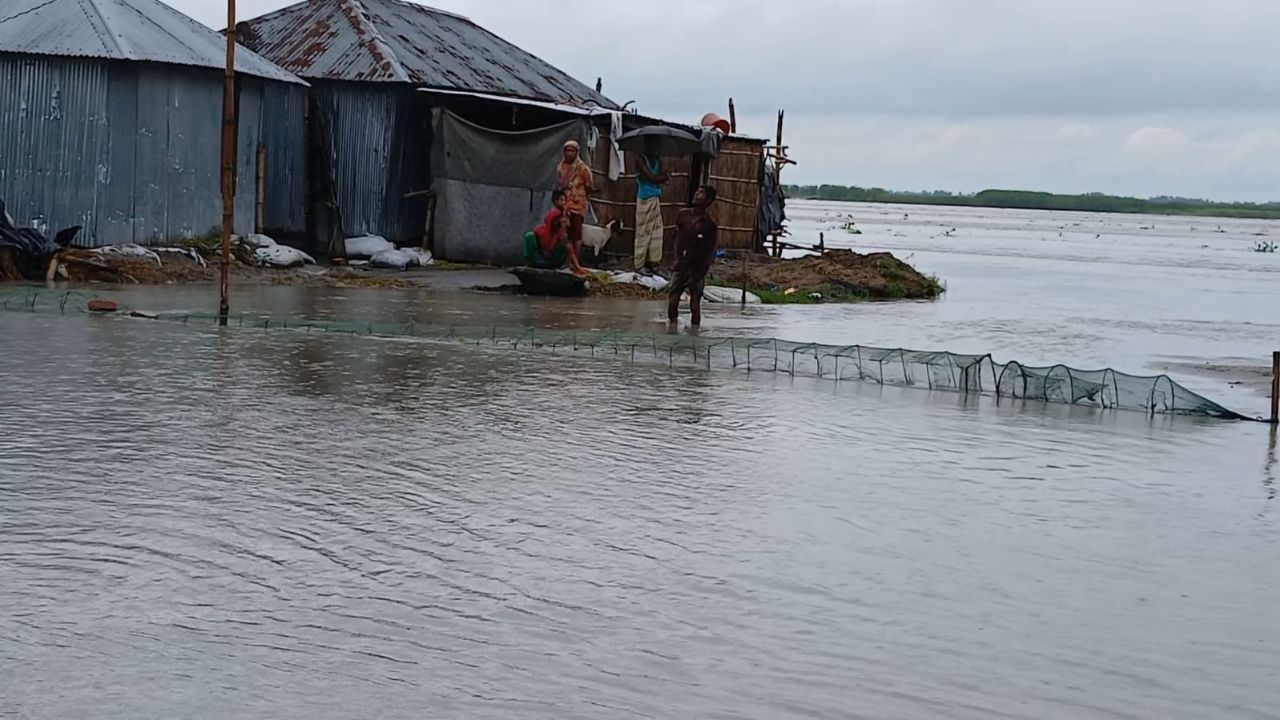

For Sultana Begum, the Teesta River did not just bring floodwaters; it took away a lifetime of memories.
The concrete home where she had lived with her husband Mostafizur Rahman for four decades was swallowed by the river within five days. Built for their three children, the house is now gone, leaving the family with nothing but uncertainty.
Sultana’s story is being repeated across the Teesta basin as the river rises for the seventh time this monsoon, leaving communities caught in a double crisis: relentless flooding and devastating erosion.
Heavy rainfall and upstream surges have pushed water into new areas, drowning newly planted Aman paddy fields, destroying vegetable farms and washing away homes along the riverbanks.
The Teesta Barrage Point in Dalia, Nilphamari, was flowing just 1cm below the danger level at 9am on Wednesday, Dalia Water Development Board Executive Engineer Amitabh Chowdhury told TIMES of Bangladesh.
Ahsan Habib, supervising engineer of the Water Development Board’s northern zone, said the situation remained unchanged at 6am. However, the water level later fell to 8cm below the danger mark at noon, 11cm at 3pm and 17cm at 6pm.
According to data from the Water Development Board’s Dalia division, the water level at Dalia point was recorded at 52.14 metres on Wednesday afternoon, just 1cm below the danger level of 52.15 metres.

The Water Development Board has opened all 44 gates of the barrage to maintain normal water flow. Officials said the level could rise above the danger mark within the next 24 hours.
However, Partha Pratim Barua, sub-divisional engineer at the Flood Forecasting and Warning Centre, told TIMES that the water level remained below the danger mark and could decline further on Thursday.
Although the water later began to recede, officials warned that levels could rise again within 24 hours.
The latest surge has flooded char and low-lying areas across Nilphamari, Lalmonirhat, Rangpur, Kurigram and Gaibandha, leaving homes submerged, roads cut off and thousands of hectares of farmland underwater.
Farmers said repeated flooding had destroyed their crops even before they could recover from previous losses.




“Seven rounds of flooding have taken away nearly 70 per cent of our major crops,” said Mohsin Ali, a farmer from Gangachara’s West Ichhli village.
Peanut cultivation has been completely ruined, while large areas of maize fields have been submerged. The newly planted Aman paddy is now also underwater after the latest rise, he added.
Fisherman Syed Ali of Kacharipara village suffered another blow when floodwaters breached his pond embankment, washing away fish worth years of investment.
River eats away homes
While floodwaters threaten livelihoods, erosion is steadily swallowing villages along the Teesta.
In Rangpur alone, erosion has appeared at 20 locations, including Bridge Bazar, Kacharipara, Char Bagdohara and Char Nohali under Nohali union.
The Water Development Board said more than 150 erosion points had emerged along the 242km Teesta basin this year, affecting both riverbanks and protection embankments.
The Mahipur Teesta Road Bridge’s north-western protection embankment and the right-bank protection embankment in Kolkonda union are among the areas under threat.
Local residents said many families affected by flooding and erosion were still waiting for meaningful assistance from local authorities.
Rangpur Deputy Commissioner Mohammad Ruhul Amin said the administration had informed higher authorities and instructed officials to take urgent steps.
Water Development Board officials said geo-bags were being placed in vulnerable areas to slow erosion.
Flood threat spreads nationwide
The flood risk is no longer limited to the Teesta basin.
The Flood Forecasting and Warning Centre has issued alerts for Sylhet, Sunamganj and Naogaon for the next 24 to 48 hours.
The Surma and Kushiyara rivers in Sylhet and Sunamganj are already flowing above danger levels, while the Atrai River in Naogaon has also crossed the danger mark.
The Sangu and Matamuhuri rivers in Bandarban, Cox’s Bazar and Chattogram are flowing close to danger levels.
Officials warned that rising water in the Dharla and Dudhkumar basins could further flood low-lying areas of Lalmonirhat, Nilphamari, Rangpur, Gaibandha and Kurigram.
The Brahmaputra-Jamuna basin, including Kurigram, Gaibandha, Jamalpur, Bogura, Sirajganj and Tangail, also remains at risk.
For families living along the Teesta, however, the immediate battle is already underway — against a river that keeps rising and a shoreline that keeps disappearing.