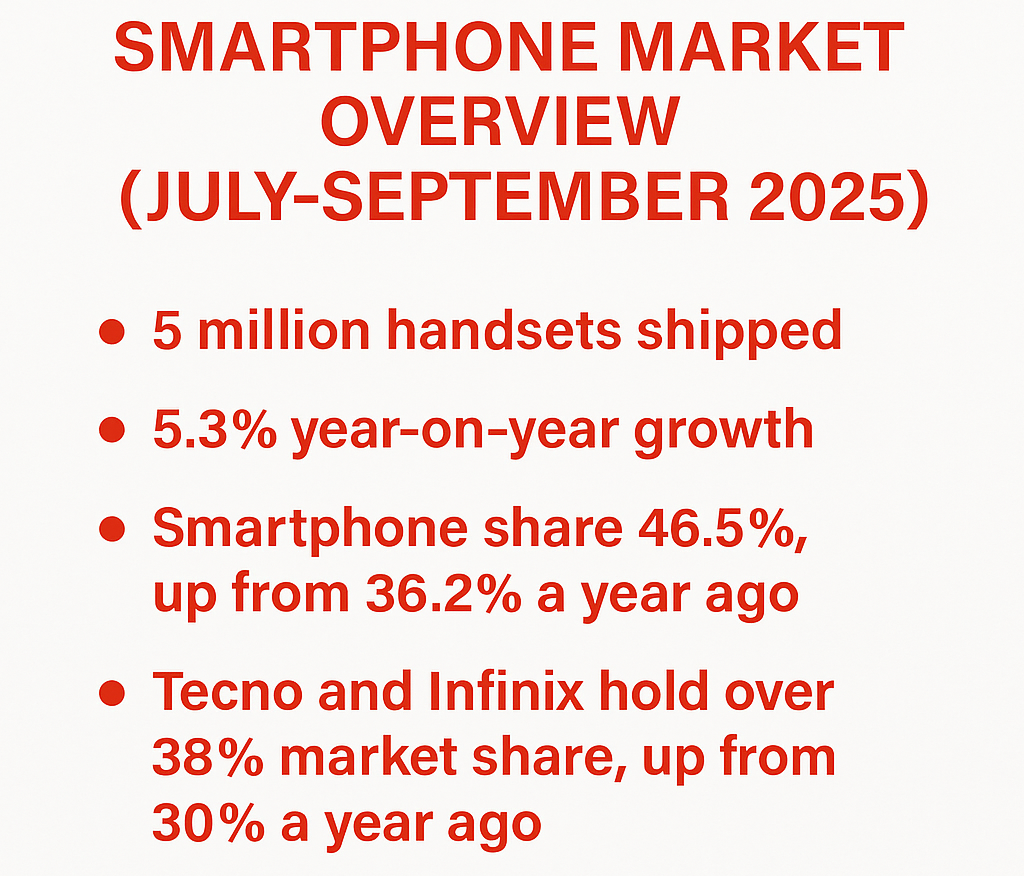
Bangladesh’s mobile handset market grew 5.3% year-on-year to five million units in the July–September quarter of 2025, according to global research firm International Data Corporation (IDC).
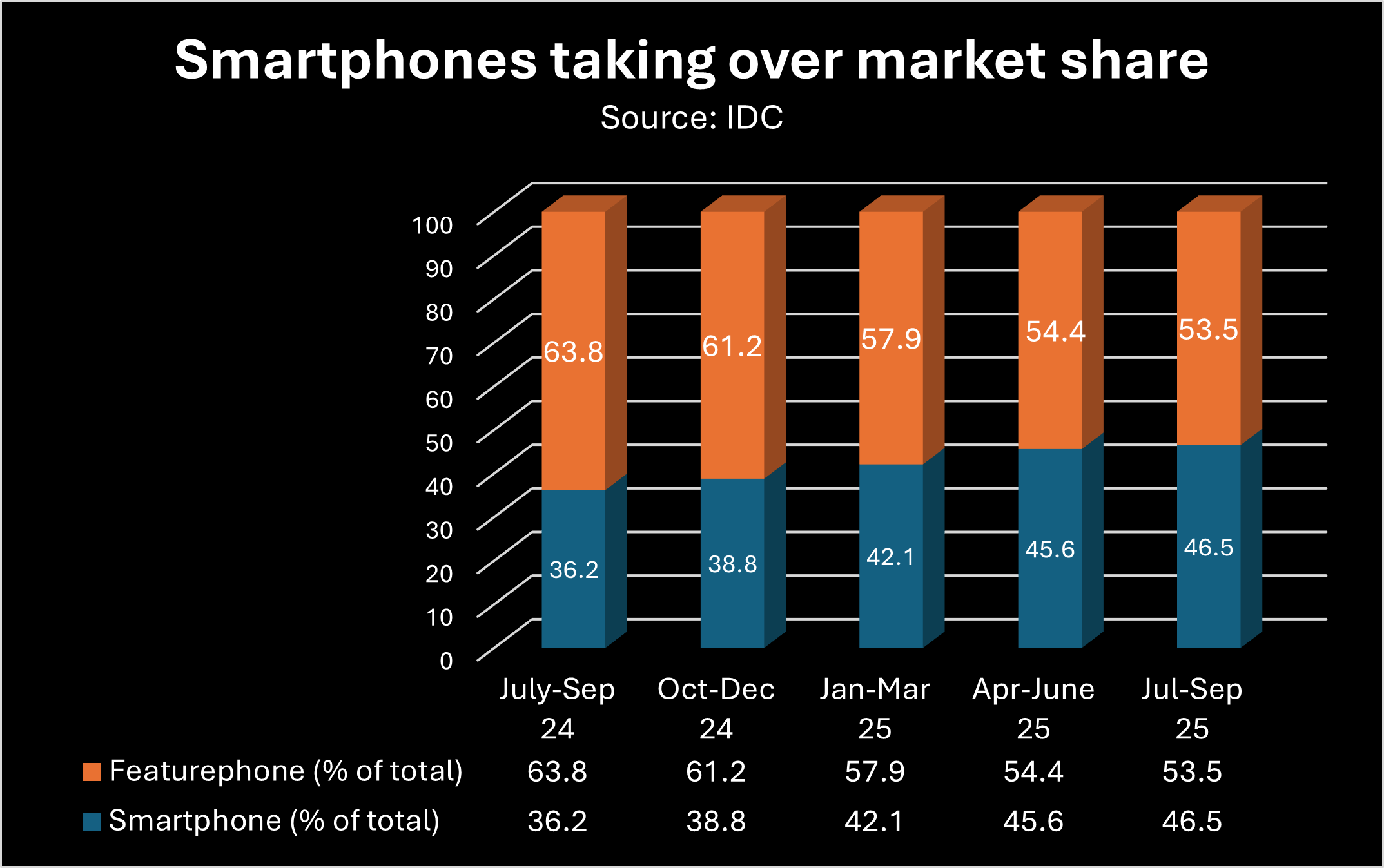
Smartphones continued to outpace feature phones as more users opted for internet-based devices. IDC data show smartphones accounted for 46.5% of total shipments in the third quarter, up from 45.6% in the previous quarter and 36.2% a year earlier.
The transition from basic phones to smartphones has accelerated with flexible financing and wider model availability. Analysts said the rise of zero-downpayment and cardless EMI schemes has brought first-time buyers into the market.
“Affordable financing and low-cost models are driving the next wave of smartphone ownership,” said IDC Senior Market Research Analyst Anjney Bhardwaj.

Industry insiders said new launches and competitive prices have further boosted demand. “The winning brands have introduced compelling new models at decent prices, encouraging many users to upgrade their phones,” said ISMARTU Technology BD CEO Rezwanul Hoque.
His company, which distributes Tecno and Infinix, met over 38% of total smartphone demand in the third quarter, up from around 30% a year ago.


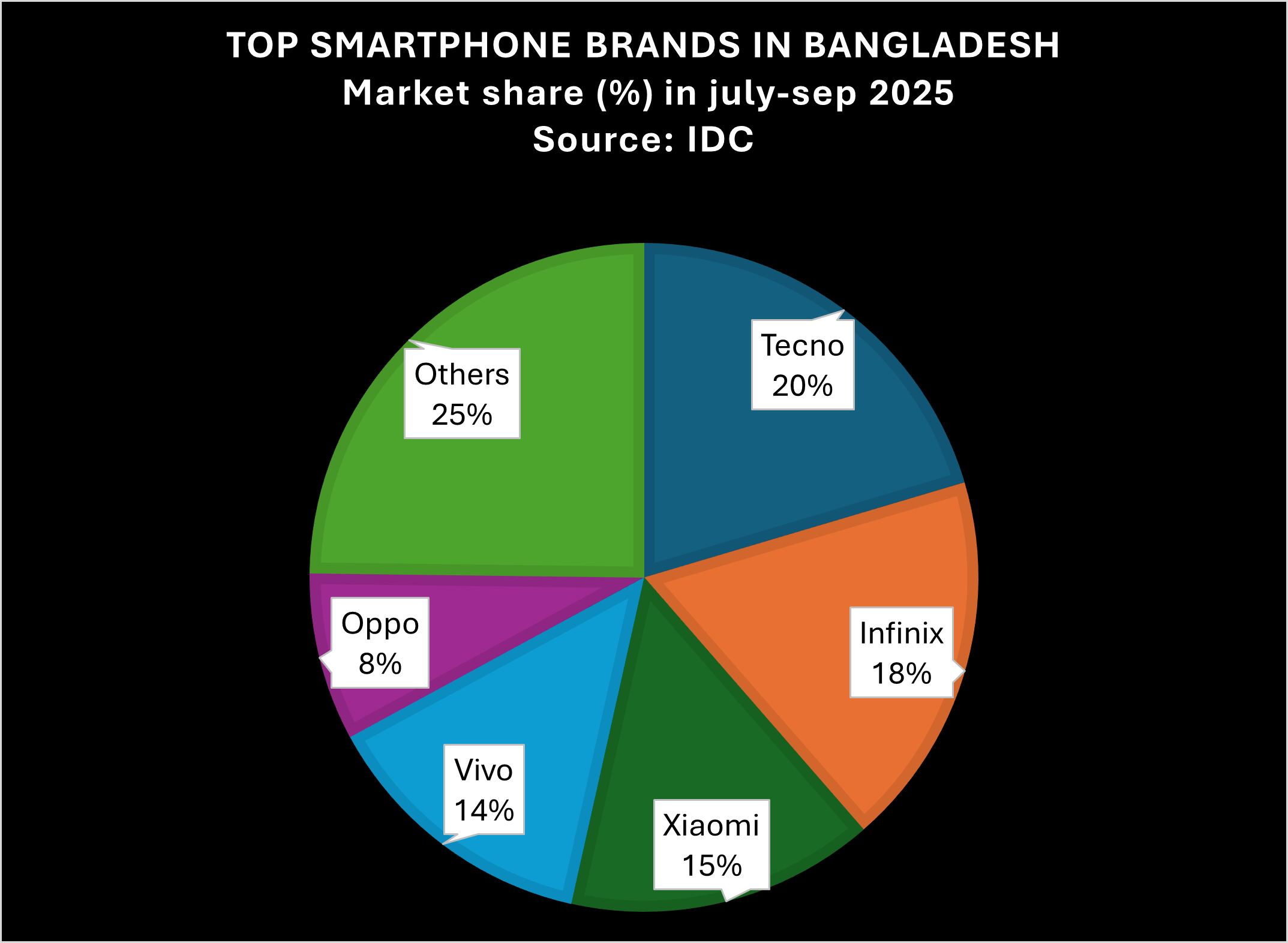
IDC data show Tecno led the market with a 20.4% share, followed by Infinix at 18.2%, Xiaomi at 14.9%, Vivo at 13.6% and OPPO at 8.1%. The rest was shared among other Chinese, Korean and Western brands.
Among the most popular models were Tecno’s Spark 40, Infinix’s Hot 60 Pro, Vivo’s Y21d, OPPO’s A6 Pro and Xiaomi’s Redmi 15C — most priced below $200. IDC noted that phones under $100 made up 41% of shipments, while those between $100–200 held 35.8% and the $200–400 range captured 19.9%.
The mid-range segment posted triple-digit year-on-year growth, while entry-level categories expanded at double-digit rates, reflecting a growing preference for better performance and features within affordable price bands.
Economic momentum also supported the trend, with Bangladesh’s Purchasing Managers’ Index rising to 59.1 in September from 58.3 in August — signalling stronger business confidence and consumer spending.
IDC said Bangladesh’s handset market is rapidly shifting from feature-phone dominance to a smartphone-led landscape, driven by affordable financing, accessible technology and widening digital inclusion. The IDC report counts shipments to the market from both local assembly plants and foreign manufacturing sources.
For its research, IDC depends on periodical tracking of all units imported or manufactured within the country and conducts interviews with national, regional and city-level distributors to gather both qualitative and quantitative data on market trends. It also directly contacts leading vendors to validate its findings.
Besides the official market, Bangladesh has a large gray market for both brand-new and used phones, which remains outside the scope of official statistics.