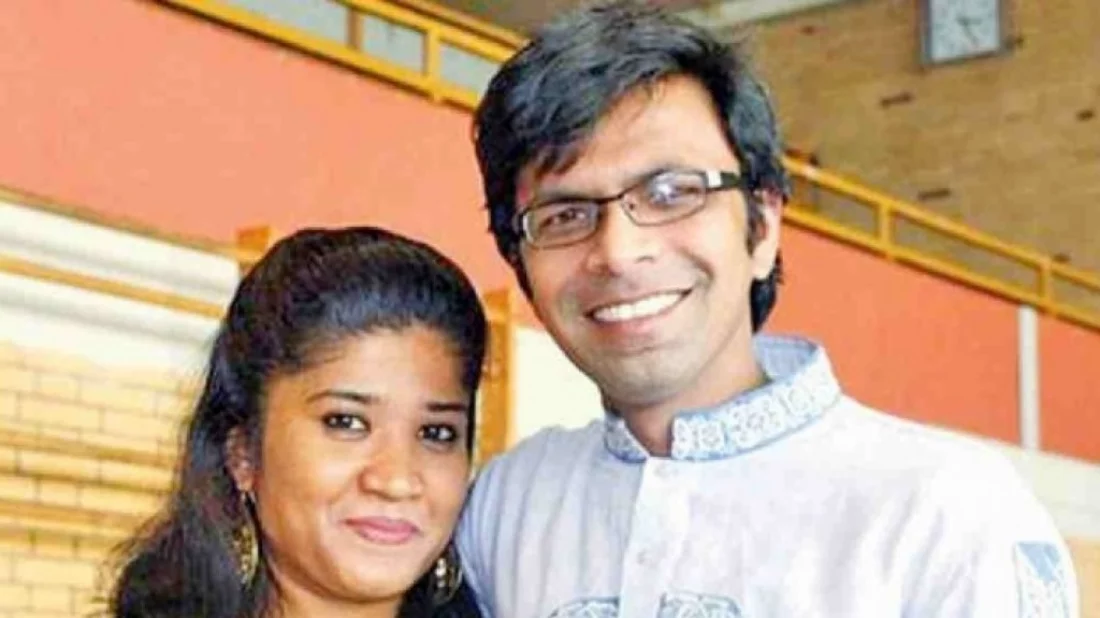



Fourteen years after the killing of journalist couple Sagar Sarowar and Meherun Runi, the investigation remains unresolved despite multiple agency changes and the formation of a high-powered taskforce.
On Sunday, the High Court granted the taskforce a further six months to complete its probe — the third such extension.
The order came from a bench of Justice Fatema Najib and Justice AFM Saiful Karim after the state sought more time.
Attorney General Md Ruhul Quddus Kazal, assisted by Deputy Attorney General Akhtar Hossain Md Abdul Wahab, represented the state, while Mohammad Shishir Manir appeared for the complainant and Manzill Murshid for the petitioner.
During the hearing, the attorney general told the court that a progress report had already been submitted to the Registrar General’s office.
“The taskforce has sought more time. The investigation is at its end stage, but some of the officials involved at the time cannot be reached,” he said.
At one stage, the attorney general requested six months to complete the probe, while Shishir Manir argued that three months would be sufficient and suggested that relevant officials be summoned before the court.
The court ultimately allowed the state’s request.
Sagar Sarowar, who worked for private television channel Maasranga TV, and Meherun Runi, a journalist at ATN Bangla, were found murdered at their rented home in West Rajabazar in Dhaka on 11 February 2012.

The case was filed by Runi’s brother, Nowsher Alam, with Sher-e-Bangla Nagar Police Station.
What’s in the progress report?
Investigators probing the killing of the journalist couple are facing major obstacles, including missing records and a lack of access to key individuals involved in the early stages of the case, the attorney general has said.
Briefing reporters after the court hearing, he said the Rapid Action Battalion had handled the investigation for 12 years, six months and 15 days before the current taskforce took over.
He said eight suspects had been arrested during that period, of whom seven remain in custody while one is absconding after securing bail.
The taskforce has recently questioned a suspect identified as Humayun, a caretaker of the building, with the court’s permission.
However, the attorney general said investigators were struggling to reach many of the officials who held responsibility at the time of the killings.
These include ministers, political figures and members of law enforcement agencies involved in the initial investigation.



“Many of the familiar faces we used to see regularly on television at the time are no longer traceable after 5 August,” he said.
He also highlighted the absence of a preserved crime scene, describing it as a key limitation.
“Those currently serving on the taskforce did not visit the scene immediately after the incident. By the time they took charge, there was effectively no crime scene left,” he said.
The attorney general said the core problem lay in the lack of continuity in the investigation.
In criminal cases, he noted, maintaining a clear chain of evidence and information is essential.
But in this case, information gathered by earlier investigators — including evidence, witness statements and details of arrests — had not been systematically handed over to the current taskforce.
“As a result, they are unable to access crucial information needed to move the investigation forward,” he said.
Doubts remain
Questions have been raised over whether the latest six-month deadline will be enough to resolve the long-stalled investigation into the killing.
Lawyer for the complainant Mohammad Shishir Manir expressed scepticism at a separate briefing following the court hearing.
“Even within six months, it is unlikely that the individuals the taskforce wants to question will be found in Bangladesh,” he said.
“If the taskforce also fails, we will have nowhere left to turn. However, we expect that the Attorney General’s Office, which has expressed support for the taskforce, will ensure visible progress within this period. Only then can we remain hopeful.”
He said many of the key figures the taskforce intends to question are currently outside the country.
“These include the then home minister, the inspector general of police, the director general of RAB and a journalist. The people they want to speak to are not within Bangladesh’s jurisdiction,” he said.
Shishir Manir also pointed to the lack of any clear motive in the case, according to the investigation report.
“No motive or clue has yet been established,” he said.
“It is not being attributed to marital conflict, business disputes, professional issues or even land-related matters. It is astonishing that such a serious incident remains unresolved, with repeated failures to uncover the truth.”
Investigation marked by repeated delays
The investigation into the killing has seen years of delays, shifting responsibilities and repeated extensions.
Following a writ petition, the High Court on 18 April 2012 assigned the probe to the Rapid Action Battalion.
More than a decade later, in September 2024, the Home Secretary sought a revision of that order, prompting fresh court proceedings.
After a hearing, the High Court on 30 September directed the formation of a high-powered taskforce comprising experienced officials from multiple agencies to take over the investigation.
The court also instructed the taskforce to submit a report within six months.
The case returned to the court on 22 April last year, when the state said the investigation was ongoing and showing progress, and sought nine months to complete the probe.
The court instead granted another six-month extension.
On 23 October 2025, following a further application by the state, the court again allowed an additional six months.
Attorney General Md Ruhul Quddus Kazal said the taskforce had submitted three progress reports since its formation, but the investigation remains incomplete.