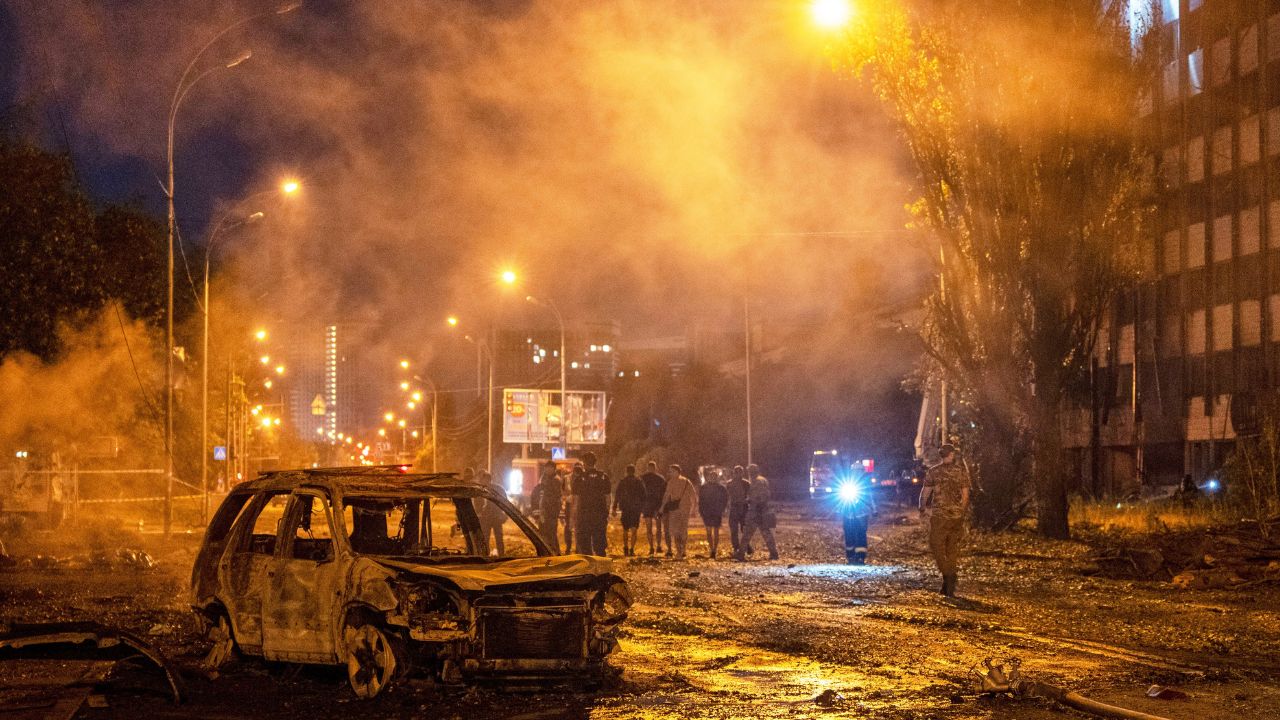



Russia unleashed a heavy barrage of ballistic missiles and drones on Kyiv overnight into Saturday, killing at least nine people and wounding 30 civilians, Ukrainian authorities said, in an assault that followed a major attack two days earlier which left ten dead and more than 50 injured across the country, according to AP.
The renewed strikes appeared to exploit Kyiv’s acute shortage of Western-supplied anti-ballistic missile defences, further diminishing prospects of a diplomatic resolution to Russia’s invasion of its neighbour, now in its fifth year.
A five-storey residential block in the capital’s Solomianskyi district was damaged by falling debris and caught fire, with rescue workers evacuating 35 people from its upper floors.
Two people died in the incident and eight others, including two children, were injured, Ukraine’s state emergency service said.
In the Darnytskyi district, seven people were killed and 14 more injured after the bombardment sparked fires and damaged houses, vehicles and an administrative building, emergency services reported.

Elsewhere in the capital, firefighters extinguished a blaze in a non-residential building in the Shevchenkivskyi district, though there was no fresh information on earlier reports from the district mayor that people had been trapped in another residential building.
Damage to commercial and residential property was also reported in two further city districts, while Lithuania’s foreign minister said the country’s embassy in Kyiv had been damaged when missiles struck nearby.
Russia’s defence ministry said on Saturday it had carried out a “massive strike” against Ukrainian military-industrial and logistics facilities in Kyiv.
President Volodymyr Zelensky renewed his appeal to Washington and other Western allies for additional Patriot air defence systems to counter Russian ballistic missile attacks.




“Every package of ballistic missile interceptors saves the lives of our people. And every night without them results in more casualties,” he wrote on X after the latest strikes.
He said late on Friday that he had spoken with US Vice President JD Vance and discussed his meeting with President Donald Trump in Washington earlier in the week, which he described as “positive and productive”.
“The Russian air strikes on our country continue and air defense, specifically interceptors for Patriot systems against ballistic missiles, remains a top priority,” Zelensky said on Telegram.
At a NATO summit in Ankara in July, Trump said Washington would license Ukraine to manufacture Patriot systems domestically, but he appeared to step back from that pledge on Friday during a Cabinet meeting at Camp David, Maryland, saying no final decision had yet been made.
Sheltering in a basement as a second air raid siren sounded overnight, 64-year-old Liudmyla Nakonechna described being woken by loud explosions at 1:30am.
“I ran into the corridor and was standing there when the bathroom door was blown off its hinges and struck me in the leg,” said Nakonechna, who is in poor health following cancer treatment. “I heard the sound of shattering glass.
My balcony was covered in glass and it was completely blown apart, while the windows in my bedroom were also blown out.”
She said she had not sought shelter since Russia’s full-scale invasion began on 24 February 2022, but that the mounting strain had become unbearable.
“It’s getting worse by the day,” she said. “Whereas before there was an attack once every two weeks, or maybe once a week, now it happens practically every day. It is incredibly hard to bear this psychologically.”
In Russian-occupied Crimea, Moscow-appointed Sevastopol city head Mikhail Razvozhayev said a 60-year-old woman was killed and two others wounded in a drone strike on the city on Saturday.
Separately, Russian outlet Astra reported that a Ukrainian drone had set an oil refinery in Ufa on fire, though local officials said only that debris from a downed drone had caused “smoke” at an unnamed industrial site.
Ukraine’s near-daily long-range drone and missile strikes, using domestically produced weapons, have battered Russian oil infrastructure for months, fuelling a fuel crisis that has proven an embarrassment for the Kremlin more than four years into its full-scale invasion.