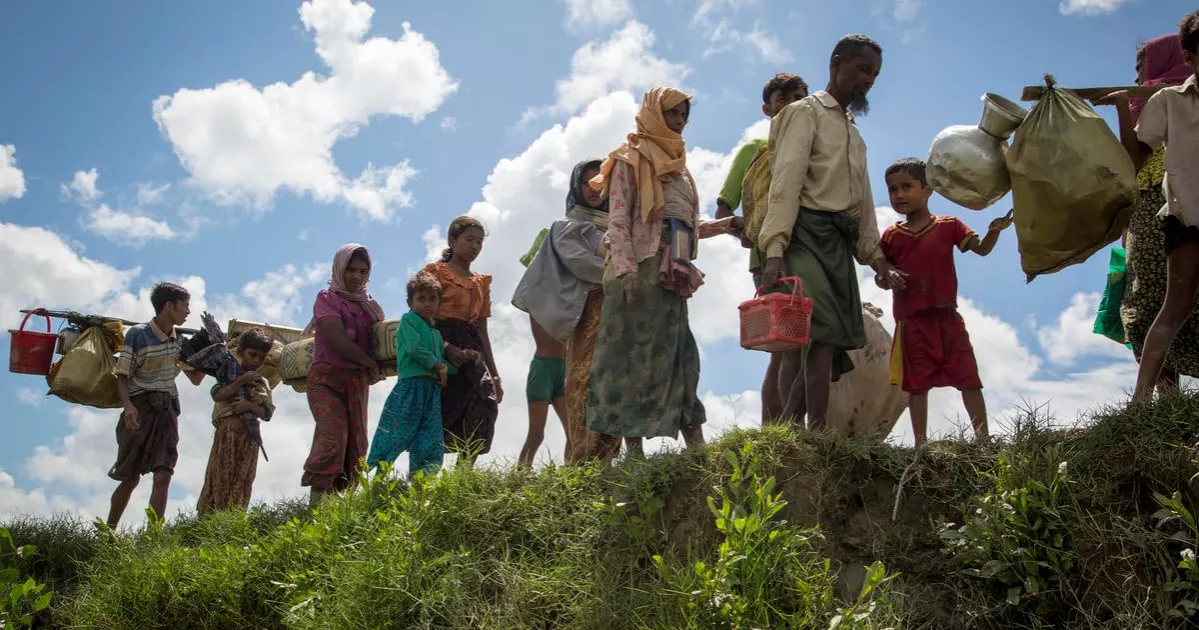

Thousands of Rohingya gathered on Saturday in the World’s largest refugee settlement in Bangladesh, calling for an end to violence in Myanmar’s Rakhine State and demanding a safe, dignified path to return to their homeland.
Just a couple of days’ back, in a high-level United Nations conference on refugee crisis in New York, Bangladesh’s National Security Adviser Khalilur Rahman described situation in Rakhine as favourable for the return of Rohingya, a view contradicted by facts presented by rights groups and Rohingya community.
Rohingya civil society in Camp-13 in Ukhiya’s Palongkhali Union organised the rally titled “Our Future, Our Voice—Message Ahead of the UN Conference on Rohingya,” where speakers urged the international community to move beyond promises and adopt a concrete, time-bound “roadmap” for repatriation.
“We do not want to hear promises anymore,” said Maulvi Syed Ullah, a Rohingya community leader. “What we truly want is the chance to return to our homeland with security guarantees. We want citizenship rights, and we want to live with dignity.”
Even as Rohingya leaders insist that Rakhine remains unsafe, Adviser Rahman argued that conditions are shifting in their favour.
Speaking at a panel discussion in New York on 25 September — “Global Refugee Asylum System: What Went Wrong and How to Fix It” — hosted by US Deputy Secretary of State Christopher Landau, Khalilur pointed to photographs of the Arakan Army’s commander meeting with Rohingya villagers as evidence of progress.
Khalilur, who also serves as Bangladesh’s high representative on Rohingya issues, urged the global community to pivot from long-term aid to facilitating repatriation. Drawing on Bangladesh’s own history, he recalled how 10 million refugees fled to India during the country’s 1971 independence war but returned once the fighting ended.

“Just as we came back, the Rohingyas want to go back. They do not want to remain in Bangladesh forever,” he said.
Bangladesh, he stressed, cannot shoulder the financial and social burden indefinitely. Hosting more than 1.2 million refugees has already cost the international community upwards of $5 billion, with Dhaka contributing “countless more, beyond money.”
“Before they fled, no one had to spend anything on them,” Khalilur said. “Their land and water are abundant. They do not need us — they need to be allowed to go back to their homes.”
Khalilur described “good news” from inside Myanmar: the Arakan Army, which now controls as much as 90 per cent of Rakhine, has begun re-engaging Rohingya communities.
He cited chilling images showing displaced Rohingya resettled in villages, local leaders selected from among them, and mosques rebuilt, including a grand mosque in a major town.




“This is a rare opportunity for the world to act decisively,” he told the panel. “Please help them go home. Spend a fraction of what is being spent here inside Myanmar so they can restart their lives and reclaim their future.”
But human rights advocates urge caution. “The Arakan Army is carrying out policies of oppression against the Rohingya similar to those long imposed by the Myanmar military,” said Elaine Pearson, Asia director at Human Rights Watch, in a report published by Human Rights Watch last July.
Amnesty International warned against any forced returns, citing risks of persecution, torture, and other abuses, and urged Bangladesh to lift restrictions on education, employment, and health care for Rohingya in the camps.
While in late August, Thailand’s cabinet approved measures allowing Myanmar refugees living in camps along the border to work legally. For many, it will be the first formal employment of their lives.
In a 24 March statement, the European Union also cautioned against rushing repatriation, saying that “even seven years after the mass displacement of Rohingya refugees from Myanmar to Bangladesh, prospects for a durable solution unfortunately remain beyond reach.” The bloc reaffirmed support for voluntary, safe, dignified, and sustainable repatriation — but only when conditions allow.
Inside Bangladesh’s camps, the gap between rhetoric and reality is stark. According to UNHCR, 150,000 Rohingya have fled Myanmar in the past 18 months, driven by fresh waves of targeted violence. More than 1.15 million now live across 33 camps in Cox’s Bazar, squeezed into just 24 square kilometres — one of the most densely populated areas on earth.
Funding shortfalls threaten to push the situation into collapse. Aid agencies warn that without urgent resources, food distributions, medical care, education, and shelter programmes could be severely disrupted. Each year, 30,000 children are born in the camps, many growing up without schooling or prospects for work.
The strain is felt most acutely by new arrivals like Nur Kolima, 31, from Buthidaung, who lives in a makeshift slum outside the official Rohingya camp at Thaingkhali.
“Three months ago, when the Arakan Army launched attacks, many of us fled,” she told TIMES of Bangladesh. “In the chaos, I lost my husband. I crossed the hills and the Naf River with my three children. I have not heard from him since.”
Denied space in the registered camps, she scavenges for food to keep her children alive. “Since my C-section surgery, I cannot do heavy work,” she said. “I appeal to the Government of Bangladesh to give us shelter and food inside the camp.”
Rafiq Mahmud, TIMES’ Ukhiya correspondent, estimates that more than 10,000 Rohingya have arrived in these unrecognised settlements in just the past six months. Inside Myanmar itself, a July UNHCR report counted more than 300,000 internally displaced people still trapped in Rakhine State.
The Rohingya crisis remains as much a geopolitical problem as a humanitarian one. Myanmar’s fractured politics, with the military junta locked in conflict with the Arakan Army and other ethnic groups, has made it difficult to guarantee safe zones for returning refugees.
International donors, meanwhile, face fatigue from a crisis with no end in sight. Since 2017, Western governments and aid agencies have poured billions into Cox’s Bazar. Yet the sense of stagnation has fuelled pressure — particularly from Bangladesh — to shift focus toward “solutions.”
At the same time, regional powers like China and India view the Rohingya issue through a strategic lens, balancing humanitarian obligations with their interests in Myanmar’s resources and geopolitical positioning.
The competing narratives — Bangladesh’s push for immediate repatriation, rights groups’ warnings of renewed persecution, and Rohingya refugees’ desperate appeals — converge as diplomats prepare for the 30 September UN conference.
For Dhaka, the images of Arakan Army leaders speaking with Rohingya villagers suggest an opening. For aid groups, they are a distraction from the continued risks on the ground. For the Rohingya themselves, the message is simple: they want to go home, but only if they can do so safely, with dignity, and as citizens of Myanmar.
Whether the world sees this moment as a turning point or another false dawn may soon become clear in New York.