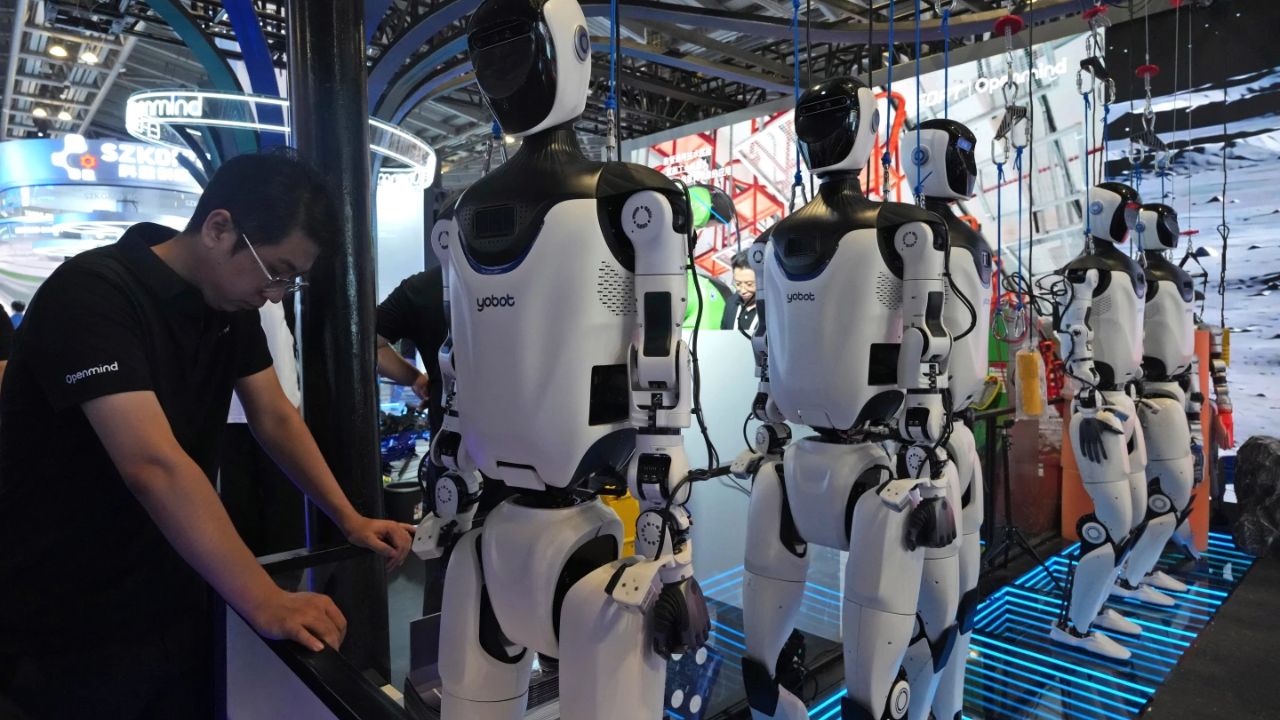



China has rapidly emerged as the world’s leading force in robotics, combining strong government backing, an advanced manufacturing base and the technological gains of its electric vehicle (EV) industry to dominate the sector.
From industrial robots on factory floors to investments in humanoid robots, the country is positioning itself at the forefront of what many experts see as the next industrial revolution.
A national Strategy for Robotics
Robotics has become a strategic priority for Beijing under President Xi Jinping’s drive to develop what he calls “new quality productive forces.” As China’s working-age population shrinks, policymakers increasingly view automation as essential to boosting productivity and maintaining the country’s manufacturing advantage, BBC reports.
China’s long-term strategy dates back to 2015, when Beijing made robotics a key pillar of its Made in China 2025 plan, aimed at reducing reliance on imported advanced manufacturing technologies.
Industries received low-interest loans from state-controlled banks, government funding, support for overseas acquisitions and other incentives. In 2021, China introduced another national strategy to further expand robot deployment.
“You can see how well that strategy worked out; without a strategy, a country is always at a disadvantage,” Susanne Bieller, Secretary General of the International Federation of Robotics (IFR), told The Japan Times.
Building on China’s EV Ecosystem
One of China’s biggest advantages has been its electric vehicle industry. “The robotics story builds directly on China’s electric vehicle ecosystem,” Kyle Chan, a researcher at the Brookings Institution, told the BBC.
Batteries, electric motors, cameras, sensors and semiconductors originally developed for electric vehicles are now being widely used across China’s robotics sector, creating what Chan describes as “overlapping industrial ecosystems.”
Chinese EV maker XPeng is one of the companies leading this transition. The company unveiled its humanoid robot, Iron, last year. Founder He Xiaopeng said that he no longer sees XPeng as simply a carmaker.

“We want XPeng to be a high-tech company. In the future, any car company will transform into a car and robotics company,” Xiaopeng added.
According to the analysts, China is applying the same formula that helped it become a global EV leader- manufacturing scale, dense supplier networks and rapid product development-to robotics.
China’s Dominance in Factory Robotics
China’s leadership is already evident in industrial robotics. According to the International Federation of Robotics, more than 2 million robots were operating in Chinese factories last year. Chinese factories installed nearly 300,000 new robots during the year, more than the rest of the world combined.
By comparison, factories in the United States installed 34,000 robots, while Japan installed 44,000.
China has also become a major robot manufacturer. Last year, it accounted for one-third of global robot production, up from one-quarter in 2023, while Japan’s share fell from 38 per cent to 29 per cent. For the first time, nearly three-fifths of the robots installed in China were domestically made, and overall, China now has five times as many factory robots as the United States, according to the IFR.
China has installed more than 150,000 factory robots annually since 2017, while its manufacturing output continued to grow. By the start of this year, the country was producing nearly one-third of the world’s manufactured goods-more than the United States, Germany, Japan, South Korea and Britain combined.




“This is not a coincidence,” Lian Jye Su, Chief Analyst at Omdia, told The Japan Times. “It has taken many years of investment by Chinese companies.”
The race for humanoid robots
While factory robots dominate manufacturing today, experts believe humanoid robots represent the industry’s next frontier.
According to Fast Company, veteran US robotics expert Robert Ambrose believes China has already overtaken the United States in the race to develop humanoid robots.
“I’ve worked at the bleeding edge of robotics innovation in the United States for almost my entire professional life. Never before have I seen another country advance so quickly,” Ambrose said.
He said that China even raced humanoid robots against humans earlier this year, underscoring the pace of its development. Although artificial intelligence dominates headlines, Ambrose argues that humanoid robotics has been developing quietly for five decades.
Mass-produced humanoid robots could arrive within the next three to five years, with the market projected to reach $38 billion within a decade.
According to Morgan Stanley, cited by Fast Company, 56 per cent of robotics companies are already based in China.
Ambrose argues the competition is about more than commercial success.
“It’s about industrial supremacy.” He says that fixed industrial robots already operate with productivity estimated to be 10 times that of humans, working almost 24 hours a day, seven days a week, with virtually no errors. Free-moving humanoid robots, he says, could eventually become even more productive.
Growing investment, but challenges remain
Chinese companies including AgiBot and Unitree are investing billions in humanoid robots.
According to the BBC, Chinese-made robots are already operating in British warehouses, where they mainly move goods. Geek+ says its next goal is to automate entire warehouse operations.
“We are working on… end-to-end unmanned warehouse solutions,” Yanyu Liu, Head of Communications at Geek+, told the BBC, referring to automating picking, handling and eventually packing goods.
The Japan Times reports that government support has fueled startups such as Unitree Robotics, which plans to go public by the end of the year. Its latest basic humanoid robot is priced at about $6,000 in China—far below comparable robots made by Boston Dynamics.
However, experts caution that humanoid robots still face technical limitations.
Developers argue that humanoids could eventually work in factories, hospitals and offices without redesigning workplaces built for people. But experts say the technology is not yet capable of handling some repetitive tasks requiring greater dexterity.
China still trails foreign competitors in producing some critical humanoid robot components, particularly advanced sensors and semiconductors.
“If you were to assemble a really top-notch humanoid robot, it would be almost completely non-China-made,” Lian Jye Su said. “Maybe it would have one or two Chinese components, but by and large the entire system would be very international.”
Why the US is falling behind
Despite companies such as Boston Dynamics producing advanced prototypes, Ambrose argues that industrial leadership depends on mass production rather than demonstration models.
He warns that if the United States continues to lag behind, American businesses could become more dependent on Chinese supply chains while workers face wage stagnation and job losses.
Ambrose, whose humanoid robot Robonaut flew to space and is now housed at the Smithsonian, says the U.S. must overcome four major obstacles: cultural fears about robots replacing workers, shortages of skilled robotics talent, high development costs and weaker policy support compared with China.
He notes that China has invested more than $20 billion in robotics and next-generation technologies through subsidies and support for equipment and talent and is projected to match U.S. robotics research and development levels by 2034.
A strategic race
China’s ambitions have faced setbacks. The US banned imports of new foreign-made advanced robots, citing national security. The Chinese embassy in Washington responded that Beijing has long opposed the US “politicising” of trade issues and sanctions based on “groundless pretexts.”
Meanwhile, China also benefits from a large workforce of skilled electricians and programmers, along with an AI industry increasingly focused on improving factory efficiency.
According to Cameron Johnson, a Shanghai-based supply chain consultant, companies in China are using AI to swoop in and say which machines are doing great and which are a little off.
People are not looking at it as a manufacturing tool, at least not yet, and not how the Chinese are, he also said.