


The family of Farhana Haque, an engineer who died in an accident on 24 August while inspecting renovation work at a Primary Health Care Centre of International Organisation for Migration (IOM) in Rohingya Camp 3, Ukhiya, Cox’s Bazar, has demanded that IOM Bangladesh and Enroute International Limited organise and inform the findings of an unbiased investigation, including the cause of the accident.
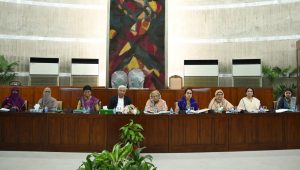
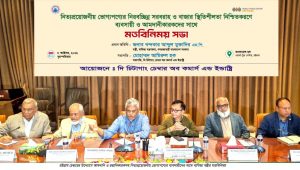
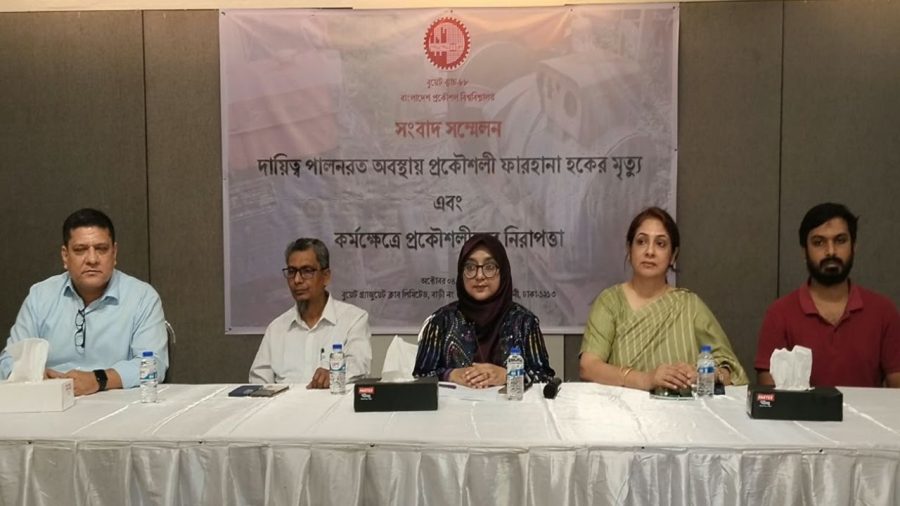
The demand was made on behalf of the family at a press conference organised by BUET Batch-88 at the BUET Graduates Club in Banani, Dhaka, on Sunday, said a press release.
Farhana Haque held a bachelor’s degree in civil engineering from Ahsanullah University of Science and Technology and a master’s degree (major in structures) from the Military Institute of Science and Technology. She joined IOM’s Infrastructure Unit in Cox’s Bazar as a Senior Field Engineer on 6 August, engaged through a third party, Enroute International Limited.
Just 18 days after joining, on 24 August, she died following an accident while performing her official duties. She was declared dead at Cox’s Bazar Sadar Hospital. She was the mother of a two-year-old son, her family members said at the press conference.

News reports at the time, citing the Officer-in-Charge of Ukhiya Police Station, said the accident occurred when her scarf and hair became entangled in a running generator during the inspection.
According to the family’s statement, the family emailed IOM on 3 and 12 September requesting the incident report, CCTV footage, details of the safety measures in place and a meeting. In a written reply sent by email on 17 September, IOM Bangladesh stated that work at the site had been suspended and that records, including the available CCTV footage, had been preserved, but that the footage did not capture the incident.


The family welcomed the offer of a briefing in the email. Enroute International has said that its review and investigation are ongoing and that no incident report has yet been finalised.
The statement said that more than five weeks after her death, neither IOM nor Enroute has formally informed the family how the accident happened or what caused it.
Farhana’s father, A K Fazlul Haque, said, “As a father, what I ask for is very simple. We are able to know truthfully how my daughter died, and that no other parents have to lose a child this way.”
Syeda Sultana Razia of BUET Batch-88, a chemical and occupational safety specialist, spoke on construction site safety. She said, “PPE is essential, but it is the last line of defence. The first question is whether the rotating parts of the running generator were guarded or enclosed, and whether the renovation work area was separately cordoned off.”
She also sought to know whether notice of the fatal accident had been given as required under the relevant section of Bangladesh Labour Act, 2006 and the relevant rule of the Bangladesh Labour Rules, 2015, and whether Article 16 of International Labour Organization (ILO) Occupational Safety and Health Convention, 1981 (No. 155), which requires employers to ensure that, so far as is reasonably practicable, the workplaces, machinery, equipment and processes under their control are safe and without risk to health, had been complied with.
Fahima Shahadat of BUET Batch-88, who has 30 years of experience in Bangladesh’s construction industry, particularly in infrastructure projects, said that sick people, older persons, pregnant women and children visit a primary health care centre, so it is essential to know whether patients were being seen at the centre while the renovation work was under way and, if so, whether there was a safety barrier separating them from the work area and the running machinery.
She called on the donor organisations concerned to seek the findings of the investigation from IOM, and on the Office of the Refugee Relief and Repatriation Commissioner (RRRC) to help ensure that the findings are communicated to the family.
In closing remarks, Md Hasibur Rashid, chairman of the press conference, said, “We want every humanitarian construction site to be safe, so that no other family has to go through such an ordeal.” Also present were members of BUET Batch-88 and former students of the Department of Civil Engineering, Ahsanullah University of Science and Technology.