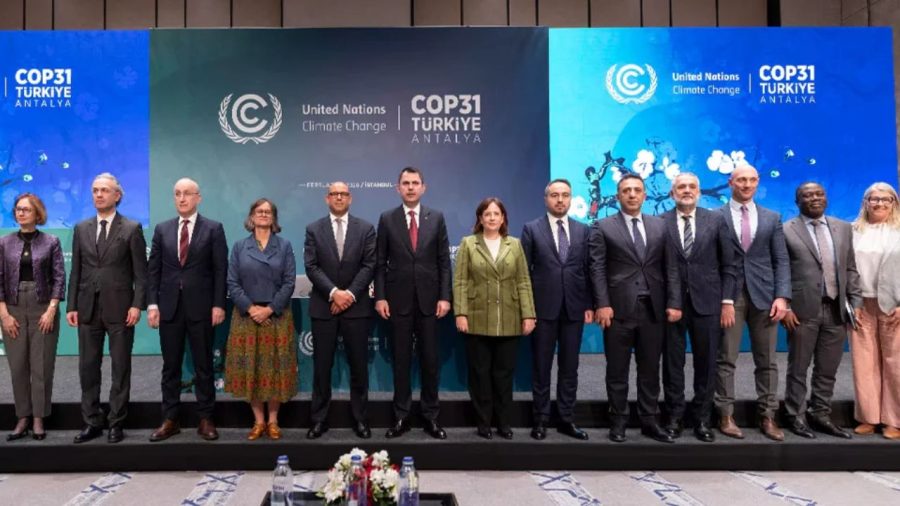



When delegates gather in Antalya on 9 November, the formal agenda will be light on headline items.
Turkey is hosting, Australia is steering the negotiations and voluntary pledges are taking centre stage.
Yet almost every theme likely to shape the talks, from fossil fuels to finance, carries the imprint of a single country: the United States under Donald Trump.
The groundwork was laid early.
The US formally left the Paris Agreement in January and in February notified the UN it would withdraw from the Framework Convention on Climate Change itself.
That month the Environmental Protection Agency (EPA) repealed its 2009 endangerment finding, the legal basis for regulating greenhouse gases.
In September it scrapped carbon standards for power plants, which produce about a quarter of the country’s climate pollution.
The agency’s own analysis had projected the standards would avoid 1.38 billion tonnes of carbon pollution through 2047.

Fossil fuels show the problem most starkly.
Nearly 200 nations pledged in Dubai in 2023 to transition away from them, yet production has kept rising and fossil fuels supplied 86 per cent of the world’s energy last year, though the issue is not a formal COP31 item.
Washington, on the other hand, has gone the other way: the power plant repeal was announced on the sidelines of a G20 meeting on “energy abundance” and Energy Secretary Chris Wright has threatened to pull the US out of the International Energy Agency unless it shifts towards the administration’s fossil fuel agenda.
With the Iran war driving up energy prices, the IEA expects coal-fired generation to grow this year.
The hosts’ flagship answer is electrification, lifting electricity’s share of final energy demand from about 20 per cent to 35 per cent by 2035.




American policy points the opposite way.
Trump has terminated EV purchase credits of up to $7,500, and new fuel economy rules project a fleet average of 34.9 miles per gallon in 2031, against 50.4 under Biden-era rules.
The Energy Department has issued guidance that would block rebates for swapping gas appliances for electric ones.
Electric vehicles made up 5.7 per cent of new US car sales in August, down from 7.4 per cent across 2025.
Money, always COP’s sorest point, will be scrutinised after devastating floods in Nepal.
COP31 President Murat Kurum has made closing the climate finance “chasm” a priority.
Yet Washington has cancelled climate-smart agriculture grants, including the $3 billion Partnerships for Climate-Smart Commodities programme.
It has pressed the EU to weaken its corporate climate accountability law and urged countries to oppose a Vanuatu-sponsored UN resolution calling for legally binding climate action.
At home, the NRDC says FEMA’s $4.1 billion resilience grant programme has been effectively halted, hollowing out the adaptation capacity Antalya hopes to scale up.
Climate knowledge itself is under attack.
The administration announced the closure of the National Center for Atmospheric Research, the country’s largest federal climate research centre, ended National Ocean and Atmospheric Administration support for the Arctic Report Card and appointed a climate sceptic to lead the federal global change research programme.
COP31, by contrast, lists youth and education among its priorities, even though the Office for Climate Education estimates only 3 to 7 per cent of young people receive quality climate education.
For Tuvalu, which is already drawing up plans to relocate its 10,600 people should the sea consume it, none of this is abstract.
The UN Environment Programme says holding warming to 1.5C is impossible in the near term, and Australia’s climate minister, Chris Bowen, has acknowledged the world will overshoot it.
The task now is to limit how far and for how long.
Yet the picture is not wholly dark. Renewables now virtually match coal at 34 per cent of global electricity generation, solar output jumped 28 per cent last year, and China’s installed solar capacity has overtaken its coal-fired fleet.
Beijing is expected to hold nearly half of the world’s renewable capacity by 2030 and is mulling a bid to host COP33 in the absence of the United States.
Policy is increasingly driven by fuel prices and energy security, while 147 parties had submitted updated national climate plans by mid-2026.
“The market dictates behaviour,” as one historian put it.
Kurum hopes Antalya will be a turning point rather than a final destination.
If the world keeps moving without Washington’s leadership, it may yet prove him right.