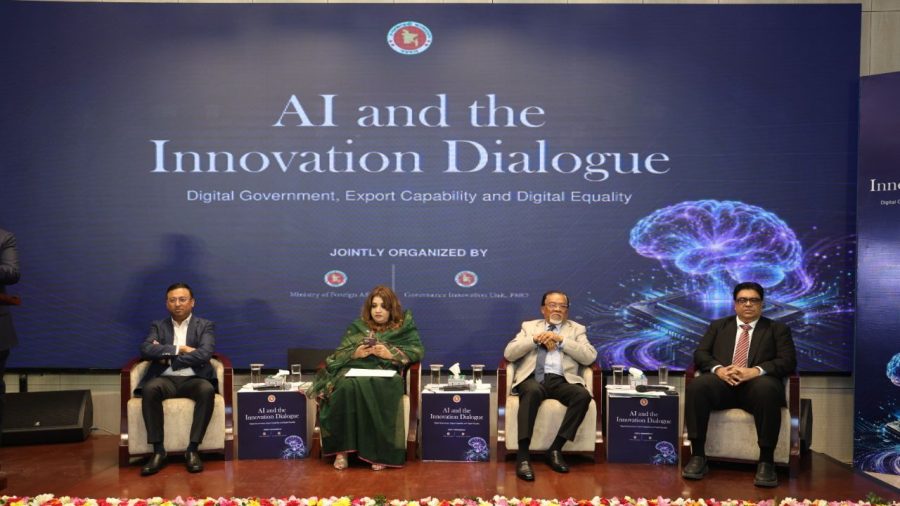



The Governance Innovation Unit (GIU) of the Prime Minister’s Office and the Ministry of Foreign Affairs jointly organised a conference titled “AI and Innovation Dialogue” today at the Foreign Ministry Auditorium in Segunbagicha, Dhaka.
The session, the third stemming from June 2026’s Trade, Growth and Economic Diplomacy Conference, reaffirmed the national priority to place Artificial Intelligence (AI) at the core of Bangladesh’s tech diplomacy and global public service delivery.
Md Ismail Zabihullah, Adviser to the PM on Public Administration and Head of the GIU, attended as Chief Guest alongside Special Guest Rehan Asif Asad, Adviser on Posts, Telecommunications, Information Technology and Science and Technology.
Zabihullah urged a whole-of-government approach to AI, recalled Late Prime Minister Khaleda Zia’s role in enacting the country’s first ICT policy, and called for seamless interoperability across public services.

Asad highlighted expanding digital access, noting BNP government policies will soon enable local production of affordable advanced feature phones.
He announced high-speed secure connectivity plans and confirmed Bangladesh will launch its own Sovereign AI within 12 months, with computing chips and memory blocs secured.
State Minister for Foreign Affairs Shama Obaed Islam, MP, declared AI the primary axis for achieving a trillion-dollar economy.




Recalling her background as a coder, she highlighted tech startup support, Silicon Valley outreach, indigenising technology, preventing tech-based gender violence, and the “Bangladesh First” policy to make the country a net technology provider.
She stressed that AI must augment human capabilities from farmers to women entrepreneurs, rather than replace workers.
He emphasised inter-ministerial collaboration and stated that “Bangladesh First” reflects readiness for investment and cooperation.
State Minister for Foreign Affairs Humaiun Kobir explained that Bangladesh’s economy has long depended on two main pillars—garments and remittances—first established under late President Ziaur Rahman.
However, to reach PM Tarique Rahman’s goal of building a trillion-dollar economy, the country now needs a third pillar: skilled “knowledge workers.”
Earlier, Foreign Secretary Ambassador Salahuddin Noman Chowdhury opened the dialogue, stressing equitable AI benefits and MoFA’s role in coordinating views for the UN Global Dialogue on AI Governance.
MoFA’s ITIT Wing and UNDP presented technical papers to establish an AI Policy Lab in Dhaka, while Lt. Gen. (Rtd.) Md Mahfuzur Rahman addressed security aspects, Joan Ai, Co-Founder & Executive Director of Blanchard House Institute, gave a special address, and Delwar Hossain offered the vote of thanks.
The session drew online participation from 25 international organisations and 85 Bangladeshi diplomatic missions alongside diplomats, officials, and industry representatives.