



A flight filled with wealthy passengers has been hijacked by a group of ideological fanatics.
A large ransom plus a vindication of their doctrine.
The passengers capitulated without much resistance, and the plane is diverted to a small island where a forgotten WW2 air strip has been restored.
Piece of cake, everything is moving like clockwork, the leader of the hijacking group felt a sensation of complacence.
He liked the passenger list too: twenty well healed Americans, two European billionaires, one Chinese real estate baron, three leading fashion models, two Swiss bankers, and one person from a small South Asian country.
Lovely, this is exactly the kind of hostages I want, group leader murmured in delight.
But he didn’t pay attention to the name of the passenger from that small South Asian country.
Amidst all the Western names, it looked a little incongruous and stood out.
The name – Masud Rana!

Or, to Bengali spy thriller aficionados: MR9!
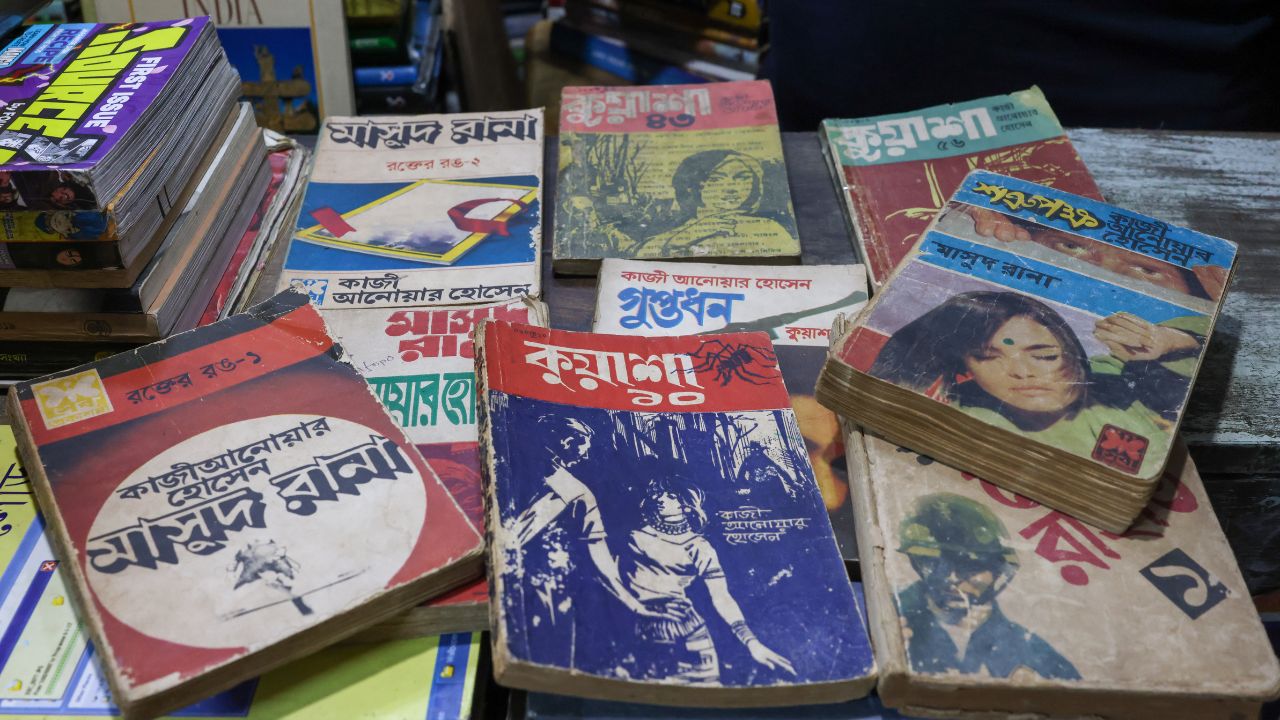
If you’re in your 50s then, Masud Rana, Kuasha and Sheba Prokashoni thrillers have been a part of growing up for sure, but do you have the old/original books?
I must have a few copies somewhere, most people I talk to give a gushing reply, but after a search, come back with an empty face.
Either they were taken away by someone or, most probably, were sold with old magazines.
But if you have Masud Rana, Kuasha copies from the 70s or the 80s then you’re sitting on a goldmine because in the last three four years, there’s been a total rejuvenation of fictional heroes created by the late Qazi Anwar Hossain.
From online auctions to scouring old book markets to even going to god-forsaken places in the middle of nowhere, Rana and Kuasha fans, especially those in their 50s and 60s, are locked in a battle to build up a collection of the original books.



Read that again, the books in demand are not the volumes with glossy covers but the ones that came out in the first decade and a half of Masud Rana and Kuasha.
So, we are talking about a period from 1966 to around 1984-85.
To trace the Rana, Kuasha craze, I went to Nilkhet Old Market where Saad Bookstore, tucked away among some other book selling shacks, have been collecting and selling old copies of Masud Rana and Kuasha for about five years.
“The trend to buy old copies began during Corona when people had plenty of time to read,” said the owner of Saad bookstore.
Ten to fifteen collectors were instrumental in triggering a race for the books, he remarked, adding: “as a result, about one to two hundred people now have enviable collections of original copies.”
Interestingly, this desire to seek out old copies is a phenomenon common among mature readers between the age 48-58, informed the book-seller.
As a collector, my preference is to get the Masud Rana and Kuasha books that were published prior to 1971, observed Ashraf, a corporate professional.
The first copy of Rana, titled Dhonghso Pahar, 1966 version, is a prized item, with the price going up to Tk. 50,000, said Ashraf.
However, if one can get the Urdu version of this called ‘Maut ka tila’ published in West Pakistan, then it will be an auction-item with the final price going near about a lakh, added Ashraf enthusiastically.
While most of Rana’s books are adapted from James Hadley Chase, Wilbur Smith, Alistair Maclean, Jack Higgins and others, there are some original plots which are always coveted.
For instance, the 1973 book, Pishach Dweep (The Island of Vampires), which has an original story with the plot based in a secluded island in Bangladesh, owned by a modern-day vampire cult leader, the price is consistently high.
About two months ago, one copy sold for Tk. 10,000.
Speaking about his biggest purchase, Ashraf refers to the 1968 book Rotno Dweep, based on Alistair Maclean’s When Eight Bells Toll.
The intrigue of the Kuasha books lies in the fact that after 1977, the series was never printed as individual books, says the owner of Saad Bookstore, adding: “about five years ago, the volumes were printed but collectors shun these new productions as they simply appear too perfect and lack the aesthetic edge.”
Every Kuasha book, both from the 60s and the 70s, is a work of literary art, contends, Atiqul Islam, a trader who idolised Kuasha in the early 80s.
In the 70s, famed painter Hashem Khan made the cover illustrations and most of them were unique as the covers captured the psychedelic aura of the period blending it with the inherent enigma of the Kuasha series, feels Atiq.
Once, after hearing that someone had a copy of Rana’s Cairo (Ceylon by Edwards Aarons), a book published in 1969, I travelled to Rangpur to get it, recalled Atiq.
It was in an old bookstore which was been cleared up and the book was among a pile of pre-liberation period manuals, said Atiq.
And the price?
Stifling a chuckle, he said almost sheepishly: Tk. 8000.
At SAAD Bookstore, the owner just sold Kuasha 73 at a very reasonable rate of Tk. 300 and also has the Rana book: Shonnashini (1981 book based on The Khuffra Run by Jack Higgins) and the asking price is around Tk. 400.
The rates of the early ones are always high, although at this moment, many of them, if available, can be bought within Tk. 1000 to Tk. 1500, he observed.
That’s certainly good news for general collectors who are looking for reasonable rates.
Oh, by the way, you must be thinking why I am not using the book shop’s owner’s name, right?
Well, here’s the final sting: he is known as Masud to all the other book sellers and his full name: Masud Rana!