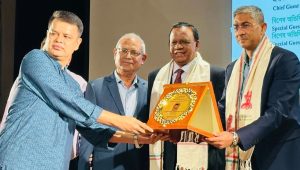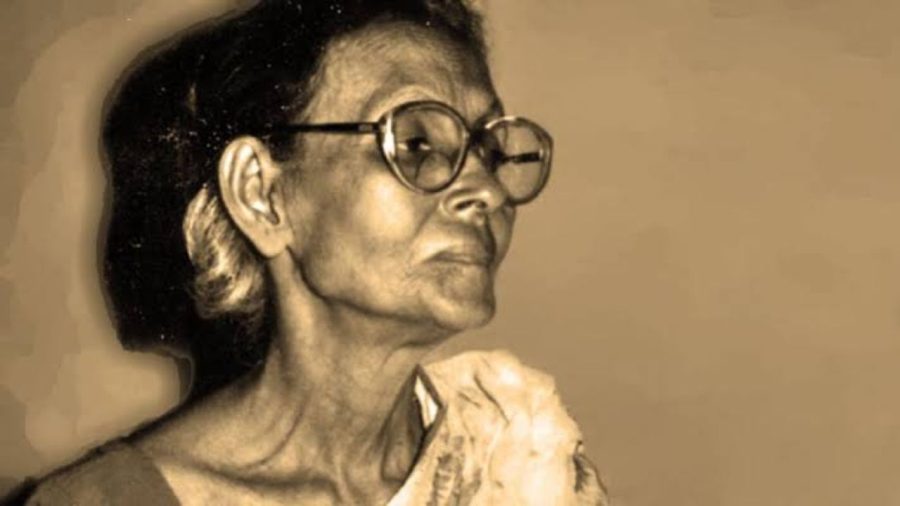



A three-day Ila Mitra Mela opened at Nachol Dak Bungalow ground on Sunday afternoon to commemorate the death anniversary on 13 October and birth anniversary on 18 October of Ila Mitra, the legendary leader of the historic Tebhaga movement in Nachol.
Organised by Ila Mitra Mela National Committee, the mela commenced at 3:30pm with the national anthem, followed by an inaugural performance presented by mother Sajeda Rahman and son Mridanga Rahman on behalf of Udichi Sangsad.
A message issued for the mela by Mirza Fakhrul Islam Alamgir, honourable president, was read out by Abdullahil Kafi Ratan, general secretary of Communist Party of Bangladesh and member of the mela committee.
Presided over by member secretary of Chapainawabganj district mela committee Sentu, the opening session was addressed by president of Communist Party of Bangladesh Sajjad Zahir Chandan, general secretary of the party Abdullah Hel Kafi Ratan, director of the feature film “Nacholer Rani” Syed Wahiduzzaman Diamond, and freedom fighter and president of Krishak Samiti Chapainawabganj Humayun Kabir, among others.
Champion of farmers’ rights
Speakers paid tribute to Ila Mitra, describing her as an unforgettable name in the struggle for the rights of exploited farmers and the Santhal community.
By leading the Tebhaga movement for farmers’ two-thirds share of produce against landowning zamindars and jotedars, as well as the peasant rebellion in Nachol, she became deeply revered as “Rani Ma” among local inhabitants.
Her resolute stance through arrest, imprisonment, and severe physical torture secured her an enduring place in the history of peasant movements across the subcontinent.

Born on 18 October 1925 in Kolkata, her ancestral home was in Bagutia village under present-day Jhenaidah district.
In 1945, she married Ramendranath Mitra, also known as Ramen Mitra, an active member of the communist party and peasant movement organiser from Chapainawabganj.
Although Ramen Mitra belonged to an influential local landlord family in Krishnagobindapur, Chapainawabganj, Ila Mitra dedicated herself to the struggle for the rights of exploited farmers and workers, supported by her husband’s political ideals.
After her marriage, she moved to her husband’s home in Krishnagobindapur and taught at a local school in the area.

During that period in former East Bengal, most farmers cultivated land without owning it and were forced to hand over a large share of their harvested crops to landowners.
The Tebhaga movement emerged to demand two-thirds of harvested crops as the farmers’ rightful share, heavily impacting Nachol in Chapainawabganj.
Ila Mitra played a pivotal role in rallying poor farmers and Santhals in Nachol, raising their awareness, sharing their struggles, and gaining their trust as “Rani Ma.”
Beyond crop shares, her movement aimed at organising farmers against zamindari exploitation, social inequality, and deprivation alongside her husband Ramen Mitra and political comrades.
Uprising and state repression
The rebellion escalated into violent confrontation in January 1950. On 5 January, a clash between police and farmers in Chandipur resulted in the deaths of several police officers.
The then Pakistan government launched severe repression across the region, torturing peasants and Santhals, burning homes, and forcing many to flee.
Going underground, Ila Mitra was arrested on 7 January 1950 at Rohanpur railway station in Chapainawabganj while attempting to escape disguised as a Santhal woman.
Following her arrest, she was taken to Nachol police station and subjected to inhumane physical torture to extract information and confessions before being transferred to Rajshahi Central Jail as her health deteriorated.
Her subsequent statement in court detailing the torture remains a harrowing historical record of state repression against political prisoners.
Convicted and sentenced to life imprisonment in the Nachol peasant uprising case, her physical condition worsened severely in prison, sparking widespread demands for her release from political leaders including Maulana Abdul Hamid Khan Bhashani, students, and citizens.
Following the victory of the United Front in the 1954 East Bengal provincial assembly election, she was released on parole in June 1954 to undergo medical treatment in Kolkata and was unable to return to East Bengal due to illness.
Later years and enduring legacy
In India, she remained active in politics with the Communist Party of India (CPI), winning election multiple times as a member of the legislative assembly (MLA) in West Bengal and serving as deputy leader of the communist party in the legislative assembly.
She made significant contributions to peasant movements, women’s rights, education, and social justice.
Nearly 42 years after leaving East Bengal, she returned to Bangladesh in 1996.
Marking the 50th anniversary of the Tebhaga movement, she was accorded warm receptions in Dhaka on 4 November 1996, and on 6 November 1996 at Bhuvan Mohan Park in Rajshahi and Nachol College ground in Chapainawabganj, where thousands gathered to catch a glimpse of “Rani Ma.”
She passed away in Kolkata on 13 October 2002, leaving behind a legacy of resistance against oppression, peasant emancipation, women’s awakening, and social justice.