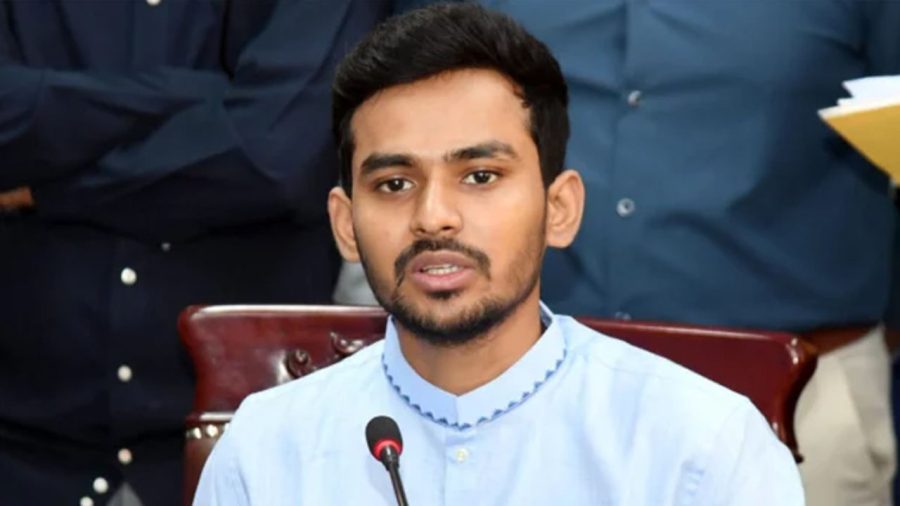



National Citizen Party (NCP) Spokesperson Asif Mahmud Shojib Bhuyain has said that party-level organisational measures taken by the Bangladesh Nationalist Party (BNP) regarding the vandalism at Radda Clinic are insufficient, demanding that those involved be prosecuted and properly punished under criminal law.
Speaking to journalists on Friday afternoon following a visit to St Christina’s Church in the capital, he noted that although the government has leaned towards party-level action, the vandalism constitutes an explicit criminal offence.
He stressed that when a criminal offence occurs, proceedings must be conducted through criminal law to ensure appropriate punishment.
Asif claimed that citizens cannot accept mere party-level action, as the rule of law under which the nation is governed must be strictly upheld. He warned that unless punishment is ensured under criminal law, similar incidents will continue to recur.
Highlighting past instances where individuals continued committing crimes even after being expelled from political parties, he said that without legal proceedings, future occurrences cannot be prevented.

He urged for a situation to be created where such events are prevented entirely, rather than taking isolated action or holding protests after individual incidents occur.
The NCP spokesperson noted that imposing exemplary punishment could serve as an effective deterrent against future incidents.




Expressing concern over recent developments around places of worship, he pointed out that within the past month, a madrasa was looted in one location while idols were vandalised in another. He attributed these occurrences to an overall deterioration in the general law and order situation.
With the upcoming Durga Puja festival approaching, the NCP spokesperson warned that occurrences of such incidents during this period could create a negative image for Bangladesh internationally.
He urged the government to treat the matter as a crisis and prepare to tackle it by engaging all relevant stakeholders. He recalled that over the past two years, particularly prior to Durga Puja, various initiatives were undertaken—including discussions with political parties—to avoid such crises. However, he expressed concern that similar proactive measures are currently lacking.
Criticising government assertions that the country’s law and order situation is normal, Asif said that statistics from the Dhaka Metropolitan Police (DMP) contradict official claims. He remarked that there is a divide between political statements and actual data, noting that DMP data demonstrates an increase in crime rates alongside changing patterns of crime.
Emphasising the necessity of preventive measures before crimes are committed, Asif observed that if perpetrators are arrested immediately following an offence, others would hesitate before breaking the law.
Citing the attack on Radda Clinic, which involved over 200 attackers, he questioned the accountability mechanisms, saying that only 1 or 2 per cent of the attackers have been arrested.
Regarding NCP’s role, he shared that alongside organisational expansion and preparations for local government elections, the party stands by citizens during difficulties. He added that NCP stood by Radda Clinic, successfully helped recover it, and noted that some initial measures are now being taken.
Asif said that justice is rarely achieved in the country unless issues are discussed publicly and brought to the attention of appropriate authorities with sufficient vocal pressure. He added that numerous similar incidents take place in remote areas outside Dhaka but go unaddressed because they fail to receive media coverage.
Addressing allegations regarding the involvement of leaders and activists from the ruling party and its associate organisations in various misdeeds, he cited specific examples: a Chhatra Dal leader who poisoned grass in a char after being denied Tk200 for buffalo grazing, and a Juba Dal leader whose name surfaced in connection with the looting of chicken droppings, leading to several arrests.
He concluded that such incidents are repeatedly occurring due to actions by the ruling party and its affiliate and associate organisations.