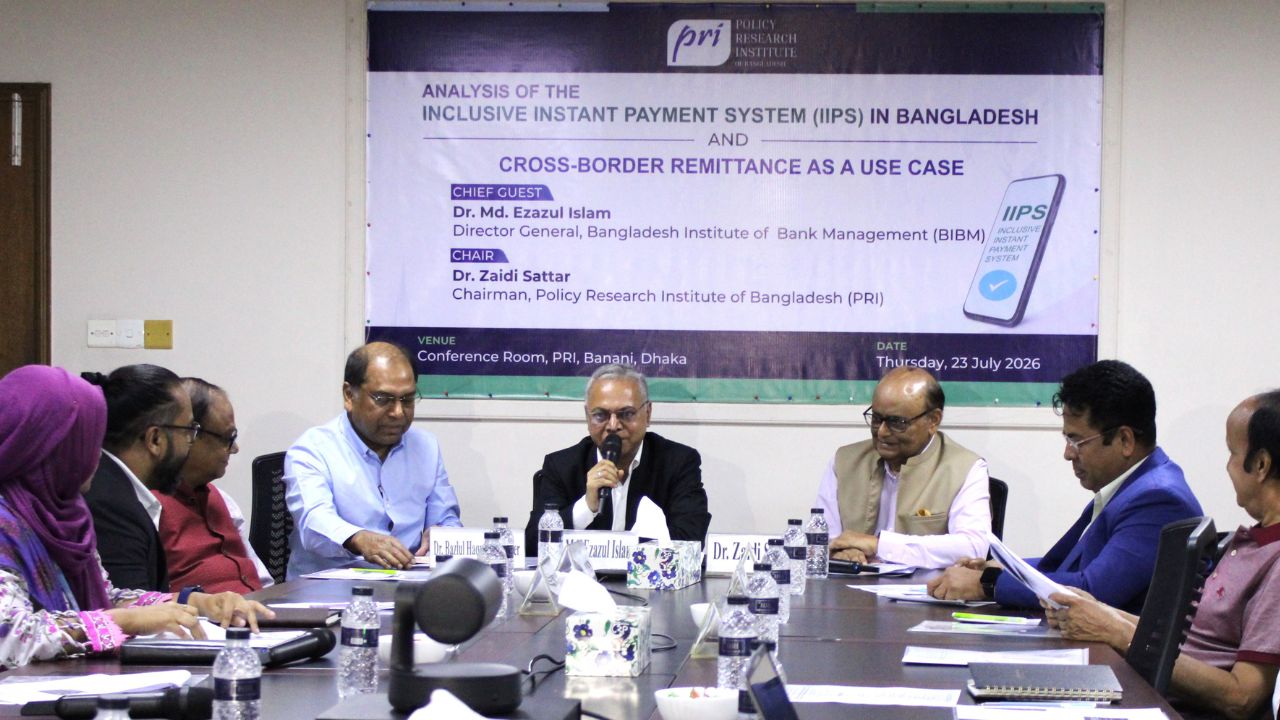

Bangladesh needs an inclusive instant payment system connecting banks, mobile financial services (MFS) providers and digital wallets to reduce remittance costs, curb hundi and bring more migrant funds into formal financial channels, the Policy Research Institute of Bangladesh (PRI) said on Thursday.
At an inception workshop on its study titled “Analysis of the Inclusive Instant Payment System (IIPS) in Bangladesh and Cross-Border Remittance as a Use Case”, PRI said cross-border remittances could serve as the first major use case for a shared digital payment infrastructure that enables faster, cheaper and more transparent transactions.
The proposed system would create interoperable payment rails linking banks, MFS operators and other financial service providers, allowing users to transfer money across platforms without the restrictions created by fragmented networks.
Remittances account for around 6 per cent of Bangladesh’s GDP, but their economic impact remains below potential as a large share is used for consumption rather than productive investment, PRI Chairman Zaidi Sattar said.
Highlighting the challenge of informal channels, Sattar said many migrants continue to rely on hundi despite the expansion of formal financial services. He cited around 700,000 Bangladeshi migrants in Oman as an example, saying many prefer informal channels because of lower costs, faster delivery and easier access.
The ongoing PRI study is examining why migrants choose formal or informal remittance channels, focusing on transaction fees, exchange rates, speed, trust, documentation requirements and recipient access.

Preliminary analysis from the study shows Bangladesh’s digital payment ecosystem remains fragmented, with major platforms often operating as closed networks. Although banks and MFS providers have expanded access, limited interoperability creates additional costs and prevents seamless transfers between different platforms.
Earlier efforts to establish interoperable payment systems struggled because participation was voluntary, leaving dominant market players with limited commercial incentives to open their networks, PRI said.
A fully functional instant payment system for cross-border remittances could save migrant households $250 million to $400 million annually by reducing transaction costs, according to the study’s preliminary assessment. Global remittance transfers currently cost an average of around 6.5 per cent, while some interoperable payment corridors have reduced costs to below 1 per cent.




The study also identified weaknesses in financial inclusion. Based on Global Findex data, PRI said financial inclusion in Bangladesh, measured through account ownership combined with active use, declined to 43 per cent in 2024 from 53 per cent in 2021.
Researchers said digital financial services have largely remained limited to receiving money and immediate cash withdrawals. Expanding inclusion would require linking digital transactions with savings, credit, insurance and emergency liquidity products, they said.
To encourage users to retain funds within the formal financial system, PRI proposed remittance-linked products such as automated savings schemes, micro-insurance and credit facilities based on remittance flows.
Bangladesh Bank is developing IIPS using the open-source Mojaloop platform to connect banks, payment service providers and eventually microfinance institutions under a common digital infrastructure.
The system, launched in November 2025, is expected to support feature-phone users, simplify account opening, reduce failed transactions and strengthen fraud prevention through the Tazama toolkit, according to Bangladesh Bank officials.
Beyond remittances, interoperability should be expanded to bank transfers, wallet-to-wallet payments, QR transactions, merchant payments and government-to-person transfers, PRI said.
The research will survey Bangladeshi migrants across six major destination countries — Saudi Arabia, the United Arab Emirates, Qatar, Malaysia, the United Kingdom and the United States — with 1,100 respondents targeted from each country.
The survey will examine country-specific barriers and help develop policies based on migrant behaviour, legal conditions and market structures across different remittance corridors.
Digital financial access also remains uneven, with Bangladesh recording a 20 percentage point gender gap in account ownership, among the widest in South Asia, according to Global Findex 2025 data.
Bangladesh Institute of Bank Management Director General Ezazul Islam said IIPS could reduce digital payment costs, improve transaction traceability and strengthen tax compliance. Its success, however, would depend on governance, pricing structures, consumer protection, dispute resolution and settlement risk management.
PRI Distinguished Fellow Ahsan H Mansur said financial inclusion, IIPS and the transition towards a cashless economy should be pursued under a single national strategy.
Bangladesh Bank spends around Tk20,000 crore annually on cash management, with the cost continuing to rise, Mansur said. Lowering digital transaction costs and making smartphones and internet services more affordable would be critical to expanding adoption.
He also highlighted the investment potential of the Bangladeshi diaspora, saying dedicated mechanisms for non-resident Bangladeshis could help channel an estimated $2 billion to $3 billion in investment through formal financial channels.