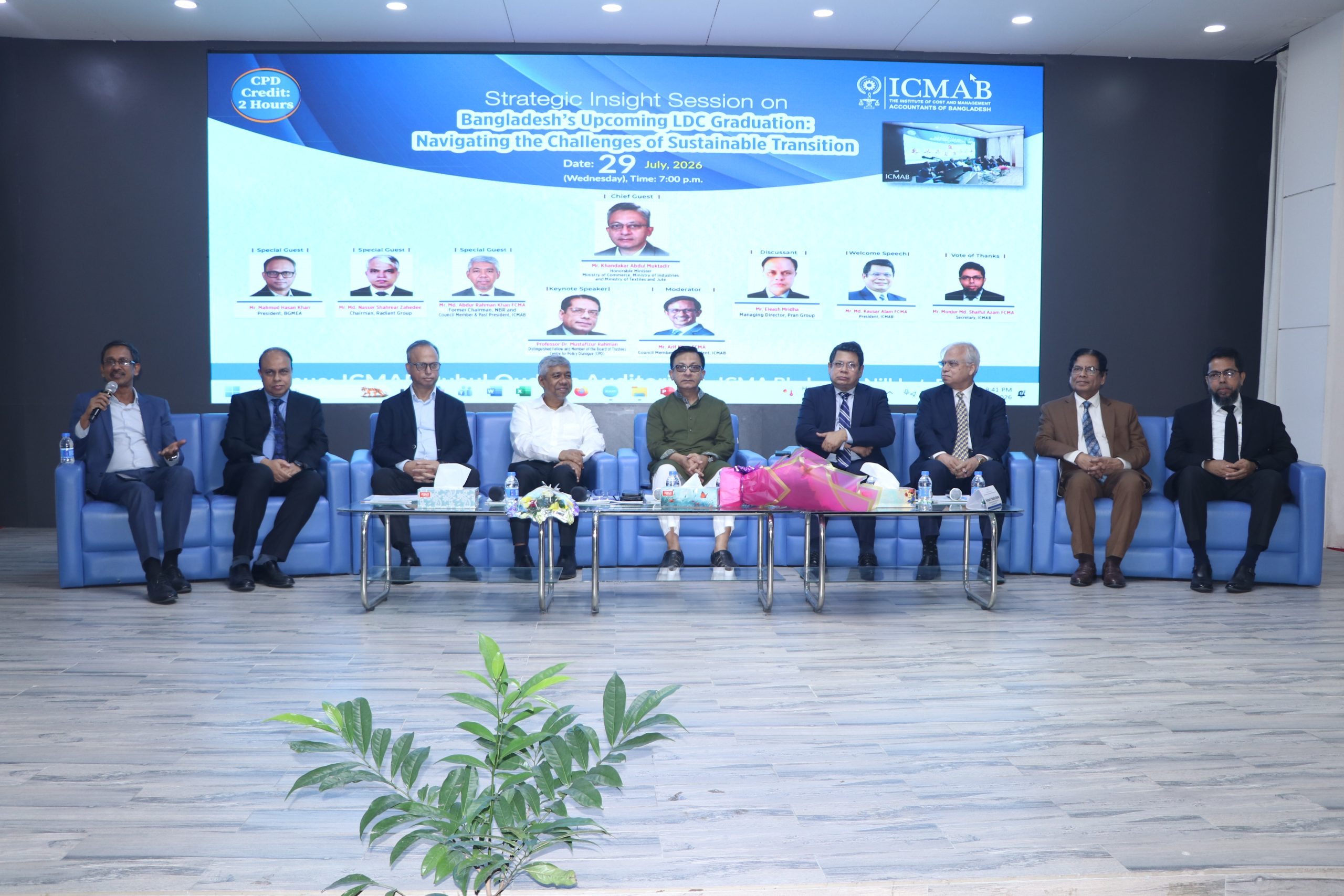



Bangladesh must raise productivity, secure reliable energy supplies and accelerate reforms to remain competitive after graduating from the least developed country (LDC) category and losing preferential trade benefits. Policymakers, business leaders and economists made the call at an ICMAB dialogue in Dhaka on Thursday.
Participants at the Institute of Cost and Management Accountants of Bangladesh (ICMAB) event said graduation would begin a more demanding phase of economic development, with sustained export-led growth depending on structural reforms, financial-sector stability and a predictable investment climate.
Commerce, Industries, Textiles and Jute Minister Khandakar Abdul Muktadir said Bangladesh had met the graduation criteria, but the withdrawal of LDC trade preferences would increase pressure on exporters, pharmaceutical manufacturers and other internationally competitive industries, making reforms more urgent.

He said the government was expanding liquefied natural gas infrastructure, stabilising the banking sector, simplifying business regulations and digitising investor services, while reliable gas supplies would revive idle industrial capacity and boost production and growth.
Bangladesh Garment Manufacturers and Exporters Association President Mahmud Hasan Khan said exporters must focus on greater domestic value addition, adding that the ready-made garment sector could grow by at least 10 per cent with reliable energy and affordable financing. He urged Bangladesh Bank to expand special refinancing facilities.




Former National Board of Revenue chairman Md Abdur Rahman Khan said policy continuity, good governance, infrastructure and political stability would determine the benefits of graduation, while implementation would matter more than policy announcements.
Economist Mustafizur Rahman warned of tougher competition as preferential tariffs expire, saying higher productivity, export diversification and faster policy and institutional reforms would be essential to maintaining competitiveness.
ICMAB President Md Kausar Alam said professional accountants could support the transition through stronger financial governance, strategic planning and better corporate decisions.
Participants agreed that graduation would be a milestone, not a guarantee of success, with sustained growth depending on structural reforms, energy security, financial-sector stability, skilled human resources and a predictable investment climate.