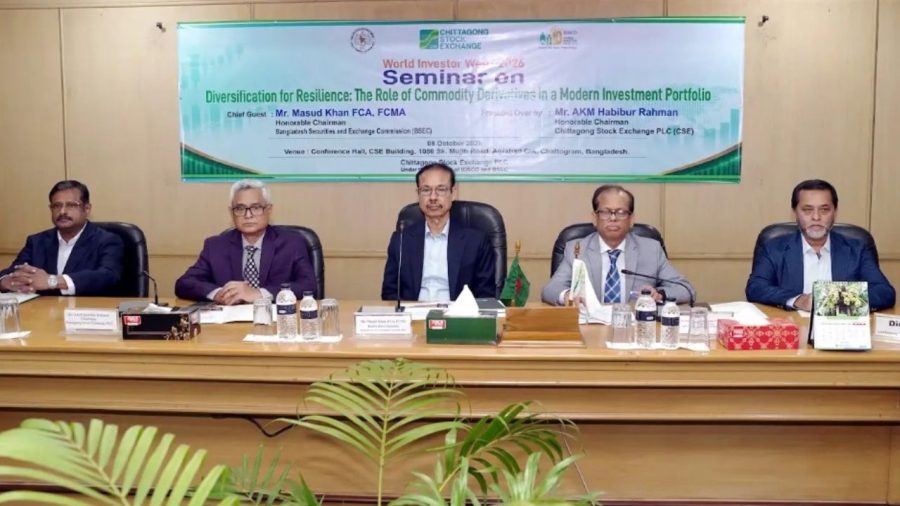



Bangladesh’s stock market lacks the institutional weight needed for greater market depth and maturity, with retail investors accounting for about 90 per cent of the investor base compared with 33 per cent in India and 17 per cent in Malaysia, Bangladesh Securities and Exchange Commission (BSEC) Chairman Masud Khan said on Thursday.
That imbalance leaves the market more dependent on individual sentiment and underscores the need for deeper participation by pension funds, insurers, mutual funds and other long-term investors.
Khan made the remarks at a World Investor Week 2026 seminar organised by the Chittagong Stock Exchange (CSE) in Chattogram.
The problem is not only who invests, but also what they can invest in.
Bangladesh has equities, bonds, Treasury bills and mutual funds, but many of those products have failed to develop into sufficiently active markets, CSE Managing Director M Shaifur Rahman Mazumdar said.
At the same time, the number of active beneficiary owner accounts has fallen significantly, he said, even as investor participation has been growing in neighbouring markets.

Mazumdar linked that decline to governance and systemic weaknesses and argued that product diversification was necessary to reverse it.
Without a broader range of tradable assets, he said, attracting domestic, foreign and institutional investors would remain difficult.
BSEC is now trying to widen both sides of the market.




Masud Khan said the regulator had reopened direct listings and was working on revised initial public offering rules, hybrid listings, corporate bonds, exchange-traded funds and real estate investment trusts.
The commission is also trying to bring more domestic, multinational and large-cap companies to the exchanges.
The aim is to improve price discovery, widen investment choice and build market capitalisation, which Khan said would help lift trading volume.
CSE is pursuing the same objective from the product side.
The exchange has completed the legal and technical framework for a derivatives market and is now building the supporting ecosystem, including mock trading facilities for brokers.
Mazumdar said commodity derivatives could add another layer to a market still heavily centred on equities.
BSEC said it would support CSE in launching the market as quickly as possible.
CSE Chairman AKM Habibur Rahman said Bangladesh remained underdeveloped across equities, fixed income, commodity derivatives and currencies.
He pointed to corporate bonds as an area with substantial potential and said real estate investment trusts could bring new money into the market.
But product expansion alone will not solve the depth problem.
Habibur Rahman said stronger participation by pension funds, insurance funds and mutual funds would be needed to build a more resilient market.
For Bangladesh, that is the central challenge: the market has a large base of individual investors, but comparatively little institutional capital to anchor trading, absorb shocks and support a wider range of securities.
Until that balance changes, adding new products may broaden the menu, but the market will still struggle to gain depth.