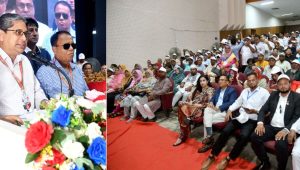
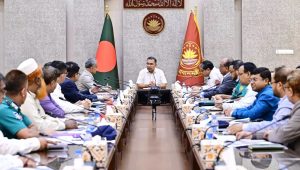
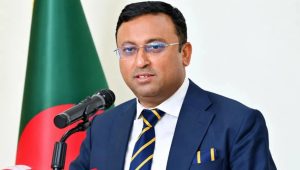
Prime Minister and BNP Chairman Tarique Rahman has expressed a firm commitment to building a self-reliant Bangladesh, calling for the collective cooperation of all citizens to achieve this goal.
Speaking at a discussion organised by BNP at the Engineers Institution auditorium in Ramna on Friday to mark Independence Day, Tarique urged party colleagues and all democratic-minded people to unite for the nation’s progress.
“Our aspirations are limitless, yet we have resource constraints,” he said, adding, “Despite the gap between our desires and our means, I firmly believe as a citizen and a political activist that if we move forward and work together for the country, we can build a self-reliant Bangladesh.”
He emphasised that the pledge for this Independence Day should be for all classes and professions to live well together through co-existence.
Government initiatives highlighted
Highlighting his administration’s activities, the prime minister described the current democratic government as one elected and established by the people.

He noted that the government has initiated various programmes aimed at improving living standards, including the distribution of family cards and farmer cards, canal digging, tree plantation, and employment generation.
Tarique stressed that the government is working with tireless effort to improve the quality of life for all citizens.
Tributes and historical perspective
The meeting commenced with prayers for the departed souls of party founder and proclaimer of independence, es-president Ziaur Rahman, former prime minister Begum Khaleda Zia, and the Liberation War martyrs.
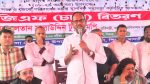

Reflecting on history, Tarique recalled that the people of Bangladesh snatched victory against what was then one of the most powerful armies in the world. He cautioned against research or discussions that belittle the glory of the independence struggle.
“If we always dwell on the past, one eye is blind; if we forget the past, both eyes are blind,” he remarked, adding that excessive focus on the past in the recent past had hindered the nation’s path to a prosperous future.
Ziaur Rahman’s legacy
Addressing the younger generation – noting the large number of youth who had gathered outside the venue due to space constraints – Tarique described ex-president Ziaur Rahman as a “key factor” of the Liberation War.
He stated that Ziaur Rahman’s dream of a sovereign Bangladesh was not a sudden development, but a long-held vision nurtured during his time as a soldier.
He cited Ziaur Rahman’s own essay, “A Nation is Born” [Ekti Jatir Jonmo], as a crucial historical document.
Originally published in the Dainik Bangla Independence Day supplement on 26 March 1972 and later in Shaptahik Bichitra in 1974, the article details the events of 2:15am on 26 March 1971.
Tarique noted that when the essay was first published, no contemporaries, freedom fighters, or members of the then-government contradicted its contents, proving its authenticity.
Struggles of 1971, 1990, and 2024
The prime minister drew parallels between the sacrifices of 1971 and the movements of 1990 and 2024, stating that while independence was achieved through millions of lives in 1971, the country was protected in 2024 through resistance against autocracy.
He expressed that the goal of all movements from 1971 to the present has been to establish a secure, democratic, and sovereign Bangladesh based on equality, human dignity, and social justice.
Tarique also referenced the ongoing struggle of the Palestinian people as a testament to the value of independence.
Chaired by BNP Secretary General Mirza Fakhrul Islam Alamgir and moderated by Publicity Secretary Sultan Salauddin Tuku, the meeting featured speeches from Standing Committee members Khandaker Mosharraf Hossain, Abdul Moyeen Khan, Nazrul Islam Khan, Amir Khosru Mahmud Chowdhury, and Salahuddin Ahmed.
Other notable speakers included academic Professor Wakil Ahmed, economist Professor Mahbub Ullah, University Grants Commission Chairman Professor Mamun Ahmed, and Dhaka University Vice-Chancellor Professor ABM Obaidul Islam.