Prime Minister Tarique Rahman on Wednesday outlined a set of measures to transform Dhaka into a clean and green city, focusing on waste management, mosquito control and urban greening.
He presented the plan during the question-and-answer session in parliament, chaired by Speaker Hafiz Uddin Ahmad. The response followed a query from Cumilla-9 MP Md Abul Kalam on steps taken to develop the capital.
Tarique said Dhaka North City Corporation and Dhaka South City Corporation are implementing initiatives under the Local Government Division. These include mosquito control, improved waste disposal, greening drives and graffiti-related activities.
He also said there is a plan to convert the Matuail landfill in Dhaka South into an integrated circular economy-based waste management and energy production centre with investment from a South Korea-based private company. The goal is to turn all waste into zero waste.
In Dhaka North, the government is expanding urban forestry through Miyawaki forests, Japanese forest models and open green spaces. The city plans to plant 5 lakh trees over five years. Authorities will also use vacant spaces under metro rail lines and elevated expressways for plantation, the prime minister added.
Tarique further mentioned that controlling environmental pollution will remain a priority.
He noted that development has remained Dhaka-centric for now.
“The government aims to gradually ensure basic services nationwide. Plans include expanding industrialisation, healthcare and education in different regions to reduce migration pressure on the capital,” he added.

Air pollution, rivers and environmental protection
He said the Department of Environment has prioritised controlling environmental pollution to turn Dhaka into a clean and green city. A set of measures has already been taken in this regard.
As part of these steps, the Department of Environment and Dhaka Transport Coordination Authority (DTCA) are working together to introduce modern bus services and 250 electric buses to reduce air pollution in Dhaka. With World Bank support, major sources of air pollution in the capital have already been identified, and the department is working accordingly.
Regular mobile court drives are also being conducted against vehicles emitting black smoke, construction activities and pollution caused by construction materials.
Initiatives have been taken to shut down illegal polluting brick kilns around Dhaka. Mobile courts and enforcement operations are continuing for this purpose.
Savar upazila has been declared a degraded airshed to reduce air pollution. Brick kiln operations and open burning of waste have been banned in the area.
To prevent pollution of rivers, canals and water bodies around Dhaka, installation of Effluent Treatment Plants (ETPs) has been made mandatory for industries generating liquid waste. So far, 248 industries have installed ETPs. Installation of Internet Protocol (IP) cameras for real-time monitoring of wastewater treatment plants is also ongoing.
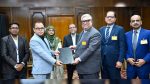



The Department of Environment has already identified the sources and nature of pollution in the Buriganga, Shitalakhya, Balu and Turag rivers. It has also identified pollution sources in 19 major canals flowing through Dhaka city.
Tarique Rahman said that to improve urban greenery and reduce environmental pollution, the Forest Department has signed memorandums of understanding with Dhaka North and South City Corporations, the Water Development Board and the Roads and Highways Department. These agreements aim to implement joint tree plantation and zero soil programmes along road medians, U-loops, pending areas and canal banks.
Under this programme, 41,565 saplings of fruit-bearing, forest, medicinal and ornamental trees have already been planted. The ground has also been covered with creepers, shrubs and grass to reduce pollution in the city.
As part of a five-year programme to plant 25 crore trees, initiatives are being taken to use vacant areas suitable for afforestation to turn Dhaka into a clean and green city. He expressed hope that these coordinated efforts will gradually help build a cleaner and greener Dhaka.
In response to a written question from MP Amir Ezaz Khan, the prime minister said the government is aware of severe river erosion risks in Dacope and Batiaghata upazilas of Khulna district. The embankment built in Dacope in the 1960s has been damaged by river erosion, cyclones and tidal surges.
The “Coastal Polder No. 31 Rehabilitation” project is under review. If implemented, it will protect local residents from river erosion. The government remains committed to protecting lives and property and will continue monitoring and repair works in erosion-prone areas.
Women, children and social protection
The prime minister further said the government is working to build a safe, inclusive and climate-resilient Bangladesh, where women and children are equal partners in development. Several programmes are under way under the Ministry of Women and Children Affairs, including the Vulnerable Women Benefit scheme, maternal and child support programmes, microcredit for women’s self-employment and marketing support through the Joyeeta Foundation.
He added that maternal and child support programmes will be expanded, increasing financial benefits and the number of beneficiaries. The expansion will also include pre- and post-natal care, vaccination and institutional delivery services.
Measures to prevent violence against women include laws and regulations, a national toll-free helpline, one-stop crisis centres and cells, a national forensic DNA profiling laboratory, a national trauma counselling centre and safe shelter facilities for women and children.
Tarique Rahman said children are the future of the country and the nation. The Bangladesh Shishu Academy is implementing several programmes for their development and welfare, including cultural training, National Children’s Awards, competitions, children’s film production, early childhood development programmes for underprivileged children, autism awareness activities and child rights protection initiatives, including environmental conservation.
Under the street children rehabilitation programme, 151 children are currently receiving accommodation, food, education and healthcare through two residential centres. Nine outreach schools are also operating under this initiative.
A total of 64 childcare centres are running for children aged six months to six years of working mothers. These centres provide balanced meals, pre-school education, primary healthcare, indoor play facilities and recreation.
The election manifesto also emphasises establishing daycare centres for working women and breastfeeding corners in all workplaces, including garment factories, offices and courts.
On climate adaptation, Tarique said rainwater harvesting and management activities are ongoing under the Gender Responsive Climate Adaptation (GCA) project under the Ministry of Women and Children Affairs. The aim is to ensure safe drinking water and improve livelihoods by reducing climate-induced salinity risk and enhancing adaptation capacity in coastal communities, especially for women.
Under this project, livelihood support, training and agricultural inputs have been provided to 43,000 women. Rainwater harvesting systems have been completed in 13,308 households and handed over to beneficiaries.
During the 2025–2026 fiscal year, installation is ongoing for 2,000 household-based rainwater harvesting systems with a capacity of 3,000 litres each. Installation is also underway for 658 community-based rainwater harvesting systems for 10 households each.
Family card programme
On social protection, Tarique Rahman said the government will provide family cards to 4 crore families in phases after data collection and budget planning.
He added that calculations show there will be no risk or pressure on the budget for the family card.
Responding to a question from lawmaker Hasnat Abdullah, the prime minister said the family card initiative has received strong public response, with women in Cumilla-4 constituency showing particular interest.
He described the programme as an investment, not funded by printing new money. It will keep the economy active and may help reduce inflation.
In the initial phase, 37,814 female heads of households in 13 districts and three city corporations are receiving Tk 2,500 per month through family cards.