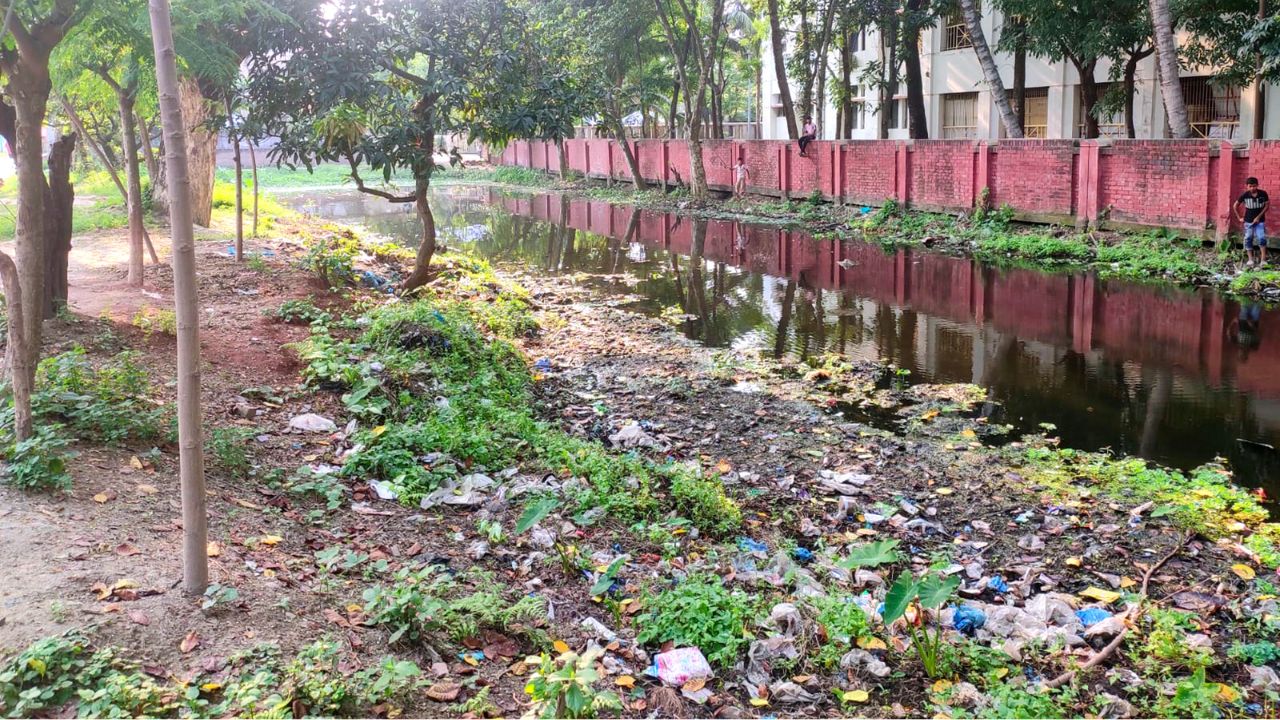

Pabna’s ponds, large reservoirs and other natural waterbodies, once integral to the district town’s history, culture and daily life, are rapidly disappearing because of encroachment, pollution, indiscriminate filling and prolonged official neglect.
Many of the centuries-old waterbodies once served as major sources of drinking water, helped replenish groundwater and added to the town’s natural beauty. A recent visit to different parts of Pabna, however, found most of them in poor condition, with no government agency able to provide a complete inventory or a coordinated conservation plan.
The nearly 200-year-old Jamtala waterbody, also known as the Indigo Planters’ Moat, beside Bachchu Smriti Road behind the deputy commissioner’s office, has already been partly filled and encroached upon.
The remaining portion is also being narrowed as the deputy commissioner’s office constructs a boundary wall around the site.
At Himsagar pond near Chartala intersection in Dilalpur, sewage and household waste are dumped into the water daily. Residential drainage lines are directly connected to Taltala pond in Kalachand Para, polluting the water and spreading a foul smell.
Jhajhra pond in Shalgaria has become covered with water hyacinth and turned into a breeding ground for mosquitoes. Majumder pond in Radhanagar is close to being completely filled, while Jelapara pond has lost much of its natural beauty and usefulness because of years of neglect.
Another pond beside Rajshahi Krishi Unnayan Bank at Jugipara intersection is also reportedly being filled.
Pabna municipality resident and teacher Pavel Mridha said the destruction of natural waterbodies was causing the city’s groundwater level to fall steadily.

“The water crisis will become more severe in the coming years. The loss of these waterbodies will upset the ecological balance and leave future generations facing serious hardship,” he said.
Local residents said the waterbodies were vital not only to the environment but also to the city’s long-term security and liveability. Yet the authorities do not have a comprehensive list of the sites or a coordinated plan to protect them.
Pabna municipality Executive Officer Md Dulal Uddin said he could not immediately provide the total number of waterbodies under the municipality.
He said detailed information was available with the sub-assistant engineer. However, the official could not be reached despite repeated attempts.
Municipal Administrator Md Moniruzzaman also could not provide a specific figure.




“I cannot say anything at this moment. We will try to provide an answer if an application is filed under the Right to Information Act,” he said.
Asked about the municipality’s role in preventing the filling, encroachment and pollution of waterbodies, he declined to comment.
Department of Environment Pabna Assistant Director Md Yusuf Ali said his office also had no specific list of the district’s waterbodies.
He said mobile courts were conducted jointly with the upazila administration whenever complaints were received.
Pabna Sadar Upazila Nirbahi Officer Tamara Tasbiha said there were two ponds on the upazila parishad premises, but her office had no complete information on waterbodies owned by the administration or all government-owned waterbodies in the upazila.


She advised contacting the Sadar Upazila Land Office for further information.
Pabna Sadar Assistant Commissioner for Land SM Fuad said the upazila had 30 officially listed sairat water estates, including 19 covering more than 20 acres each.
However, he said the land office did not maintain a complete list of other waterbodies.
The executive engineer of the Bangladesh Water Development Board’s Pabna division was also unable to provide the number of waterbodies under the agency’s control.
Pabna University of Science and Technology Faculty of Life and Earth Sciences Dean Nazmul Islam said ponds, large reservoirs and other natural waterbodies played an indispensable role in maintaining the urban environment and groundwater balance.
“The filling and pollution of waterbodies are increasing the risks of drinking-water shortages, loss of biodiversity and urban waterlogging,” he said.
He called for a comprehensive inventory of all waterbodies using land records, satellite images and modern survey methods, followed by effective conservation measures.
Pabna municipality covers 27.20 square kilometres and comprises 24 mouzas and 15 wards. According to 2011 data, it had a population of 181,939.
Residents and environmentalists said the conservation of waterbodies in such a densely populated urban area was not merely an environmental concern but a matter of public interest.
They blamed the worsening situation on a lack of reliable data, poor coordination among government agencies and weak monitoring.
Bangladesh Poribesh Andolon Pabna district General Secretary Abdul Hamid Khan called for an immediate digital inventory of all waterbodies in the town.
He also demanded strict drives against encroachment and pollution, regular restoration work and firm enforcement of existing laws.
“Unless urgent measures are taken, Pabna’s century-old waterbodies will soon survive only in history,” he said.
Several laws provide for the protection of waterbodies, including the Bangladesh Environment Conservation Act 1995, amended in 2010; the Bangladesh Water Act 2013; the Land Crime Prevention and Remedy Act 2023; and the Playground, Open Space, Garden and Natural Waterbody Conservation Act 2000.
The laws contain provisions against filling, encroaching upon or changing the classification of natural waterbodies. However, residents and environmentalists said poor enforcement and inadequate monitoring had allowed Pabna’s historic waterbodies to disappear steadily.