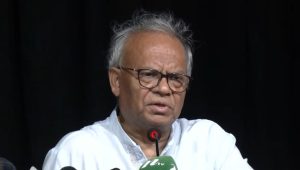
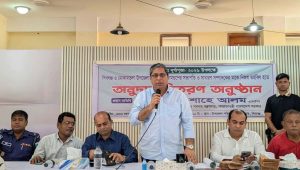
Leader of the Opposition and Bangladesh Jamaat-e-Islami Amir Shafiqur Rahman has said the opposition will now focus on serving the country’s 18 crore people rather than assisting the government, accusing the ruling party of being unwilling to accept opposition cooperation.
Speaking at a discussion titled “One Year of July Charter: Commitments and Expectations” at Dhaka Reporters Unity (DRU) in Segunbagicha on Sunday afternoon, he said the opposition wanted the government to succeed, not collapse, but questioned its ability to work with political rivals.
The discussion was organised by Amar Bangladesh Party (AB Party).
“We previously wanted to assist the government. From now on, we will assist the country’s 18 crore people,” Shafiqur said.
He accused the Bangladesh Nationalist Party (BNP) of abandoning its earlier commitments to constitutional reform after coming to power.
Shafiqur said BNP leaders had faced oppression until the afternoon of 5 August but quickly forgot their experiences afterwards.
He said that despite disagreements over certain provisions of the July Charter, BNP had agreed to implement the referendum mandate but was now retreating from that commitment.
He insisted that the opposition would not change its position even if BNP did, pledging to ensure implementation of the July Charter and the referendum mandate at all costs.

Criticising alleged government interference in constitutional institutions, Shafiqur claimed that some ministers had been calling members of the Public Service Commission (PSC) and demanding their resignations.
He said the commission was not a family business belonging to any minister.
Shafiqur also alleged that ruling party lawmakers had received special allocations for their constituencies while opposition MPs were excluded.
“The 2024 mass uprising did not take place for this rotten politics,” he said.
Taking aim at BNP’s “Bangladesh First” slogan, he accused the ruling party of placing personal and family interests above those of the country.




“We will not hand over our beloved Bangladesh to syndicates,” he said.
Shafiqur said the opposition had rejected various inducements and would remain as steadfast as the Himalayas in pursuing its objectives, even if others betrayed the nation.
He said the opposition movement aimed to secure people’s rights, prevent the return of fascism, establish a society free from discrimination and build a liveable Bangladesh for future generations.
He ruled out arson and violence during the movement, saying the 2024 mass uprising had demonstrated that fascism could be defeated through street protests driven by patriotism and determination.
Shafiqur also pledged that opposition lawmakers would serve as sentinels for the country’s 18 crore people.
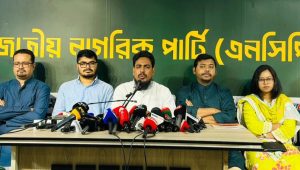
Addressing the discussion, National Citizens Party (NCP) Chief Organiser for the Southern Region Hasnat Abdullah accused BNP of paying lip service to the July Charter while remaining sympathetic to the Awami League.
“BNP talks about the July Charter, but the Awami League is in their hearts,” he said.
Hasnat alleged that BNP was withdrawing from important reform proposals despite its earlier commitment to implement the charter.
He criticised the ruling party’s position on the referendum verdict and the formation of the Constitution Reform Council.
He also questioned the government’s approach to amendments to the Right to Information (RTI) Act and transparency in public procurement.
Hasnat further alleged that relatives of Home Minister Salahuddin Ahmed were involved in bribery linked to police postings.
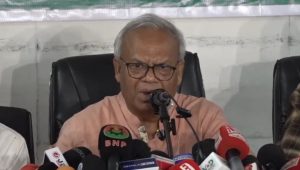
AB Party Chairman Mojibur Rahman Monju said the public had grown tired of repeated assurances that the July Charter would be implemented in full.
He said BNP itself had claimed that 848 of its activists were killed during the July uprising and argued that the government had a responsibility to honour their sacrifices by implementing the charter.
Monju said the July Charter contained 84 reform proposals and a seven-point pledge, much of which was consistent with BNP’s own 31-point programme.
He accused the party of behaving as though the charter had been imposed on it after assuming office.
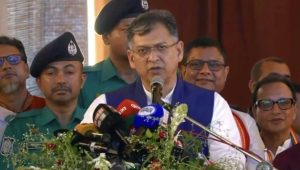
Liberal Democratic Party (LDP) Chairman Colonel (retd) Oli Ahmad said the Prime Minister had repeatedly promised to implement the July Charter in full.
He described honouring that commitment as a moral responsibility of the political leadership.
Oli also expressed concern that the distribution of various cards before the election could raise fears of attempts to influence voters.
Bangladesh Khelafat Majlis Amir Mamunul Haque described the July Charter as one of the most important political documents in Bangladesh’s history and a blueprint for rebuilding the state.
He alleged that BNP had accepted the election results to form the government while disregarding the referendum mandate.
Mamunul warned that failure to implement the charter could deepen the crisis surrounding constitutional reform.