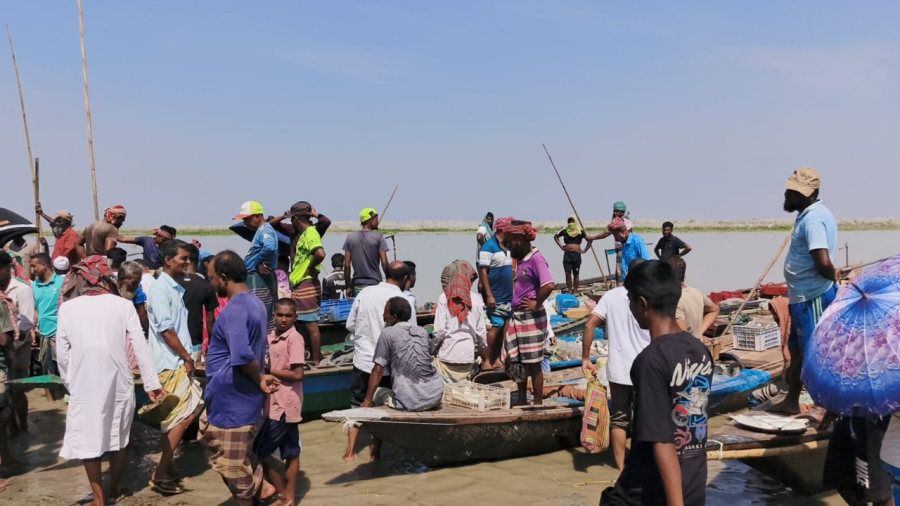



Freshly caught hilsa continues to be sold openly along the Padma River in Madaripur’s Shibchar upazila despite a nationwide fishing ban during the breeding season, raising questions about the effectiveness of enforcement operations.
Ten days into the ban, temporary fish markets remain active along the riverbanks, attracting buyers from Shibchar and neighbouring upazilas, even as authorities have seized 180,000 metres of illegal fishing nets and jailed 12 fishermen.
Two major trading spots are located along the Padma at Kazirsura in Bandarkhola union and near Hirakhar Bazar in Char Janajat union, where makeshift hilsa markets operate every morning and afternoon. Although trading peaks during those hours, freshly caught fish remains available throughout the day.
According to the Shibchar Upazila Fisheries Office, authorities have seized and destroyed 180,000 metres of illegal current nets over the past 10 days. They have also confiscated 20kg of hilsa, while mobile courts have sentenced 12 fishermen to varying prison terms and imposed fines totalling Tk16,000.
Despite the continuing operations, the thriving trade along the river has raised concerns about enforcement, particularly in remote char areas where access is difficult.

The Padma riverbank at Kazirsura Bazar can be reached by road, but visitors must cross a stretch of the river to reach the market near Hirakhar Bazar. The difficult terrain makes regular enforcement operations challenging, allowing fishermen and traders to bring freshly caught hilsa ashore and sell it directly to customers.
Buyers travel to these remote locations to purchase fresh Padma hilsa, including fish weighing between one and 1.5kg, and even 2kg, with prices varying according to size.
Fish sellers said fishermen from Shibchar were not the only ones operating in the Padma during the ban, with others from Munshiganj and Shariatpur also continuing to fish.




“If we stop fishing, how will we survive? Others are still catching fish,” they said.
Several fishermen, speaking on condition of anonymity, said the authorities faced difficulties conducting operations across remote stretches of the Padma.
“Although the administration carries out drives, reaching remote areas of the Padma is difficult. Most fishermen do not stop fishing during this period, and neither do we,” they said.
The fishermen said demand for fresh hilsa remained high during the ban, with buyers travelling directly to the riverbanks to purchase fish. Many fishermen borrow money to buy nets and repair their boats before venturing into the river during the restricted season, when cash earnings can be higher, they added.
Residents, however, expressed concern that unchecked fishing during the breeding season could threaten future hilsa stocks.
Tamim, a resident of the Padma riverbank, said hilsa was sold openly during the ban every year despite the authorities being aware of the practice. He criticised the lack of effective action, saying stricter enforcement could stop both fishing and sales, while warning that continued illegal fishing could threaten future hilsa stocks.
Shibchar Upazila Fisheries Officer Satyajit Majumdar acknowledged that staff shortages made it difficult to maintain comprehensive surveillance across the river and surrounding areas.
“Because of a shortage of manpower, it is difficult to maintain 100 per cent surveillance across the entire area. However, we conduct operations promptly whenever we receive specific information,” he said.
Majumdar said the fisheries department planned to dismantle all remaining hilsa trading spots along the Padma.
“The market at Kazirsura has already been dismantled. We will shut down the other fish-selling spots as well,” he said.
He warned that the authorities would also begin taking action against buyers purchasing hilsa during the ban.
“From now on, action will also be taken against buyers. Our regular enforcement operations will continue,” Majumdar said.