


Tourists seeking relaxation in Cox’s Bazar, Bangladesh’s leading tourist destination, are increasingly exposed to safety risks as accommodation facilities marketed as “eco-friendly” operate without adequate safeguards, while crime and fraud remain widespread.
Thousands visit the coastal town daily, but many face risks, ranging from mugging and extortion to drug-related crime, honey traps and other forms of fraud.
Resorts and cottages made of wood and bamboo may look attractive and carry the “eco-friendly” label, but many pose serious hazards. Hundreds of gas cylinders are used daily, often alongside faulty or haphazard electrical wiring, while most hotels, motels, resorts, cottages and restaurants lack adequate fire-fighting arrangements and even sewage systems.
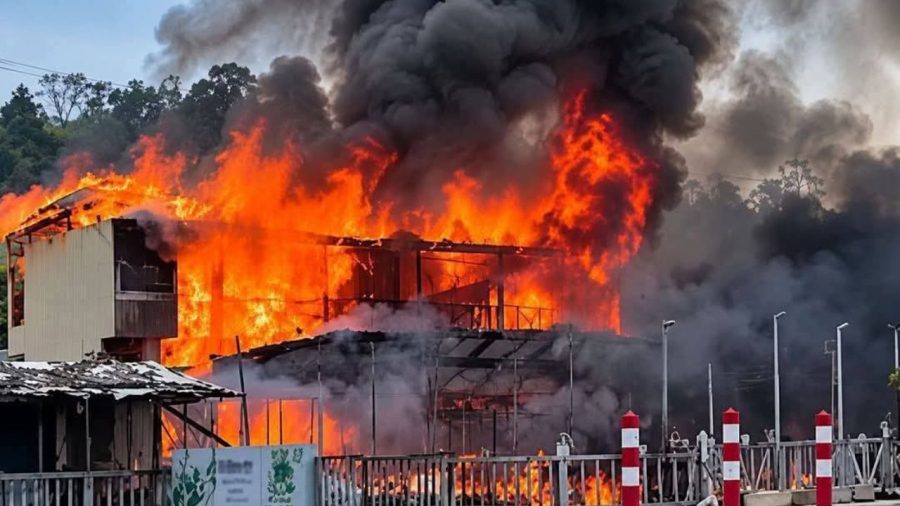
The consequences of negligence became tragically clear on Saturday when 10 holidaymakers died in a fire at TupTup Restaurant and Resort in Inani. The victims were unable to escape after the blaze broke out.
Khandaker Mahmud Morshed, deputy director of the Department of Environment in Cox’s Bazar, told TIMES that environmental clearance was generally unnecessary for residential hotels with fewer than 20 rooms or restaurants involving investments below Tk30 lakh.
He said businesses were exploiting these exemptions, while even establishments legally required to obtain environmental clearance often operated without it.
Over the past year, 58 hotels, motels, restaurants, resorts and cottages were fined nearly Tk1.5 crore for lacking environmental clearance, Mahmud Morshed said. Another 28 cases were filed against more than 100 hotels in ecologically critical areas.
District administration figures show that more than 200 hotels, motels, resorts and cottages applied for approval, but only around 50 had all their documents in order.
Tourism businesses are legally required to secure approvals from 18 to 24 authorities, including environmental clearance, but many operate without them.

Most also disregard fire safety licensing requirements and approvals from the Cox’s Bazar Development Authority or district administration.
Deadly fire exposes oversight failures
Following the TupTup tragedy, authorities filed a case against 23 people, including the resort owner, arrested its manager and formed a five-member district administration committee to investigate the fire and surrounding circumstances.
But the response has raised questions about why longstanding violations and fraudulent activities were allowed to continue.
Rashed Mohammad Ali, former general secretary of the Cox’s Bazar municipal unit of the Bangladesh Nationalist Party (BNP), criticised the authorities’ response, deploring that the administration only springs into action and forms investigation committees after an accident occurs.
Cox’s Bazar Deputy Commissioner Md A Mannan said a committee comprising representatives of the Fire Service, Department of Environment, Tourism Corporation, Cox’s Bazar Development Authority and district administration had been formed.
Its recommendations would be forwarded to the Ministry of Tourism, after which the administration would implement the measures directed, he said.




More than 150 residential hotels and resorts have sprung up along both sides of the approximately 80-kilometre Marine Drive towards Teknaf.
Over 100 establishments, including TupTup Resort, are located along the route to Patuartek in Inani, about 40 kilometres from Cox’s Bazar town. Across the district, the total exceeds 600.
Some have even been built on ecologically critical areas, despite legal restrictions prohibiting construction within 300 metres of the seashore inside Cox’s Bazar municipality and 500 metres outside it.
Most operators run their businesses with only a trade licence from the relevant municipality or union parishad.
Abul Kashem, president of the Cox’s Bazar Hotel and Motel Owners’ Association, told TIMES, “Resorts and cottages do not follow rules and regulations. That is why we have not included them in our association. The administration should bring them under a regulatory framework to help the tourism industry move forward.”
Fire Service licensing inspector Shafiqul Islam said compliance had also deteriorated.
“Only 50 hotels have renewed their licences with us this year. However, we have received 100 applications. Previously, around 200 hotels had licences. That is why we have served notices on most of the hotels.”
Syed Muhammad Morshed Hossain, deputy assistant director at the district Fire Service office, said, “We served TupTup Resort with notices twice, but the authorities did not heed the warnings. They did not put fire-fighting arrangements in place.”
Everyday fraud and crime
Beyond unsafe accommodation and regulatory violations, tourists in Cox’s Bazar face persistent threats from criminal networks involved in extortion, mugging, honey traps and other fraud.
Allegations include secretly recording visitors at spa centres and using the footage to extort money.
Several businesspeople in the Sugandha Beach area told TIMES that crime had become commonplace in the busy town, which receives an estimated 50,000 or more tourists daily.
They identified drugs as a major driver and alleged that some displaced Rohingya from Myanmar had formed criminal networks with local residents.
Law enforcement agencies have also uncovered international fraud operations in the area.
On 5 September, several Chinese and Taiwanese nationals were arrested during raids at Marina Beach Villa Resort in Himchhari and Hotel Sea Palace in Kolatoli.
Authorities recovered nearly 2,000 iPhones, 50 monitors, 44 central processing units (CPUs), and Chinese police logos and rank badges.
Investigators later found that the group’s scamming operations targeted the stock markets of three countries.
Drug smuggling and territorial disputes frequently trigger shootings and killings involving armed groups and criminal gangs.
Mugging gangs operate in the town’s streets and alleys, while robberies, harassment, hostage-taking and violence against women have also been reported at beaches and other tourist spots.
Kidnappings for ransom also occur periodically in different Cox’s Bazar upazilas and around Rohingya camps.
Speaking to TIMES, Cox’s Bazar Superintendent of Police ANM Sazedur Rahman said, “Drugs are behind everything — murder, mugging, kidnapping, extortion, involvement in illicit relationships, honey traps, juvenile gangs and arms dealing.”
Drugs entering across the Myanmar border by land and sea remain readily available, while those controlling the yaba trade remain at large.
Md Hasan, an autorickshaw driver in the Jhaubon area for nearly 15 years, alleged that several criminal networks which include young women and integrated Rohingya are involved in nefarious acts.
Md Mizanur Rahman, inspector of the Department of Narcotics Control in Cox’s Bazar, told TIMES that the agency had identified 200 drug dealers in the area, including Rohingya.
He said some individuals on the list had Bangladeshi fathers and Rohingya mothers.
Nishat Angela, Superintendent of Tourist Police in Cox’s Bazar, said the force responded whenever tourists reported problems and sought assistance.