


Archaeological researchers have unearthed evidence suggesting that the roots of human writing may be 40,000 years older than the previously accepted timeline.
Scientists discovered meaningful, repeated patterns consisting of dots, lines, crosses, and notches engraved on artefacts nearly 45,000 years old within caves in southern Germany.
These findings challenge the established historical narrative that writing first emerged approximately 5,000 years ago in ancient Mesopotamia.
The research team, which examined over 3,000 individual symbols across 260 objects, found these markings on mammoth tusks and ivory figurines. Many of these items originated from the Achtal valley and the Lonetal cave system in Baden-Württemberg.

Christian Bentz of Saarland University, a co-author of the study, said “the markings represent an early alternative to writing.”
He further noted that the sequences of symbols exhibit a clear structure and repetition.




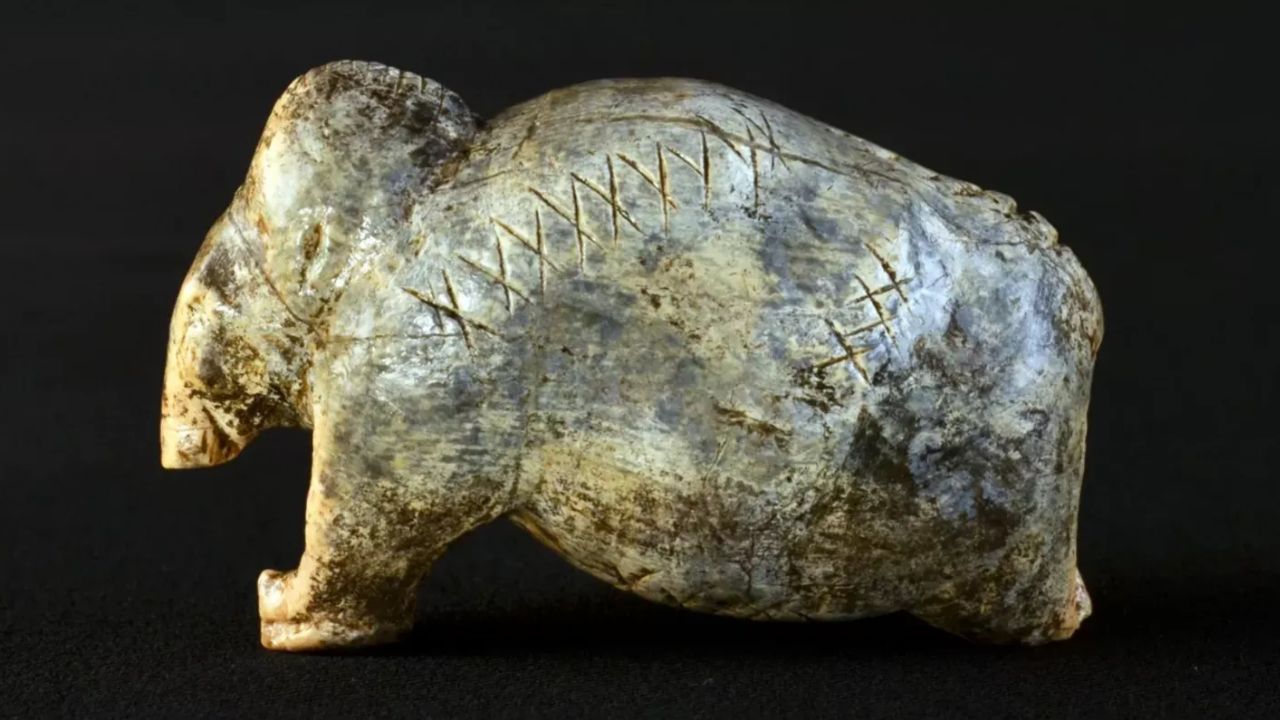
Among the significant discoveries is a small mammoth figurine carved from ivory, which features rows of engraved dots and crosses.
Another artefact, known as the “adorant,” depicts a human-like figure on an ivory plaque marked with notches and rows of dots. Investigators believe the deliberate and careful placement of these marks indicates a method of communicating specific information or ideas rather than serving as mere decoration.
Ewa Dutkiewicz from Berlin’s Museum of Prehistory and Early History said “the findings show Stone Age people were intellectually comparable to modern humans.” She added that “researchers have only begun to understand how widespread such symbol systems may have been”.
The study, published in the journal Proceedings of the National Academy of Sciences, highlights that the predictability and density of these Ice Age symbols closely resemble proto-cuneiform tablets from Mesopotamia, which appeared roughly 40,000 years later.
The researchers also observed that symbolic figurines carried more complex and denser patterns than tools. As many of these items were small enough for easy transport, the team suggests they were intended for regular use in communication.
This discovery fundamentally redefines current understanding regarding the evolution of symbolic systems and the origins of human writing.