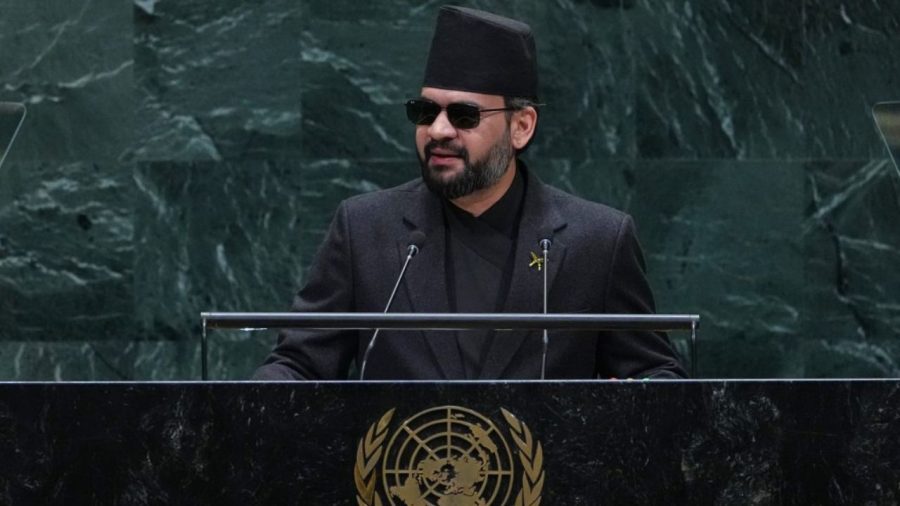



Nepal’s Prime Minister Balendra Shah has issued a stark call for global climate action at the United Nations General Assembly (UNGA), describing the catastrophic August flooding in his country as a “warning to the world”.
Speaking in New York on Thursday night at the 81st Session of the UN General Assembly, Shah stressed that the recent calamity “was not just a local tragedy,” reports Al Jazeera.
Directing his comments to international delegates, he asked, “Have you really heard that warning?”.
He criticized world leaders, saying they “have been negligent to translate those warnings in action at the speed and scale that vulnerable people require.”
The disaster struck on 26 August, when a collapsed glacier unleashed a massive surge of mud, rock, and floodwater across northern Nepal and the border region with China and Tibet.

Official figures from Nepal’s National Disaster Risk Reduction and Management Authority confirm that at least 1,453 lives were lost, 5,500 individuals remain unaccounted for, and 13,795 survivors were pulled to safety.
According to a report by researchers at the World Weather Attribution (WWA) group, the event was a “compound crisis” resulting from extended global warming, glacier recession, melting permafrost, and structural geological instability.
Emphasising the stark inequality of climate impacts, Shah pointed out that populations who contributed least to environmental degradation “are paying a colossal price for it.”




He noted that Nepal generates less than one-tenth of 1 per cent of global greenhouse gas emissions.
Whilst roughly 99 per cent of the nation’s electricity is derived from hydropower, floodwaters submerged critical infrastructure, trapping numerous hydro project workers inside tunnels.
“Our glaciers are retreating, our mountain slopes are becoming unstable, our rivers are becoming less predictable, and every major disaster threatens to erase years of development,” Shah warned.
To mitigate future risks, the prime minister called upon the international community to assist with the financial burden of climate adaptation.
He put forward a proposal for a regional “Himalaya Climate Resilience Mechanism” comprising Nepal, India, and China.
The framework would facilitate the exchange of satellite data and technical knowledge, the tracking of glacial lakes, and the creation of enhanced joint early warning systems.
Financial losses from the flood are estimated at $5 billion, according to an initial assessment by the Nepali government.
Nepal has formally applied for $20 million from the UN Loss and Damage Fund, the maximum sum permitted per request.
Established in 2022 following severe flooding in Pakistan, the UN fund has yet to issue its first payout, leaving Nepal’s application as a critical benchmark for its effectiveness.
Separately, the United States announced an additional $31 million in flood relief funding earlier in the week.