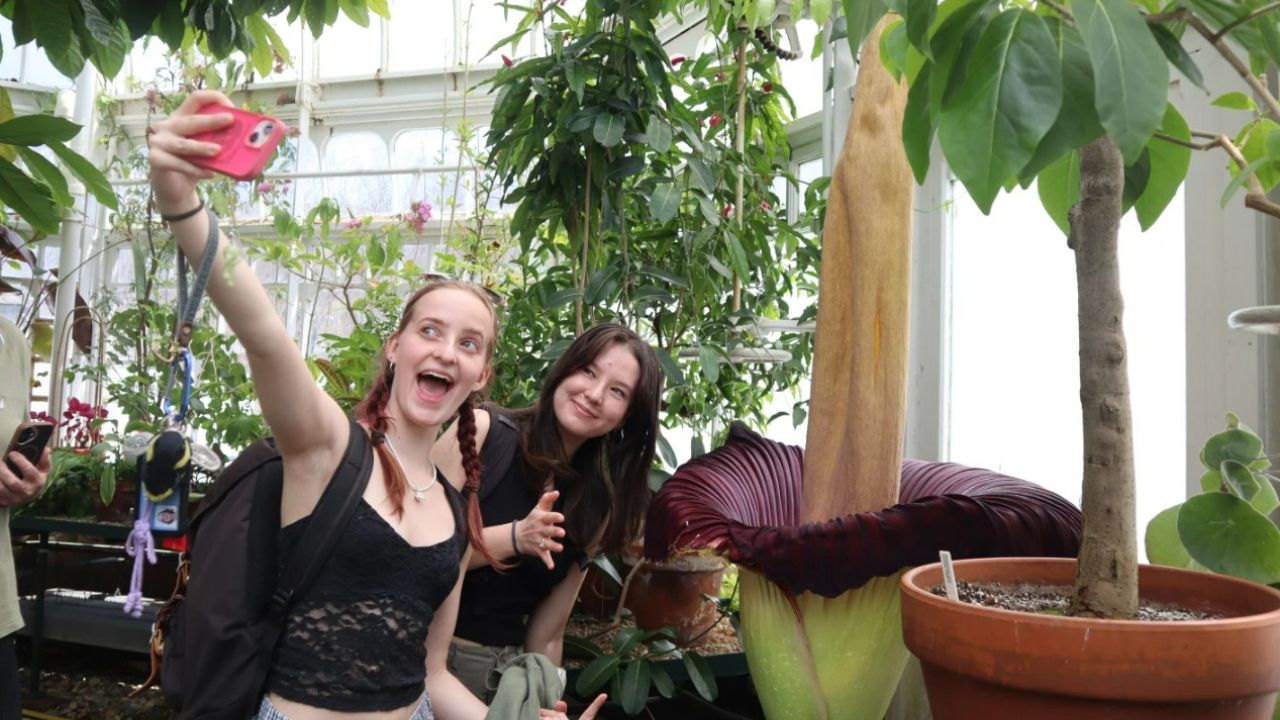

The wait is over, and the stench has arrived.
Mount Holyoke College’s famously fickle corpse flower, affectionately nicknamed “Pangy,” has unfurled its massive maroon bloom once more, treating visitors to the botanical world’s most notorious perfume: the unmistakable reek of decay.
For those brave enough to step inside the campus’s Talcott Greenhouse this week, the experience was nothing short of olfactory shock. One visitor likened the air to rotting eggs. Another recalled the grim scent of dissecting a dead bird. A third settled on the image of a dirty diaper left to bake under a hot sun, reports AP-UNB from SOUTH HADLEY, Mass., USA.
“I expected it to be bad, but it was genuinely like rotting flesh,” said Nyx DelPrado, a first-year student, wrinkling their nose after a close encounter. “Its name is accurate.”

The Amorphophallus titanum, native to the steamy rainforests of Sumatra, is a rare botanical spectacle that blooms unpredictably and for only 24 to 48 hours. Its evolutionary trick is simple: mimic a carcass to lure carrion-loving flies and beetles as pollinators. Pangy first shocked the campus with a bloom in 2023, and its sudden reawakening has once again drawn crowds eager to witness—and gag at—the fleeting event.
A stench with a purpose
Tom Clark, who directs the Mount Holyoke College Botanic Garden, explained that the plant’s gag-inducing odor is actually a sophisticated survival strategy. Over the past six weeks, Pangy grew at a feverish pace, shooting up several inches daily before finally cracking open overnight Monday. By Tuesday morning, the smell was undeniable.
“Walking through the front door, we could smell it,” Clark said. “As we got closer to the greenhouse, it became stronger and stronger. It was literally unbearable. If you didn’t know what was in there, you’d ask, ‘What died in here?’”




What looks like a single flower is actually an enormous inflorescence—a towering central spike called a spadix, wrapped in a deep purple, velvety leaf-like hood called a spathe. While this grand structure will wilt within days, the plant’s underground tuber lives on, capable of producing another surprise bloom years down the line.
From shock to strange wonder
The line of curious students and locals grew steadily as word spread. For many, the reality of the smell was both shocking and strangely fascinating.
“I didn’t know what the name meant. I thought it would smell like a corpse, but I don’t actually know what a corpse smells like,” admitted student Maheen Siddiqi after taking her turn. “And then I got a whiff—it was like really bad eggs or sulfur.”
Others found the scent surprisingly familiar. Caroline Murray, a senior from Vermont, shrugged off the stench. “It smells kind of like a compost pile, or a working farm. I’m from Vermont, so I’m used to manure.”
One visitor, Michael Breton, drove two hours and burned a vacation day just to be there, having tracked corpse flower news alerts for years. “If you see an article from two days ago, it’s already gone. You have to run fast,” he said. His verdict? “A stinky diaper left out in the sun. But the plant itself? Bright, beautiful, and colorful. A lovely thing.”
A fleeing moment, an enduring lesson
By midday Tuesday, greenhouse vents were opened to spare the staff, and the odor began to soften—though it remained unforgettable. The plant will soon collapse and rot away. Since corpse flowers cannot self-pollinate, seeds will only form if another titan arum blooms nearby at the same time.
Clark called the event a “plant museum” moment, a rare chance to showcase the wild diversity of the world’s flora—over 2,000 species live in the greenhouse, a tiny fraction of the planet’s estimated 350,000 to 400,000 plants.
For student Namuuna Negi, the fleeting horror was part of the draw.
“It’s the impermanence,” Negi said. “People like to be in on what’s happening. If they hear something is going to die soon, they want to go see it before that happens—so they can talk about it later.”