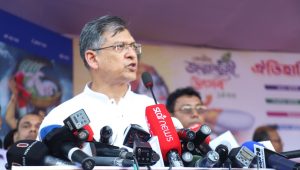
National Citizen Party (NCP) Chief Coordinator Nasiruddin Patwari has claimed that the “Sheaf of Paddy,” political symbol of Maulana Abdul Hamid Khan Bhashani, has been stolen.
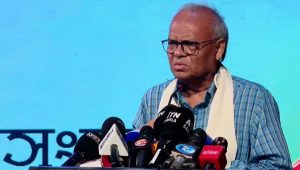
He made the remarks on Wednesday during a seminar titled “Government conditions during paddy procurement season and the cries of farmers amidst untimely heavy rains: Crisis and ways out.” The event was organised by the NCP’s Agriculture Cell at the party’s temporary central office in Banglamotor, Dhaka.
Addressing the seminar, Patwari said agriculture represents a significant portion of the lives of Bangladeshi people, which led Maulana Bhashani to choose the sheaf of paddy as his party’s symbol. “Maulana Bhashani is still here, his name remains, but the symbol has been stolen,” he claimed.
He further said that Bhashani had pioneered farmer-centric politics in Bangladesh, suggesting that if the symbol had remained with its rightful legacy, crops would not be submerged today. He lamented that while the real paddy is currently underwater and farmers are in distress, the “sheaf of paddy” is in power.
Concerns over syndicates and ‘red cards’
Expressing grave concern over the current agricultural situation, the NCP leader alleged that paddy, which was supposed to protect the nation, is now controlled by businessmen and syndicates. “Paddy from the fields of Bogura has moved to Gulshan. Instead of the farmers, the syndicates are now the ones profiting,” he claimed.

Patwari also criticised government initiatives like the ‘Smart Card’, ‘Farmer Card’, and ‘Family Card’, labelling them as projects to embezzle money. He warned that the NCP has introduced its own ‘Red Card’, which they will brandish when these government schemes fail.
Regarding regional politics, Patwari noted that certain Indian political groups seek to create fresh tension in South Asia, but asserted that the people of Bangladesh would remain united to protect the country’s sovereignty and interests.
Threats to food security
Presenting the keynote paper, NCP Agriculture Secretary Golam Mortuza Salim warned that any disruption in paddy production would threaten not only food security but also the national economy and social stability.



He criticised the government for failing to provide early weather warnings to farmers, noting that developed nations provide such alerts at least a month in advance.
The seminar’s chief speaker, Ekushey Padak-winning agricultural economist Jahangir Alam, highlighted that Boro paddy production has been significantly hampered this season due to an irrigation crisis in North Bengal and floods in the Haor region. This, he warned, has created fears of a food crisis and further food inflation.
The potato crisis and policy failures
Atiq Mujahid, NCP Joint Convener and Member of Parliament for Kurigram-2, pointed out that the crisis extends beyond rice to potatoes. He reported that farmers in northern regions are dumping potatoes on roads in protest against unfair prices, with some even driven to suicide in despair.
He described the government’s paddy procurement system as “syndicate-dependent,” where middlemen benefit while farmers suffer due to poor policies.
NCP Joint Convener Sarwar Tushar criticised the government for issuing “agriculture cards” to “Tiktokers” instead of supporting genuine farmers with harvesters and drying technology. He urged the government to scrap the “agriculture card farce” and introduce agricultural insurance.
Tushar also suggested that the government should purchase paddy directly from the doorsteps of farmers, following the principle of the late Dr Zafrullah Chowdhury of taking services to the people’s doors.
He demanded that crop prices be determined in advance to allow farmers to bargain effectively and urged the government to shift its policy from buying rice to buying more paddy.
‘Administrative negligence’
Mazharul Islam Fakir, Convener of Jatiya Sramik Shakti, blamed administrative negligence for delayed harvests.
He noted that while Haor farmers usually harvest between late Chaitra and early Boishakh, they are still harvesting as late as 30 Boishakh this year due to delays caused by government officials responsible for seed distribution and marketing. He called for these officials to be held accountable.
Additionally, Shadrul Alam, Convener of the National Health Alliance, emphasised the need for the national budget to include easy-term loans for farmers and called for transparency in their distribution.