



At Gausnagar in Dhaka’s New Eskaton on Wednesday morning, the familiar roar of engines was interrupted by a panicked warning from one motorcyclist to another, “Drive carefully! There are AI cameras now. Who knows when they’ll slap us with a case?”
The anxiety is spreading fast across the capital as the Dhaka Metropolitan Police replaces whistles and roadside chases with artificial intelligence-powered surveillance in a dramatic new crackdown on traffic chaos.
After years of failed drives to restore order on Dhaka’s lawless roads, police have unleashed what many drivers now describe as “invisible police” stationed everywhere at once.
Just days into this digital surveillance era, the “eye in the sky” is already proving to be a formidable deterrent.
Powered by the “AI Based Road Transport Act 2018 Violation Detection Software,” the cameras automatically detect violations, capture images and video evidence, and initiate digital prosecutions without any direct involvement from officers on the street.
For the first time, many drivers say, there is no room for roadside bargaining, emotional appeals, or requests for leniency. The AI does not negotiate.
The digital surveillance network officially went live on 7 May, with smart cameras installed at some of Dhaka’s busiest and most chaotic intersections.

From Shahbagh and Bangla Motor to Kawran Bazar, Bijoy Sarani, Gabtali and Airport Road, the system is now operating around the clock, silently tracking violations even when no police officer is visible nearby.
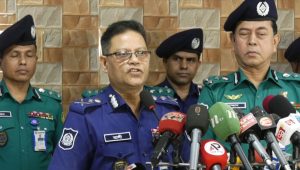
At a press briefing on 11 May, Additional Police Commissioner (Traffic) Md Anisur Rahman said notices for traffic violations are now automatically being sent to the registered addresses of vehicle owners and drivers.
He warned that ignoring fines may no longer be an option. Failure to pay within the stipulated time could escalate into court summonses or even arrest warrants, transforming traffic violations from a roadside nuisance into a serious legal matter.
And the numbers are already staggering.
Within just the first three days of operation, the AI system detected more than 2,500 separate traffic violations across the capital.

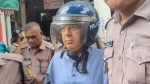


The cameras captured drivers jumping red lights, crossing stop lines, driving in the wrong direction, parking illegally, and riding without helmets or seatbelts. The footage was later reviewed by the Traffic Technical Unit (TTU), which finalised more than 300 digital prosecutions.
The move marks a major shift from Dhaka’s traditional enforcement system, where officers had to physically spot a violation, pursue the vehicle through congested roads, and manually file cases, a process long criticised for inconsistency, chaos, and opportunities for influence.
Now, according to DMP Commissioner Md Sarwar, the technology itself is reshaping driver behaviour in ways years of conventional enforcement failed to achieve.
Among Dhaka’s vast army of motorcyclists, the impact has been immediate and deeply personal.
Ride-share driver Md Aminur learned the lesson the hard way.
“I was busy riding on the sidewalk to beat the traffic,” he said. “A day later, a text appeared on my phone informing me of a Tk2,000 fine. Now, I have to be infinitely more careful.”
Another biker, Hasmat Ali, said the psychological atmosphere on Dhaka’s streets has completely changed.
“Earlier, if I didn’t see a traffic officer, I felt at peace,” he admitted. “But now with these cameras, the fear is constant.”
Car drivers are also struggling with the new reality.
Noor Islam said the most unsettling part is the delayed punishment.
“Before, I could at least ask the officer what mistake I made,” he said. “Now, I don’t even realise I broke a law until the text arrives later.”
For traffic police officers, however, the technology is proving to be a breakthrough.
SI Hasibul Islam, stationed at Bangla Motor Intersection, said the days of violators escaping simply by speeding away are ending.
“Before, people would blow through a signal and disappear before we could react,” he explained. “Now, filing those cases is actually possible.”
Still, frustration is mounting among drivers whose livelihoods depend on the roads.
Biker Faruk Ahmed argued that authorities should have introduced smaller fines during the initial phase to help drivers adapt to the new system gradually.
Ride-share driver Mamun Islam voiced fears over the crushing financial impact.
“If they slap us with a Tk5,000 fine,” he said, “it could take an entire month of work just to clear the case and get back on track.”