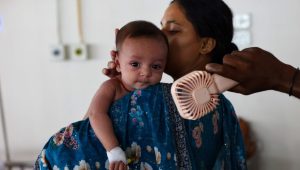
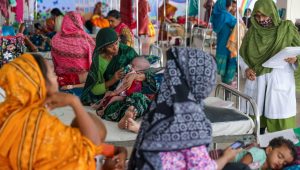
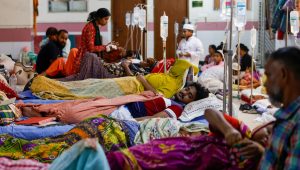
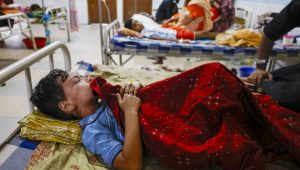
Nine-month-old Jisan spent days moving from one hospital to another in Dhaka as his family searched desperately for treatment for pneumonia and measles. Each time, they were turned away.
The infant, from Kashipur village in Jhenaidah’s Kotchandpur upazila, was first taken to Dhaka Medical College Hospital. When no bed was available there, his family tried Bangladesh Shishu Hospital and two other healthcare facilities in the capital.
None admitted him.
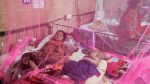
Exhausted and with few options left, the family eventually returned to Jhenaidah, where Jisan was being treated in the paediatric ward of Jhenaidah General Hospital with limited medical facilities.
But his condition remained serious.
Doctors later advised the family to take him back to Dhaka for advanced treatment, a recommendation that left his relatives frustrated and distressed after their earlier experiences in the capital.

Then came a breakthrough.
After news reports highlighted the child’s struggle to secure treatment, authorities at Bangladesh Neonatal Hospital Ltd in Narayanganj came forward and offered to take responsibility for his care.
Late Tuesday, an ambulance carrying Jisan left Jhenaidah for Narayanganj.
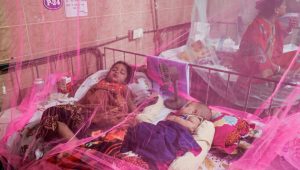
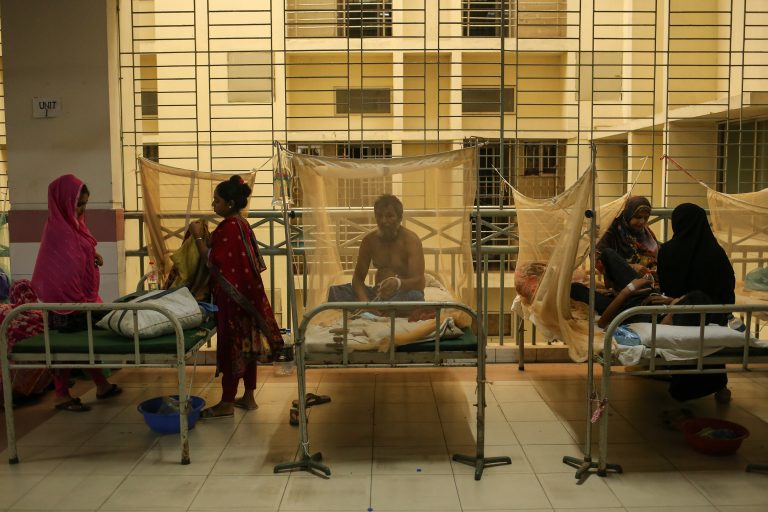
The case has once again drawn attention to the pressure on Bangladesh’s healthcare system, particularly the shortage of paediatric beds amid the current measles outbreak in major public hospitals, where families from outside Dhaka often travel in search of specialised treatment only to face overcrowding and long waits.

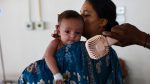
Jisan’s father, Daud Hossain, said symptoms of measles first appeared in his son around 20 days ago, after which the child was admitted to Jashore Ad-din Hospital for treatment.
A sample was later sent to Dhaka for testing.
After Jisan appeared to recover from measles, the family took him back home. But soon afterwards, he began showing symptoms of pneumonia and was admitted to Al-Falah Hospital in Jhenaidah town.
While he was undergoing treatment there, the measles test result came back positive.
“As the days passed, his condition continued to worsen,” Daud Hossain said. “So we took him to Dhaka on Monday.”
He said the family’s finances had been drained by the prolonged treatment at private hospitals.
“My financial condition has collapsed after keeping him admitted to private hospitals for so long,” he said. “Now I am borrowing money to continue his treatment.”
Jhenaidah General Hospital Superintendent Mustafizur Rahman said the child’s immune system had weakened after contracting measles, making him vulnerable to pneumonia.
“His condition is extremely critical,” he said.
He added that doctors referred the infant to Dhaka again because continuing treatment in Jhenaidah carried significant risks.
“But the child’s father was reluctant to return to Dhaka because of financial hardship,” he said.
Jhenaidah Sadar Upazila Nirbahi Officer Tarek Hasan said local authorities intervened after learning about the family’s struggle.
“We visited the hospital and spoke to the family after hearing about the crisis surrounding the child’s treatment,” he said. “We convinced them to take the child to Narayanganj, and eventually they agreed.”
Hospital authorities said 23 children with measles or measles-like symptoms are currently admitted to Jhenaidah General Hospital, adding that the number of patients has been increasing steadily in recent days.