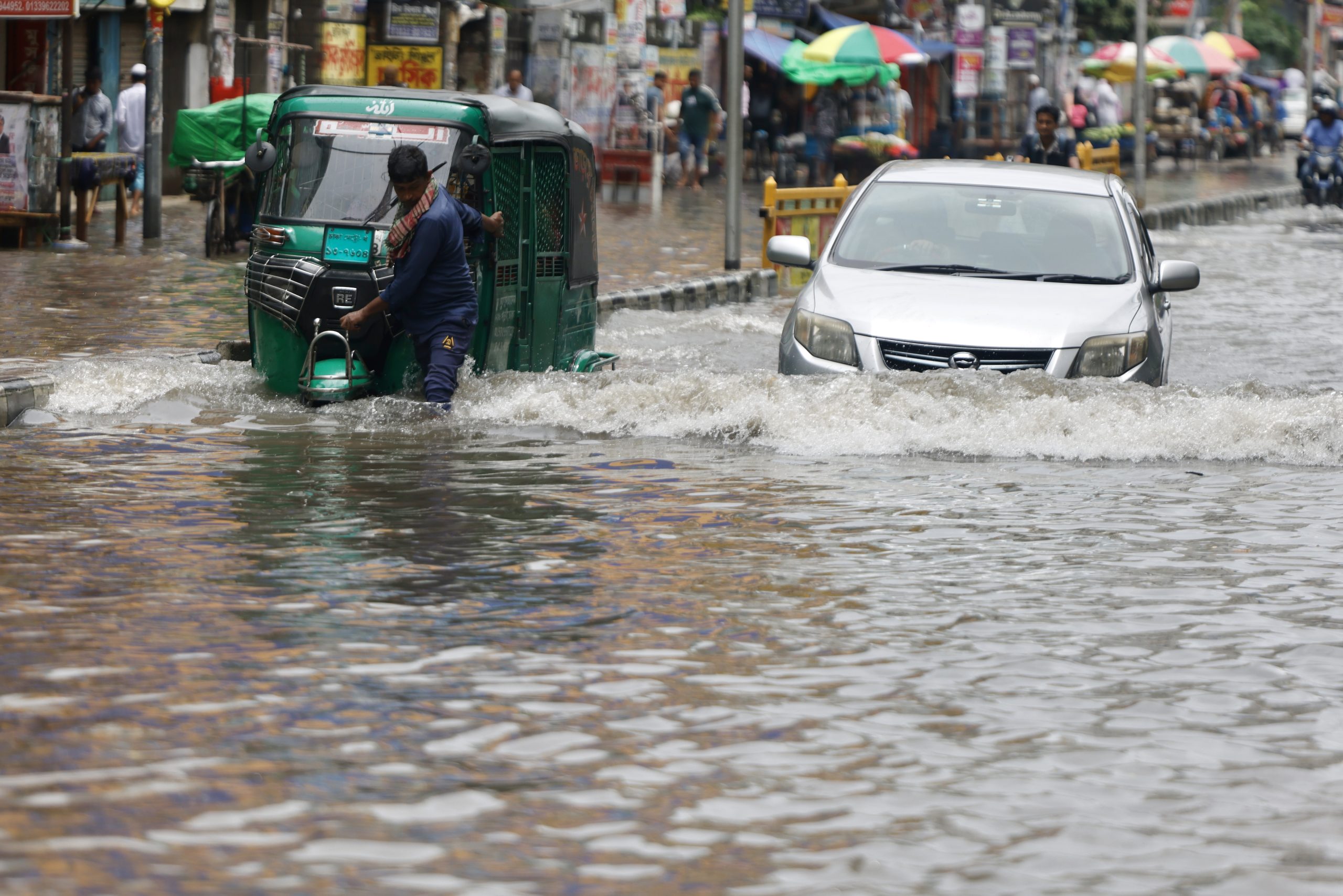

This year’s monsoon has drowned major cities like Dhaka and Chittagong, pushing millions of people into unspeakable suffering and causing the deaths of almost 100 people. Many consider this a familiar sight of the monsoon season. However, the reality could be different – at the very least, the intensity of flooding and human loss and suffering can be reduced. Although climate change is considered one of the factors responsible for heavy and excessive rainfall, several other factors are causing frequent waterlogging and flooding. Rather, it is due to the apathy of politicians toward people’s sufferings. People’s wellbeing is overtaken by their self-interest through corruption, poor planning and mismanagement.
During the past few decades, due to the political short-sightedness of various governments, weaknesses of relevant institutions, corruption, unplanned urban planning, and a lack of care for the environment, various cities have been inundated by floods almost every year. Every disaster like this reminds us of the lack of good governance. Do we learn anything from these? No. If learned, such catastrophic problems would not repeat every year. And even if they did, the situation could have been within our control.
According to science, climate change may cause excessive rainfall in the future as well. Therefore, to tackle such situations, climate-resilient urban planning should be given national priority. Sadly, it is not happening in reality because our government and politicians do not prioritise or attach importance to planned and sustainable urban planning. Rather, they prefer the politics of unplanned development – projects that catch the public eye and where they have vested interests. That’s perhaps the main reason politicians show a greater interest in flyovers, expressways, elevated highways, large bridges, or visually striking structures to use them as symbols of their political success and branding them for their electoral success. Consequently, projects like underground drainage systems, canal restoration, rainwater harvesting reservoirs, or the modernisation of sewage systems get less priority. As a result, a serious imbalance in sustainable development is constantly being created.
The drainage infrastructure of cities is critical, yet it has not been developed accordingly. New unplanned roads have been built, old roads have been widened, and roads have been elevated, but the capacity of drains has not increased. New residential areas have sprung up, but adequate rainwater drainage systems have not been kept there accordingly. Consequently, heavy rains turn residential areas and roads around and inside into artificial temporary reservoirs.

To build a sustainable, livable, and healthy city, long-term planned initiatives are needed that go beyond the electoral politics. The current parliament has been running for four months. Not even once has any member from either the ruling party or the opposition spoken about city waterlogging. They were only busy with how to increase their own perks and privileges, and maintaining their political advantages and power. They seemingly had no concern over the tragic and preventable deaths of over 750 children from measles, or the controversial trade agreement contrary to the country’s interests. The interests of the public have become secondary to politicians. Urban flooding and rising waterlogging are the results of all this.
At the centre of the waterlogging and flooding problem in megacities lies the rampant corruption of politicians and bureaucrats. Laws exist in the country to protect wetlands, canals, natural water flow channels and reservoirs. However, the implementation of these laws is almost non-existent, or at best, extremely weak, inconsistent and inappropriate.
Older residents of Dhaka still remember that the city was once interconnected with numerous canals, ponds, and wetlands. During heavy rains, these natural reservoirs retained the excess water and later slowly drained it into the rivers. Over the years, canals, wetlands, and natural drainage paths have been encroached upon. Housing projects, shopping malls, factories, and commercial structures have been built in an unplanned manner under political patronage on the very spots where rainwater naturally accumulated. Due to corruption, the environment is being destroyed, and the spaces for holding rainwater are constantly shrinking – and the ordinary people are bearing the brunt of all of it.




Due to urbanisation, the spread of concrete is causing soil and green areas to gradually shrink, blocking the natural flow pathways of rainwater. As a result, streets and people’s homes are being flooded. Another major cause of waterlogging and urban flooding is the lack of coordination among various city institutions. City corporations, WASA, development authorities, the Department of Environment, the roads department, and various utility agencies are involved in city flood management. The lack of necessary coordination among institutions is a chronic problem. It is also a major obstacle to solving waterlogging and drainage issues. Although everyone is aware of this matter, the political leadership has never looked into it on a priority basis. The outcome is easily predictable. To resolve waterlogging and ensure effective urban water management, integrated planning is essential.
Waterlogging is also caused by the lifestyle and personal habits of the people, as we do not dispose of plastic waste, construction debris, and household garbage in an environmentally friendly manner. There is also an economic and health cost of waterlogging and urban flooding due to loss of productive working hours, production in factories, and damage to overall businesses. Water-borne and airborne diseases also become a serious public health concern.
Ensuring good governance is the most effective way to resolve and mitigate waterlogging and urban flooding. And for this, what is needed is transparent procurement processes, professional and planned urban planning, proper enforcement of environmental laws, independent regulatory oversight, institutional coordination, and continuity of government policies. If all these can be ensured, the infrastructure built to resolve and mitigate waterlogging and urban flooding can be sustainable and effective. And for this, a transparent and honest political commitment is required. If we can harmonise this commitment with technical capacity, we will be able to largely reduce or control waterlogging and urban flooding.
To this end, the government may consider the restoration of rivers, canals, and wetlands and keeping the government’s current canal-digging program active in an honest and planned manner, discarding political motives. All illegal encroachments, regardless of political affiliation or economic influence, should be evicted. The drainage system should be modernised based on scientific forecasting. Urban drainage management should be integrated, along with maintenance and effective waste management. Drainage blockages should be detected at an early stage using digital technology and real-time monitoring systems. And, finally, mandatory, independent, and transparent environmental impact assessments for urban development projects.
We cannot control rain and the impact of climate change. However, resolving waterlogging and alleviating the severity of urban flooding is within human decision-making and power if we can consider the aforementioned recommendations. With honesty, transparency, and foresight of the political leadership, we can ourselves determine if we want a city free from waterlogging and floods.
In conclusion, let us expect that every flooded road, city, neighbourhood, and the cries and suffering of the affected people do not merely tell us stories of the unspeakable miseries and despair of the monsoon, but also remind us of the necessity of the anticipated good governance in the future.
The views expressed in this article are solely those of the author
The writer is a Former Ambassador and Secretary, Ministry of Foreign Affairs