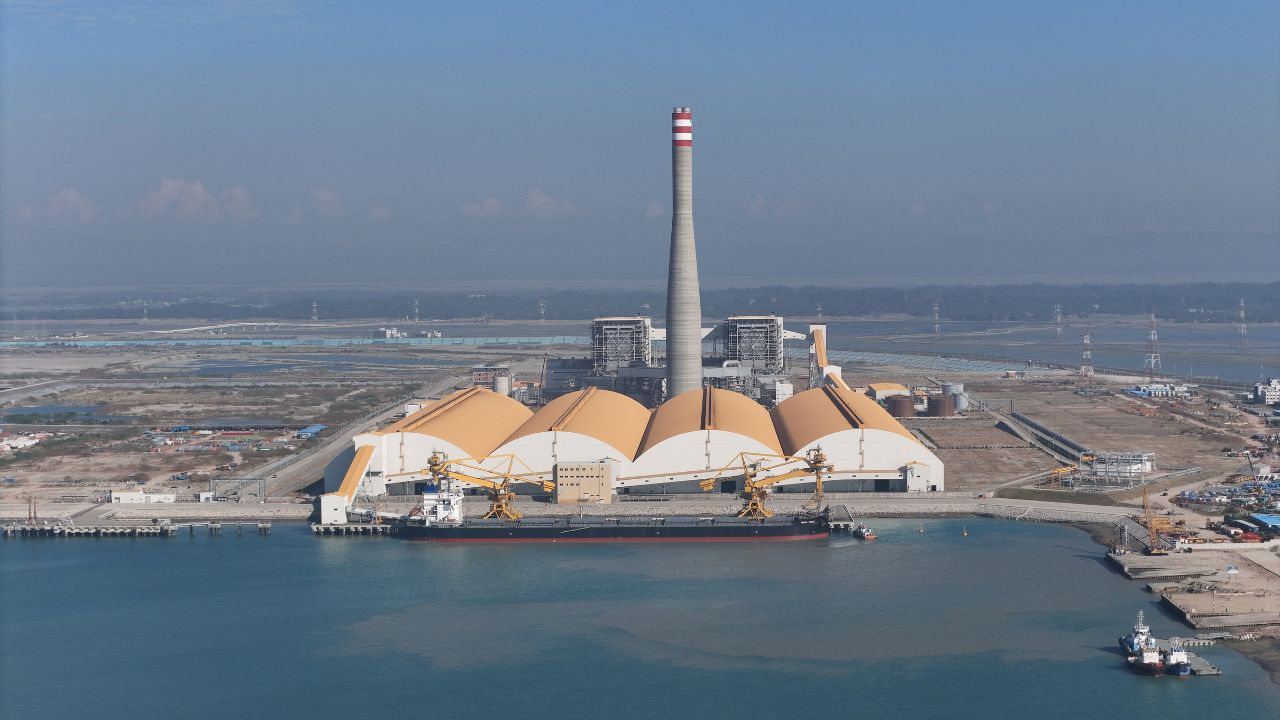



The Matarbari coal power plant jetty in Cox’s Bazar has been operating virtually like a port facility even before construction of the Matarbari Deep Sea Port is completed.
Since the Indonesian-flagged vessel Venus Triumph arrived at Matarbari on 29 December 2020, a total of 215 vessels have called at the jetty by the first week of August 2026, unloading around 6.65 million metric tonnes of coal and other raw materials.
The facilities, including two jetties, an approach channel and wave-protection breakwaters, were originally developed to support the 1,200MW Matarbari Ultra Super Critical Coal-Fired Power Plant and are now being used for vessel operations while construction of the main deep sea port is underway.
Spokesperson for the Chattogram Port Authority (CPA) Syed Refayet Hamim told TIMES of Bangladesh that the facilities were initially developed to facilitate the transportation of coal and other materials for the power plant.
“Construction of the Matarbari Deep Sea Port is now underway. Once completed, container and other large vessels will be able to call directly at the port and bring cargo from different parts of the world,” he said.
The deep sea port is expected to become a major regional transshipment hub after beginning full-fledged commercial operations in 2030.

From salt fields to maritime development
A decade ago, Matarbari in Maheshkhali was primarily known for salt cultivation, shrimp farming and fishing. The coastal area is now undergoing a transformation, with a deep sea port, a 1,200MW coal-fired power plant, a single-point mooring (SPM) facility and two floating LNG terminals being developed in and around the area.
An economic zone and other planned infrastructure are also expected to emerge around the port, turning Matarbari into a major industrial and logistics centre.
Former vice-president of the Bangladesh Freight Forwarders Association Khairul Alam Sujan said the road, rail and communication infrastructure in southern Chattogram and Cox’s Bazar is already changing rapidly around the Matarbari development.




According to him, the transformation is making the coastal region increasingly attractive to both domestic and foreign investors.
Port facilities built before deep sea port
Before construction of the main port began, authorities developed a 14.3-kilometre-long and 250-metre-wide approach channel, two jetties and Bangladesh’s first major breakwater system to facilitate coal transportation for the power plant.
The northern breakwater is about 2,150 metres long, while the southern breakwater stretches around 670 metres. Built with large stone blocks, the structures protect the channel from strong waves and help ensure safer navigation.
These facilities have effectively allowed Matarbari to function as a specialised port facility even before the deep sea port itself is completed.
Main port construction begins
The main construction of the Matarbari Deep Sea Port project formally began on 7 May 2026, with large-scale dredging of the seabed.
The project is being implemented by Japan’s Penta-Ocean Construction and TOA Corporation, with financing assistance from the Japan International Cooperation Agency (JICA). The first phase is estimated to cost around Tk24,381 crore and is scheduled for completion in 2029, with commercial operations expected to begin in 2030.
Under the initial phase, the navigational channel is being dredged to a depth of 18 metres. A modern terminal is also being developed at an estimated cost of around Tk6,200 crore, featuring a 300-metre multipurpose jetty and a 460-metre container jetty.
Terminal buildings, container yards, sea walls, retaining walls and solar power facilities are also being developed under the project.
Direct berthing of 8,000-TEU vessels
Matarbari Port has been designed following the model of Japan’s Kashima Port. Unlike Chattogram Port, whose existing facilities generally handle container vessels of around 2,000–2,500 TEU, Matarbari is being designed to accommodate much larger mother vessels.
Ships carrying up to 8,000 TEU are expected to berth directly at the port from its initial operational phase.
This could significantly reduce Bangladesh’s dependence on transshipment hubs such as Singapore, Colombo and Port Klang for handling international cargo.
According to the CPA, direct shipping from major source countries, including China, could reduce transportation time by at least three days, while direct handling of large vessels could lower logistics costs by up to 15 per cent.
A single 8,000-TEU mother vessel could carry cargo equivalent to several smaller vessels currently calling at Chattogram Port.