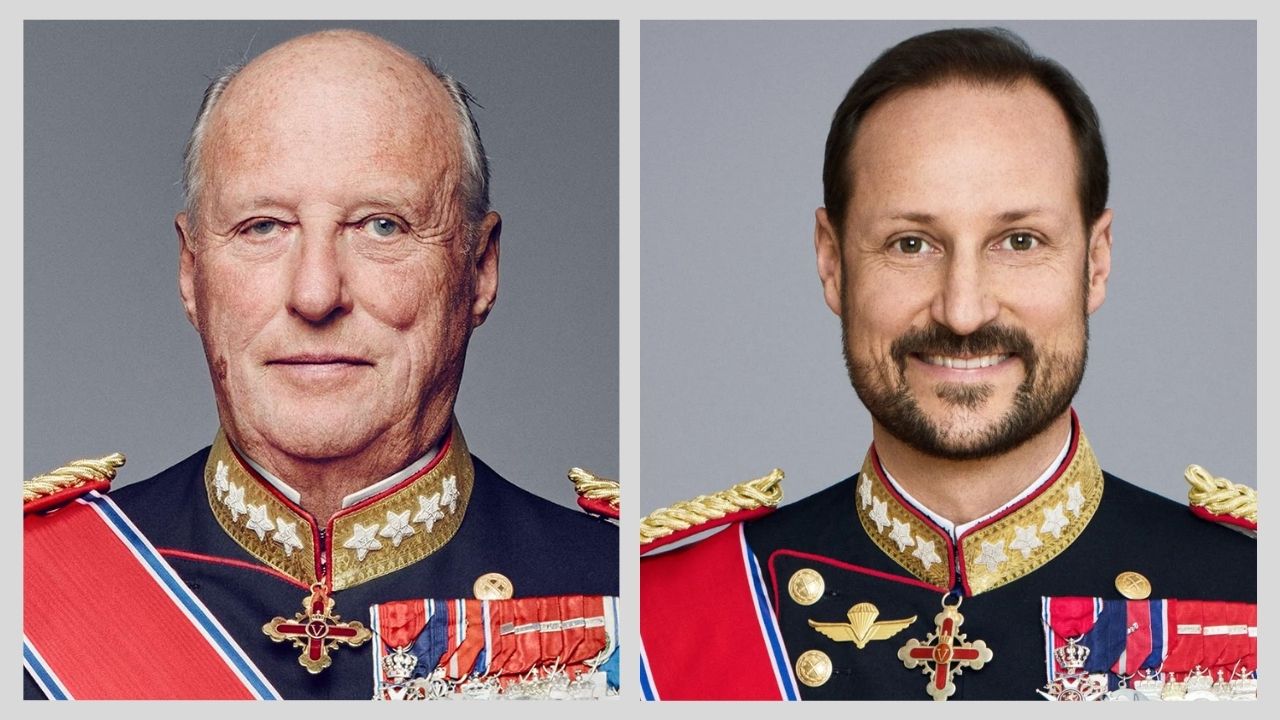



King Harald V of Norway, Europe’s oldest reigning monarch, has died at the age of 89, triggering the immediate succession of his son, Crown Prince Haakon, as King Haakon VIII.
The transition of power comes amid a turbulent period for the Norwegian royal family, marked by intense public controversy over Crown Princess Mette-Marit’s past links to the late US sex offender Jeffrey Epstein, reports Guardian.
The royal palace in Oslo announced that King Harald passed away peacefully today, Friday, August 28, at 6:35 am at Oslo University Hospital.
On Thursday, the palace had declared the King’s health to be in an “extremely serious” condition, prompting his wife, Queen Sonja, and Crown Prince Haakon, who was already serving as regent, to cancel all their scheduled public engagements.
Following the announcement of the King’s passing, flags at the royal palace were lowered to half-mast, and church bells across the country were set to ring at midday to mark the national mourning.
Norway’s Prime Minister Jonas Gahr Støre expressed deep grief, stating that the entire nation is mourning the loss and remains deeply grateful for the late monarch’s long life of service.

Støre, who is scheduled to meet the new King Haakon VIII at the palace later on Friday, praised the late monarch for demonstrating “an unwavering faith in the Norwegian people” and helping them “to see the best in ourselves, and in one another”.
Tributes also came from Sweden, where King Carl XVI Gustaf paid tribute to his “good friend” and wished his godson Haakon, who succeeds his father as head of state, success and good fortune.
King Harald V, who had served as Norway’s ceremonial head of state since 1991, was being treated at Oslo University Hospital since August 17 for haemolytic anaemia, a condition caused by an abnormally rapid destruction of the body’s red blood cells.




The late King had faced numerous health issues in recent years, including surgery for bladder cancer in 2003 and the fitting of a pacemaker in 2024. In February of this year, he was hospitalised for an infection and dehydration while on a private trip to Tenerife with Queen Sonja, who herself was hospitalised for heart problems in Norway three months later.
Despite his declining health, King Harald had consistently rejected the idea of abdication, maintaining that he had sworn a lifelong oath before the Norwegian parliament.
A great-great-grandchild of Britain’s Queen Victoria, Harald succeeded his father, Olav V, at the age of 54. Before ascending the throne, he studied at Oxford and represented his country in sailing events at three Olympic Games: Tokyo, Mexico City, and Munich.
He was widely regarded as the great moderniser of the Norwegian monarchy, revamping the crown estates and changing the way the court is run. Harald married Sonja, a commoner, in 1968, and welcomed two others, Mette-Marit and Ari Behn, as the spouses of his children.
He was deeply appreciated for his unassuming lifestyle and unceasing efforts towards national unity, notably highlighted in his emotional address following the 2011 terror attacks by far-right extremist Anders Behring Breivik and his celebrated 2016 speech advocating for diversity, tolerance, and LGBT rights.
The historic succession is, however, overshadowed by intense public controversies surrounding the royal household. In January, documents published in the US revealed that Crown Princess Mette-Marit had maintained correspondence with Jeffrey Epstein, the late US sex offender, between 2011 and 2014, long after his conviction.
The files appeared to contain almost 1,000 mentions of the Crown Princess, including intimate exchanges, which drew sharp public criticism and an unprecedented reprimand from Prime Minister Støre, who accused her of “poor judgement”.

Mette-Marit subsequently issued a statement through the royal household expressing her deepest regret for the friendship and apologising for the situation she had put the royal family in, especially the King and Queen.
These controversies have severely damaged the monarchy’s popularity. A poll conducted in February showed public support for the institution had plummeted to 54 per cent, down from 72 per cent in 2024. Multiple polls indicated that nearly half of the Norwegian population believed Mette-Marit should not become queen.
The royal family has also been shaken by a criminal scandal involving Mette-Marit’s 29-year-old son from a previous relationship, Marius Borg Høiby, who was sentenced in June to four years in prison for two rapes and 32 other charges, including violence against a former partner. Høiby is currently appealing the verdict.
Mette-Marit, 53, who is currently battling a serious lung disease and underwent a successful lung transplant in July, was a single mother to a four-year-old Høiby when her engagement to the Crown Prince was announced in late 2000.
Her background sparked immense controversy in Norway at the time, but the marriage, which marked the first time in modern European history that a direct heir brought a stepson into a royal family, was strongly supported by King Harald and Queen Sonja.
Prior to the wedding, Mette-Marit held an emotional press conference openly acknowledging what she described as a rebellious youth and prior drug use, expressing regret for her choices and strongly condemning drug abuse.