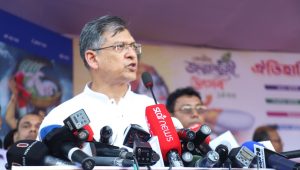
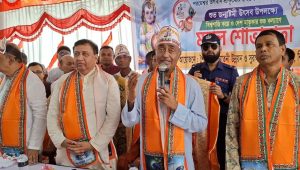
BNP senior leader Amir Khosru Mahmud Chowdhury on Sunday urged all political parties to unite in restoring democratic order in the country through the upcoming national election, instead of engaging in street violence or confrontational politics.
“Elections serve as a mechanism for correction and filtration. We must not hinder obstruct this process. If it is disrupted, we will lose the opportunity to restore democracy,” he said.
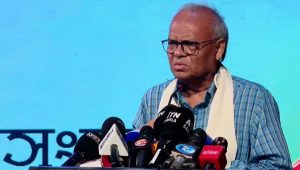
While speaking at a discussion hosted by Gono Odhikar Parishad at the Institution of Diploma Engineers, Bangladesh, Khosru stressed that political disagreements should be resolved by appealing to the people’s mandate through elections.

Khosru, also a member of the BNP Standing Committee, called on all political forces to maintain the unity and solidarity forged during the anti-authoritarian movement, aiming to establish a truly democratic atmosphere in the country.
Reflecting on the 16-year-long struggle for the restoration of democratic, political, and constitutional rights, he noted that despite the fall of the previous government 14 months ago, a fully representative and elected government has yet to be realised.


“There is now an interim government in place, but the elected parliament and representative government for which we fought are yet to be established,” Khosru said.
“Our immediate goal must be to reestablish democratic order through collective participation in the next election. This is not the moment for agitation in the streets. Our focus should be on engaging with the public. We must avoid divisive and violent politics. If we allow such practices to continue, we risk reverting to a destructive political culture,” he warned.
Khosru advocated for a revival of political norms rooted in tolerance and mutual respect, where differing views are acknowledged without hostility.
He argued that without such a culture, democracy cannot take firm root, regardless of how many reforms are introduced.
“Each party should present its vision to the people. Change must come through parliamentary processes and elections. Reforms won’t happen overnight, but they must remain on the public agenda and be pursued steadily—just as democratic institutions in the West evolved over time,” he said.
“That shared hardship has fostered a collective responsibility to shape a democratic future for Bangladesh,” he added.