


Dhaka’s latest attempt to bring order to its chaotic bus network will begin on 1 November with largely the same ageing vehicles and private operators that have long dominated the capital’s roads, raising doubts about whether the new system can deliver meaningful improvements for commuters.
Under the government’s ‘one route, one company’ model, franchise-based services will initially operate on six routes using existing buses, despite the collapse of an earlier initiative that sought to introduce a similar system.
The plan aims to end the fierce competition among bus operators for passengers, a practice blamed for reckless driving, indiscriminate stopping and worsening traffic congestion across the capital.
Instead of competing for fares, participating operators will share the total revenue collected during the day equally under the new arrangement.
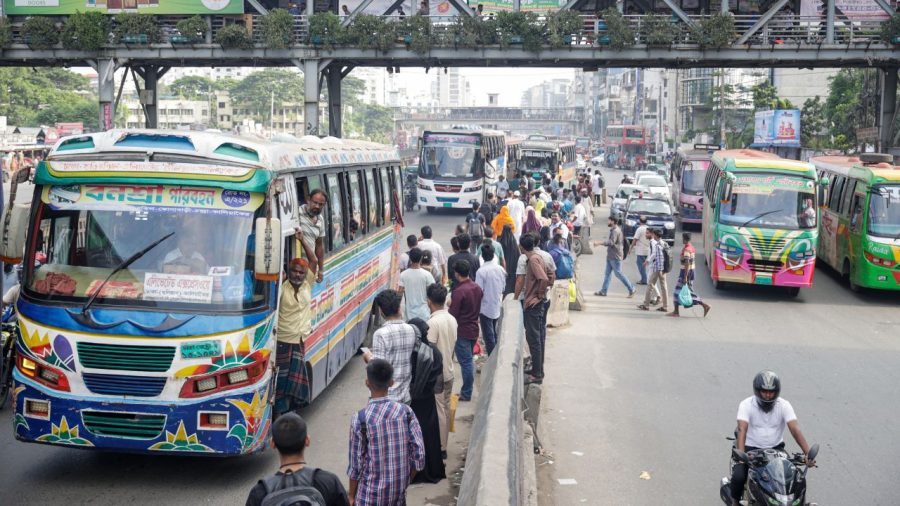
But the reliance on existing buses presents an immediate challenge. Many of Dhaka’s minibuses have cramped interiors, excessive seating, narrow doors, inadequate standing space and poor maintenance, making daily journeys uncomfortable for passengers.
The Dhaka Transport Coordination Authority (DTCA) itself estimates that around 40 per cent of buses currently operating may be excluded from the new system because of their poor condition.
Ashish Kumar Dey, general secretary of the National Committee to Protect Shipping, Roads and Railways, told TIMES that the decision to introduce new routes using old buses was unreasonable.
“It is not at all logical to introduce new routes with old buses. Maintaining service standards could prove difficult,” he said.
The government’s objective is to bring discipline to Dhaka’s roads, where fierce competition among buses operated by different companies on the same routes has long contributed to disorder.
Buses routinely stop wherever they find passengers, ignore designated stops and compete with one another to pick up commuters. They also wait at intersections while staff call out for passengers, contributing to traffic congestion and increasing the risk of accidents.

Under the ‘one route, one company’ policy, franchise-based bus services will be introduced on six routes on a trial basis from 1 November.
Three additional circular routes have also been identified, although services on those routes will take another two months to begin. The authorities plan to introduce new buses on those routes.
The routes, operating companies, number of buses and designated stops were discussed at a DTCA meeting on bus route rationalisation on 15 October. Another meeting was held three days later at the Dhaka Metropolitan Police (DMP) headquarters.
DTCA Deputy Transport Planner Dhruba Alam said preliminary estimates suggested that around 60 per cent of the buses currently operating in the capital could be refurbished and brought under the new system.
He said buses that were in poor condition or unsuitable for operation would not be allowed on any route under the new arrangement.
Dhruba said the new buses for the circular routes would be purchased by private owners rather than the government.
Orders could initially be placed for 200 to 250 buses, although the number had yet to be finalised.




The plan is to operate minibuses with a maximum of 28 seats on the circular routes, allowing them to navigate narrow streets and lanes more easily.
Earlier franchise scheme failed
The plan to introduce a franchise-based bus network in Dhaka is not new.
The initiative began in 2015, and six years later, Dhaka Nagar Paribahan launched services between Ghatar Char in Keraniganj and Kanchpur.
Two more routes were introduced in 2022.
The project aimed to consolidate more than 400 disorderly bus routes into 42 routes.
The service was launched with the participation of 22 private companies alongside the state-owned Bangladesh Road Transport Corporation (BRTC).
However, the initiative eventually collapsed as private companies withdrew their buses, citing losses.
Transport expert Moazzem Hossain, a professor at Bangladesh University of Engineering and Technology (Buet), believes the franchise model is bound to fail unless the state assumes full control.
Referring to the failure of Dhaka Nagar Paribahan, he recommended strengthening BRTC by adding at least 2,000 new buses and developing it into the principal operator.
DTCA Manager Md Aslam Uddin, however, expressed optimism about the new initiative.
“This time, the bus owners’ association is cooperating,” he said.
Bus allocation across six routes
A total of 836 non-air-conditioned buses and 20 air-conditioned buses are planned for the six routes under the new service.
The highest number of buses will operate between Shibbari in Gazipur and Dhakeshwari Temple in Old Dhaka, where VIP Paribahan will operate 253 non-air-conditioned buses.
Shibbari will serve as the main depot, while 10 buses will be stationed on the Palashi intersection–Azimpur section.
VIP Paribahan and Bikash Paribahan currently operate on this route.
On the Mirpur Zoo–Keraniganj route, Chiriakhana City Bus will operate 133 non-air-conditioned buses. Depots will be located at the zoo or Duaripara and in Keraniganj.
Dishari, Tanjil and Metrolink Paribahan currently operate on the route.
Ramzan Ali Enterprise will operate 70 buses between Ghatar Char and Demra, with parking facilities at Ghatar Char and beneath Demra Bridge.
Four Star Bus Line will operate 150 non-air-conditioned buses between Ghatar Char and Kanchpur.
Rajanigandha, Chalak, Somoy and Midline Paribahan currently operate on this route.
PNP City Service will operate 190 buses between Ghatar Char and Dhaur in Turag, with parking facilities at Ghatar Char and Kamarpara.
Poristhan and Projapoti Paribahan currently operate on the route.
On the sixth route, Dhaka Company will operate 20 air-conditioned buses between Tongi and Dhakeshwari Temple via the expressway.
Three circular routes planned
Dhaka Chaka Paribahan will operate services on the three proposed circular routes, with 20 buses allocated to each route.
The first route will run from Farmgate to Palashi via Panthapath Signal, Central Road, Science Lab, New Market and Azimpur.
The second route will start at Mohammadpur Bus Stand and travel through Asad Gate, Dhanmondi 27, Kalabagan, Science Lab, New Market, Palashi, New Market again, Jigatola and Shankar before returning to Mohammadpur Bus Stand.
The third route will run from Kadam Chattar in Uttara to Panchabati in Narayanganj via Zamzam Tower, House Building, Switch Gate, Kamarpara, Khalpar, the metro rail depot, North Station and Central Station.