


The government has once again announced ambitious plans to introduce a franchise-based bus service to bring order to Dhaka’s notoriously chaotic transport system.
However, crucial infrastructure remains missing, as designated passenger boarding and drop-off points are yet to be finalised across the capital.
Under a franchise model, buses must operate strictly according to designated stops, with commuters allowed to board and alight only at specified shelters.
Following the 2018 student movement demanding safer roads, Dhaka’s two city corporations and the Dhaka Metropolitan Police designated hundreds of boarding points. Yet, these arrangements were never effectively enforced.
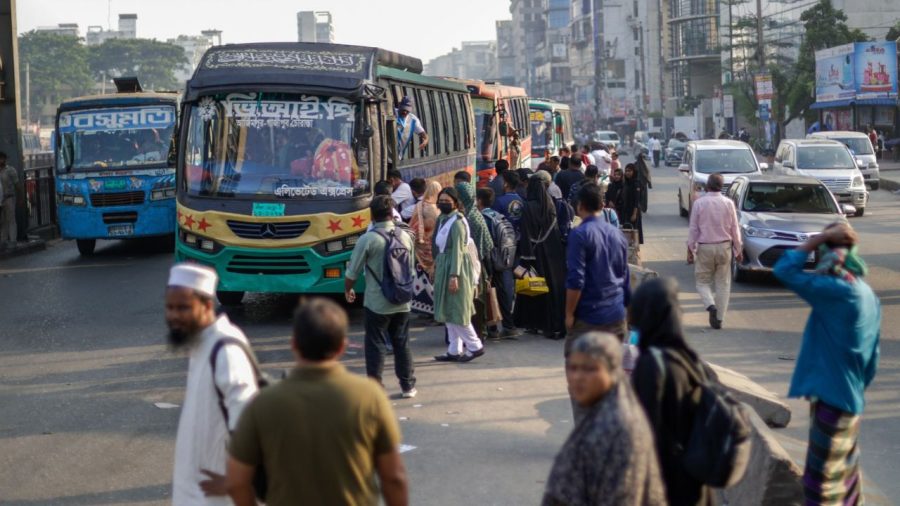
Passengers boarding wherever they please, drivers idling at stops while conductors shout for extra passengers, and buses racing side-by-side to block competing traffic have long been familiar sources of urban misery.

Against this backdrop, a high-level meeting chaired by Prime Minister Tarique Rahman on 8 October directed authorities to launch franchise-based services on two key routes within seven working days, alongside a broader directive to finalise franchises for 32 routes within two months.
Although passenger shelters exist in parts of the capital, many are unusable or illegally occupied.
In Merul Badda, buses routinely bypass designated shelters altogether. “We have to run a short distance ahead of the shelter to catch a bus,” commuter Mahathir Islam told TIMES. “Traffic police occasionally issue fines, but local drivers keep picking up passengers the same way.”
In other areas, such as Kalabagan, hawkers and temporary stalls have illegally encroached upon shelters. “Buses never stop at the designated point,” said commuter Md Rafiqul Islam. “They stop 20 or 30 yards ahead, causing everyone to sprint. Building new stops is pointless unless drivers are actually forced to use them.”




Boarding a bus in Dhaka remains an ordeal of sheer physical force. During the morning rush, drivers rarely stop fully, forcing commuters to scramble aboard amidst aggressive pushing.
At Farmgate, 65-year-old Mozammel Islam described suffering a severe leg injury after slipping while trying to board a moving vehicle. “I am frightened of catching buses now,” he said. “What if I fall and crack my head open?”
Md Aslam Uddin, Manager at the Dhaka Transport Coordination Authority (DTCA), assured that a finalised list of stops would be sent to city corporations before the new routes launch, with municipal authorities tasked with clearing encroachments and installing proper signage.
However, Md Saiful Alam, general secretary of the Dhaka Road Transport Owners Association, argued that commuters also bear responsibility, noting that passengers must break the habit of hailing buses from non-designated spots.
Private operators return despite past collapse
Dhaka’s first attempt to introduce a franchise-based bus network began in 2015, culminating in the launch of Dhaka Nagar Paribahan in December 2021 on the Ghatarchar–Kanchpur route.
Two additional routes followed in 2022. The ambitious scheme aimed to rationalise over 400 chaotic routes into 42, operated by 22 consolidated private entities alongside the state-owned Bangladesh Road Transport Corporation (BRTC).
However, the service collapsed after all participating private operators withdrew their buses, citing severe financial losses.
Transport expert Professor Moazzem Hossain told TIMES that a revived franchise model remains doomed to fail unless the state assumes full control. “If the government does not take complete control of the system, the chances of success are slim,” he warned, urging the government to bolster the BRTC with at least 2,000 new buses to make it the primary operator.
Despite past failures, authorities are once again partnering with private operators to consolidate Dhaka’s current 98 routes into 32.
Md Aslam Uddin, Manager at the Dhaka Transport Coordination Authority (DTCA), defended the strategy, asserting that “this time, the bus owners’ association is co-operating.”
Saiful Alam of the Dhaka Road Transport Owners Association explained that the plan will launch on a trial basis by merging competing operators under single route banners. “Bringing these companies together will eliminate dangerous racing for passengers,” Alam noted.
Addressing concerns over financial viability, Alam emphasised that drivers will now be placed on fixed monthly salaries. Under the new model, revenue generated along each route will be pooled centrally and distributed among participating companies using a predetermined formula. “This prevents drivers from aggressively competing for fares and ensures fair earnings across all operators,” he said.