


The Special Committee on Constitutional Amendment has discussed introducing alternative methods to a two-thirds parliamentary majority for amending the constitution, clarifying judicial jurisdiction, and bringing certain fundamental principles of state policy under fundamental rights.
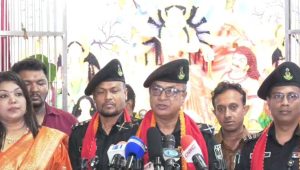
Participating teachers and constitutional experts gave opinions on the caretaker government system’s formation process, representation in the upper house, and further clarifying public sovereignty, Home Minister Salahuddin Ahmed told journalists following a meeting on Tuesday.
Salahuddin said discussants gave opinions on necessary changes across various parts of the constitution and on topics not included in the July National Charter that should be considered.
He added that many submitted written opinions, whilst others promised to submit theirs within the next two weeks.
Judicial jurisdiction and state principles
On constitutional amendment methods, Salahuddin said views were given on whether alternative methods could be introduced alongside the provisions in Article 142 of the current constitution.

He explained that a balance is needed in the amendment process so that it becomes neither excessively rigid nor overly flexible.
The meeting also covered judicial powers and independence. The home minister said discussants gave opinions on clarifying judicial jurisdiction regarding constitutional interpretation and the basic structure of the constitution.
He noted the necessity of ensuring judicial independence while preventing one organ of the state from dominating another.




Discussants noted that certain principles of state policy are not court-enforceable, leading to discussions on whether some of these could be brought under fundamental rights considering state capacity.
A proposal was also made to further clarify the concept of people’s sovereignty in Article 7 of the constitution.
Caretaker mechanism and upper house
Regarding the caretaker government system, the home minister said no specific proposal regarding its structure and mechanism has been received yet.
He said discussants opined that if consensus is not reached on alternative options for forming a caretaker government, keeping the judicial option as a last resort should be considered.
On forming an upper house, Salahuddin said discussants offered opinions on which classes should be represented, how representatives would be elected, and whether the upper house should be formed through proportional representation or in proportion to lower house seats.
He added that the committee will review these opinions and compile the proposals into a booklet.
Opposition invited to consensus process
Addressing a question on Professor Ali Riaz’s criticism regarding the absence of opposition parties in the constitutional amendment process, Salahuddin said the entire formulation process of the July National Charter took place through discussions of the Consensus Commission.
He said the opposition has been invited to join the special committee, adding, “We want them to come to the discussion and together, with all government parties, opposition parties, and everyone, accept this amendment unitedly through consensus.”
The home minister said the constitutional amendment process will proceed even if the opposition does not participate, noting, “Implementing the July Charter is our commitment; we cannot wait.”
He added that the opportunity for the opposition to submit written opinions remains open, expressing hope that they will participate in discussions after the amendment bill is introduced in parliament.