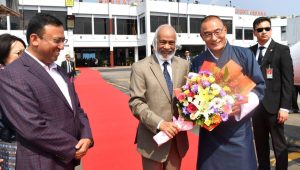
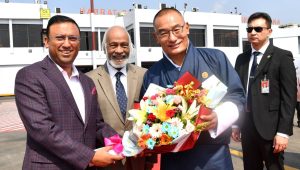
In a move signalling a profound “recalibration” of bilateral ties, Foreign Minister Khalilur Rahman and his Indian counterpart S Jaishankar, are set to share a commercial flight from New Delhi to Mauritius on 9 April.
The decision to travel together on an 8am Air Mauritius flight – a journey lasting seven to eight hours – is being viewed as a significant diplomatic breakthrough, providing the two ministers an extended window for private, high-stakes discussions away from the formal constraints of office, reports BBC Bangla.
This high-profile engagement comes just one and a half months after the BNP-led government, under the leadership of Tarique Rahman, assumed office in Dhaka.
Khalilur is scheduled to arrive in the Indian capital on Tuesday, for his first bilateral visit since the government’s formation.
While the foreign minister will spend less than 48 hours on Indian soil, the shared journey to the 9th Indian Ocean Conference in Mauritius effectively extends the diplomatic mission to a five-day engagement, underscoring the urgency both nations feel in addressing recent “disruptions” and a period of “discomfort and chill.”
A mission of ‘mutual understanding’
Diplomatic sources in Dhaka describe the visit as a “mission for mutual understanding” as both nations seek a “course correction” following the period of the previous interim administration.

The political landscape in Bangladesh has shifted significantly; unlike the BNP administration of two decades ago, the current government does not count Jamaat-e-Islami as a partner. Instead, Jamaat now serves as the chief opposition.
This shift is seen as central to the new diplomatic reality, as Indian observers had previously expressed concerns regarding the influence of certain elements during the interim period.
Preparation for the visit has been intensive. Bangladesh’s High Commissioner to India, Riaz Hamidullah, recently returned to Delhi on 5 April after brief but critical consultations in Dhaka to finalise the agenda.
The importance India accords to this visit is evident, though it remains unconfirmed whether a meeting with Prime Minister Narendra Modi will be scheduled.




Dhaka agenda: Water, border, and trade
On 8 April, Khalilur will engage in a series of crucial meetings with Jaishankar, National Security Adviser Ajit Doval, and Petroleum Minister Hardeep Singh Puri. Dhaka has also requested a separate meeting with Indian Commerce Minister Piyush Goyal, though confirmation is still pending.
From the Bangladesh side, three primary demands will lead the discussions – an end to BSF killings along the border, the initiation of formal talks regarding the renewal of the Ganges Water Sharing Treaty, and the restoration of withdrawn trade facilities.
The trade issue is particularly pressing for Bangladesh’s vital RMG sector. Currently, garment exporters have lost transshipment facilities at Delhi airport, forcing them to use significantly more expensive and time-consuming routes via Dubai or the Maldives.
Besides, land-border trade has faced stagnation for nearly a year and a half. Exporters have been forced to divert goods through the Nhava Sheva sea port in Mumbai, a long and arduous route that has hampered the flow of commerce.
Dhaka is expected to push for the immediate restoration of land-border trade and airport transshipment. Additionally, due to the energy crisis exacerbated by the situation in West Asia, Bangladesh is seeking to purchase additional diesel from India under existing agreements.
Delhi perspective: Connectivity and security
Former Indian Minister of State for External Affairs MJ Akbar, who continues to maintain informal links with Dhaka, noted that both sides now recognise the recent “disruption” in ties served the interests of neither nation.
However, India’s willingness to restore facilities is likely to come with its own set of expectations.
Former Indian High Commissioner to Bangladesh, Pinak Ranjan Chakravarty, suggested that Delhi will push for the resumption of stalled connectivity projects, most notably the Agartala-Akhaura rail link.
India is expected to maintain a firm stance on regional security. While Delhi acknowledges Bangladesh’s right to trade with Pakistan, it will seek categorical assurances that no “strategic space” will be granted to Islamabad – a point on which India is unlikely to compromise.
Regional pivot: BIMSTEC over SAARC?
A significant point of contention remains the direction of regional cooperation. Indian observers, including economist Prabir De, have noted that India expects the new Dhaka administration to prioritise BIMSTEC over attempts to revive SAARC.
Bangladesh currently holds the chair of BIMSTEC, but there is frustration in Delhi that no meetings have been convened by the chair over the past year.
The interim administration’s perceived preference for reviving SAARC was viewed with caution in India. With one year remaining in Bangladesh’s tenure as BIMSTEC chair, Delhi is expected to exert pressure on Dhaka to fulfill its responsibilities and focus on the Bay of Bengal initiative.
A precursor to higher stakes
The visit to Mauritius, where the 9th Indian Ocean Conference is being co-organised by India’s Ministry of External Affairs and the India Foundation – a think-tank led by RSS and BJP leader Ram Madhav – will provide the final backdrop for this high-level “recalibration”.
Ultimately, Khalilur’s trip is seen as a precursor to a potential official visit by Prime Minister Tarique Rahman to India.
While it remains uncertain if India will be the Prime Minister’s first foreign destination, the outcome of these seven hours in the clouds between Delhi and Mauritius will likely determine the future trajectory of the partnership.
As the two nations move to bridge the recent divide, this visit stands as a definitive message that both Dhaka and Delhi are ready to move past the “chilly” diplomatic climate of the recent past.