
Distinguished members of society said former prime minister Khaleda Zia was a national leader who earned a place in the hearts of people across political divides.
They said even after spending long periods in prison and under house arrest, Khaleda Zia, who led BNP for more than four decades, consistently rejected politics of vengeance.
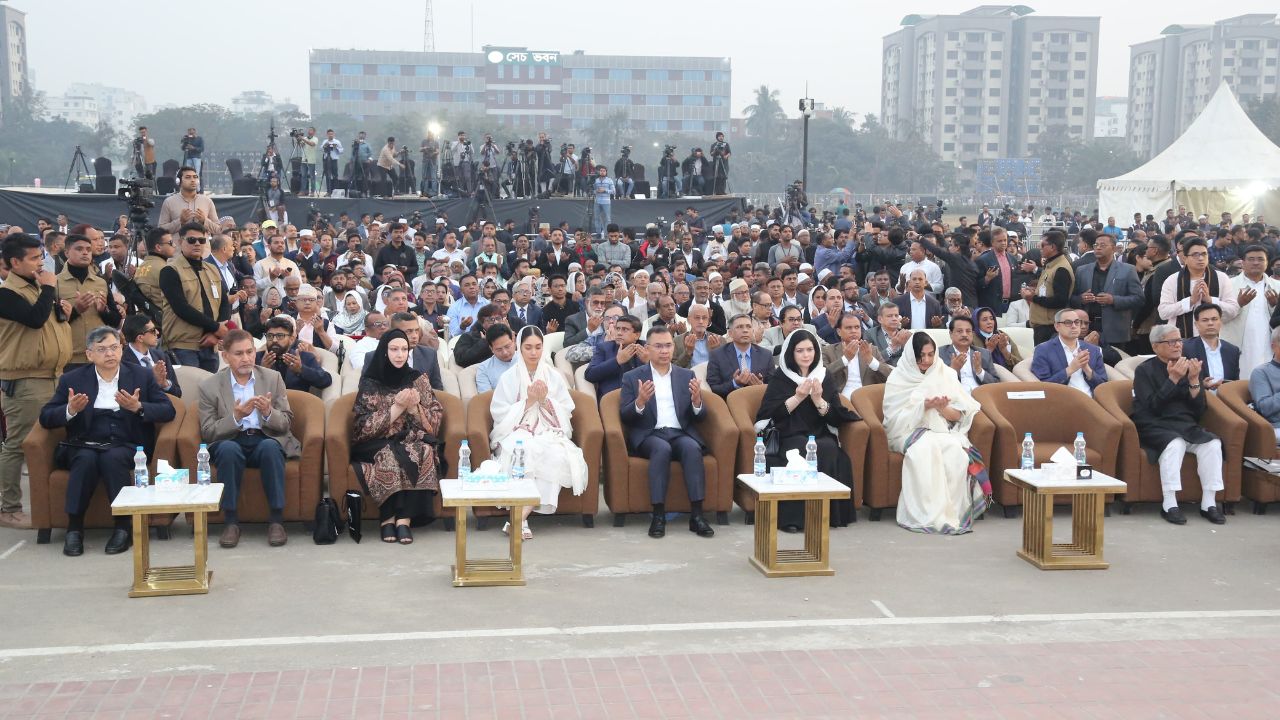
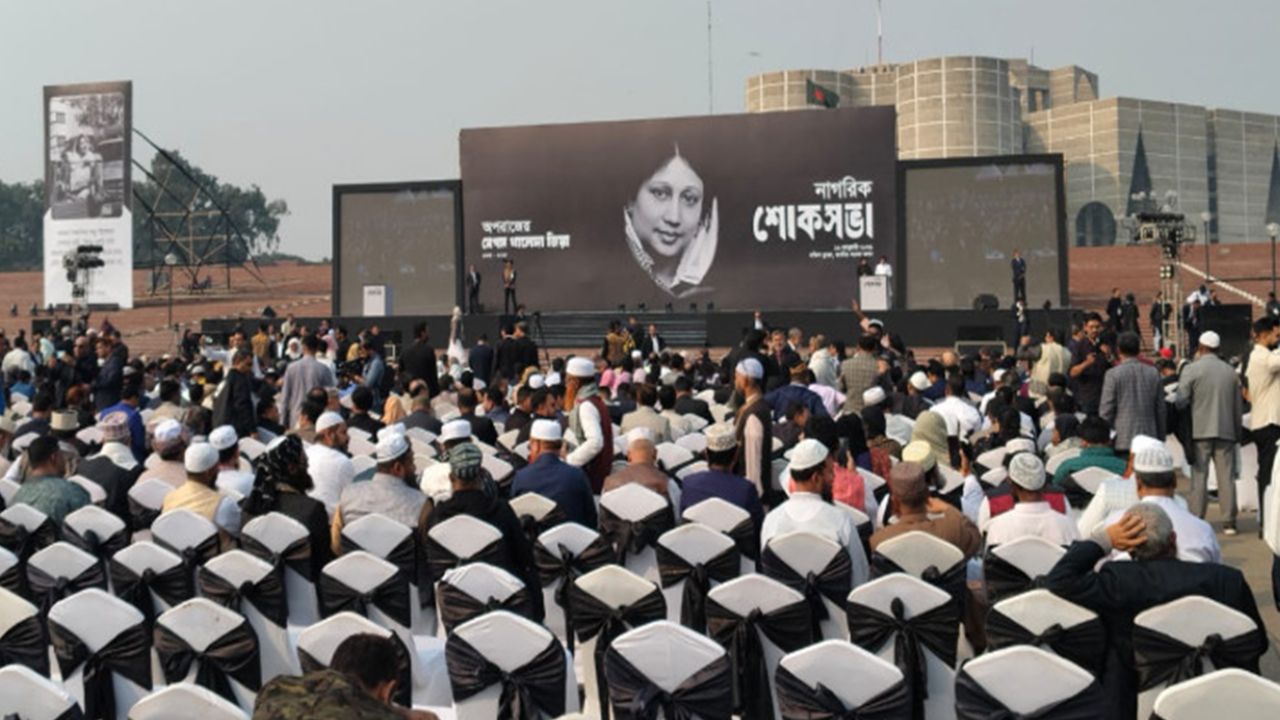
These remarks were made at a citizens’ memorial service organised in her memory on Friday afternoon at the South Plaza of the National Parliament Building. Discussions focused on her political life, personality, democratic ideals, and calls to investigate aspects of her medical treatment during her lifetime.
The programme began shortly after 2:30pm with recitation from the Holy Quran, followed by reading condolence messages. The event was attended by leading political figures, diplomats, journalists, development workers, academics, researchers, editors, businesspeople, and people from various professions.
Among those present were BNP Chairman Tarique Rahman, his wife Zubaida Rahman, daughter Zaima Rahman, Syeda Sharmila Rahman, wife of Khaleda Zia’s younger son Arafat Rahman Koko, and other family members.

Senior BNP leaders, including members of the party’s standing committee, also attended alongside diplomats from various countries stationed in Bangladesh. Invitations were issued in advance, and entry without an invitation was not permitted.
Jaijaidin Editor Shafik Rehman said participation in the democratic process was essential to transform grief into strength, adding that the memorial service would be meaningful only if people expressed their respect through voting.

Daily Star Editor Mahfuz Anam said Khaleda Zia’s tolerance of independent journalism and her ability to accept criticism had deeply inspired him.
He said despite prolonged imprisonment and house arrest, she continued to reject politics of vengeance, reiterating her message of “no destruction, no revenge.” Mahfuz Anam said her final call was to build a knowledge-based society, on which Bangladesh’s future success would depend.
New Age Editor Nurul Kabir said Khaleda Zia never resorted to vindictive public remarks even in the face of severe political repression. He said that at a time when political culture was marked by a lack of restraint, he had seen her maintain composure despite personal attacks.
Amar Desh Editor Mahmudur Rahman said Khaleda Zia remained in people’s hearts even when out of power, which was reflected in the spontaneous public grief at her funeral.




Khaleda Zia’s chief physician Professor Dr FM Siddiqui raised serious allegations regarding her medical treatment, saying many had questioned whether she had been subjected to slow poisoning.
He said the drug methotrexate accelerated the progression of her fatty liver disease into cirrhosis and, in effect, acted like a “slow poison.”
He alleged that negligence in treatment led to rapid deterioration of her liver function, describing it as “intentional negligence,” and called for an investigation into whether this was part of a deliberate plan.
Dr Siddiqui also cited negligence in treating her diabetes and arthritis and demanded a high-power investigation committee, seizure of medical records, and scrutiny of the government medical board’s role.
Writer and researcher Mohiuddin Ahmed said Khaleda Zia’s political life could be divided into three phases – rise, governance, and resistance to repression.
He said she was Bangladesh’s first prime minister elected through a free and fair election, a record that remains intact. Describing her character, he said she embodied elegance, a rare quality in politics.
He referred to her video message on 7 August 2024, delivered after her release, in which she urged the country to move away from politics of vengeance, saying this message pointed towards the need for political reconciliation.
Economist Debapriya Bhattacharya said Khaleda Zia was an attentive listener and a pragmatic decision-maker who balanced technical advice with national realities and global considerations.
He said the decision during the last BNP government not to export gas was a policy milestone, noting that she had taken seriously the argument that Bangladesh should reserve gas for future generations.
Speakers at the memorial service agreed that Khaleda Zia’s life, struggle, and ideals would remain a significant chapter in Bangladesh’s democratic history.
Others who spoke included former chief justice Syed JR Modachchhir Husain, Law, Justice and Parliamentary Affairs Adviser Asif Nazrul, Professor Mahbub Ullah, Faham Abdus Salam, Puja Udjapan Parishad President Basudeb Dhar, Debashish Roy, ICCB President Mahbubur Rahman, DPI President Abdus Sattar Dulal, former diplomat Anwar Hashim, ICC Bangladesh Executive Committee member and Transcom Group CEO Simin Rahman, UGC Chairman SM A Fayez, and researcher Rashed Al Mahmud Titumir.
Condolence messages were read by Ittefaq Executive Editor Saleh Uddin. The programme concluded around 5:30pm with prayers and munajat.
BNP leaders attending included Secretary General Mirza Fakhrul Islam Alamgir, Standing Committee members Nazrul Islam Khan, Abdul Moyeen Khan, Mirza Abbas, Selima Rahman, Salahuddin Ahmed, AZM Zahid Hossain, Security Adviser Major General (retd) Fazle Elahi Akbar, Chairman’s Adviser Mahdi Amin, and other senior leaders.
Security at the venue involved members of the army, police, Rapid Action Battalion, Border Guard Bangladesh, Coast Guard, Ansar, and intelligence agencies. Security measures were strengthened as attendance increased, while BNP leaders and activists managed discipline at the venue.
Khaleda Zia died on the morning of 30 December while undergoing treatment at Evercare Hospital in Bashundhara.
Her funeral was held the following day at the South Plaza of the National Parliament Building with the participation of hundreds of thousands of mourners, after which she was buried beside the grave of the late president Ziaur Rahman at Chandrima Udyan.