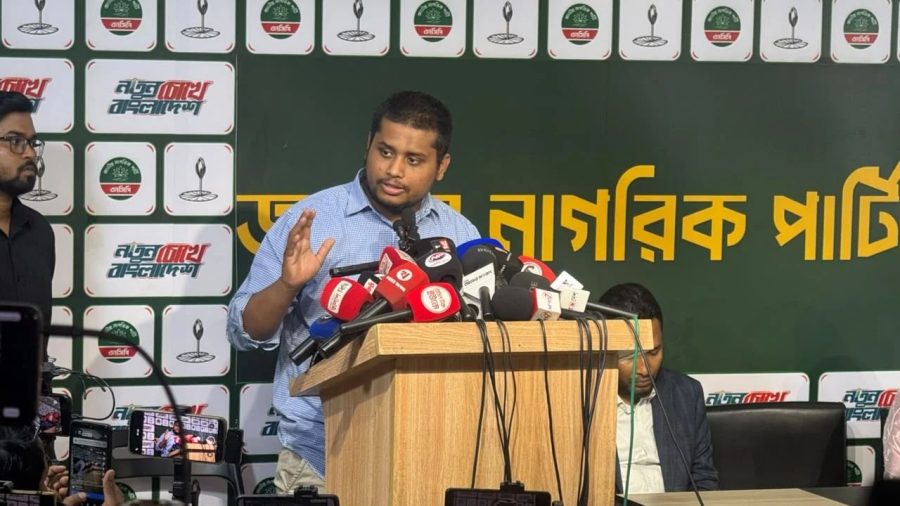



NCP southern region chief organiser and lawmaker Hasnat Abdullah has alleged that there has been no visible progress in the trials over the July killings and that some cases have been used as a means of making money.
He said injured people and families of those killed in the July uprising were facing legal complications, a shortage of witnesses and alleged trading in cases. Promises to provide them with employment and monthly allowances had also remained unfulfilled, he added.
Hasnat made the allegations at a discussion titled “Justice for the July killings: The gap between political promises and reality” at the NCP central office in Rupayan Tower, Banglamotor, Dhaka, on Tuesday. The party’s July Killing Trial Monitoring Cell organised the event.
Addressing the government, Hasnat said the trial process had become a mere formality for the authorities.
“How will the government ensure justice? The BNP speaks of July but remains sympathetic to the Awami League,” he said.
Hasnat alleged that some BNP leaders had used cases related to the July killings as a means of making money. He claimed that cases were filed against 200 to 250 people without consulting the victims, and that some of those cases were later settled in exchange for money.
He said the alleged practice had raised questions about the credibility of the cases while benefiting those involved.
The NCP leader also alleged that the current law minister had secured bail for a leader linked to the Awami League in his constituency before the election to ensure his own electoral victory.
“This is more or less the picture across Bangladesh,” he said.

Dividing BNP leaders into two groups, Hasnat said one group had been with the party for a long time and faced imprisonment, persecution and legal cases, while another group joined the BNP or began identifying themselves as party leaders after 5 August.
He alleged that some leaders from both groups had engaged in profiteering through cases related to the July killings.
Hasnat also questioned the government’s promise to create jobs.
He said that, against a pledge to create one crore jobs, claims were being made that around 30 lakh jobs had been created through activities centred on markets and various stations.
He also criticised the presentation of jobs created by setting up canteens and shops on university campuses, reportedly providing 10,000 to 15,000 jobs for educated young people, as well as fertiliser dealerships awarded to family members of lawmakers, as examples of employment generation.




Hasnat alleged that cases filed at police stations had also become a source of “employment” for some BNP leaders. He said the opportunity would end if charge sheets were submitted.
He further alleged that some BNP leaders maintained secret financial ties with the Awami League. Businesses associated with the Awami League, including S Alam, were being rehabilitated, he claimed.
He also alleged that business activities at the union level and in government contracting were being conducted in the names of the sons of people who returned from abroad after 5 August and later became ministers.
Referring to an attack on former interim government Chief Adviser Professor Muhammad Yunus, Hasnat said the interim government had shown leniency towards the Awami League. In contrast, he alleged that the current BNP government had failed to ensure the security of people who supported the July uprising.
Calls for accountability over July massacre
Hasnat expressed frustration over progress in the July killings trials, saying most of those convicted were absconding. He also claimed that little progress had been made in enforcing verdicts against convicted individuals who remained in the country.
He said accountability for the July killings should not be limited to determining individual responsibility but should also establish the responsibility of the Awami League as a political party.
Hasnat alleged that the Awami League had yet to acknowledge its crimes. He said acknowledging wrongdoing, pledging not to repeat it and changing behaviour were necessary steps towards atonement.
Comparing the BNP government to an unroadworthy vehicle, Hasnat said Tarique Rahman had been put behind the wheel of a vehicle whose wheels, engine and steering were faulty.
He said an accident was inevitable even with a skilled driver if those parts were not functioning properly.
On the economy, Hasnat said revenue collection had fallen far short of the target, while remittance and foreign investment remained below expectations and the country was facing an energy crisis. He also alleged that various sections of the government had become centres of business interests.
Addressing BNP grassroots leaders and activists, Hasnat urged them not to ruin their lives through blind loyalty to party leaders.
He alleged that family members of lawmakers were receiving fertiliser dealerships, while party activists who had faced persecution for 17 years were not receiving the benefits they had expected.
He called on BNP leaders to prioritise public expectations over power and business interests.
At the discussion, NCP Joint Member Secretary and lawmaker Abdullah Al Amin said the government had made no visible progress in ensuring justice for the July killings or bringing convicted fugitives living abroad back to the country.
“At this moment, it seems that justice for the July killings has become a mere formality for the state machinery,” he said.
Abdullah Al Amin alleged that some accused individuals were receiving political protection. He also pointed to inconsistencies between the BNP’s statements and actions regarding extortion.
Referring to the resignation of former reserved-seat lawmaker Ferdousi Ahmed Misty following an attack in Radda, he questioned why her resignation was being presented as action against her instead of taking legal measures.
Abdullah Al Amin said that suffering persecution for 17 years did not give anyone the right to engage in extortion, land grabbing or other wrongdoing after coming to power.
He warned that if the BNP continued along the same path as before, disregarding people’s desire for change, the consequences would backfire on the party itself.
Pointing to a lack of coordination among different branches of the government, he said, “There is no synchronisation among the different branches of the government. Naturally, people are feeling that things cannot continue this way.”
He urged the BNP to take a clear position on individuals involved in crimes committed under the Awami League, stressing that action should be taken against those involved in the massacre and violence without harassing innocent people.