





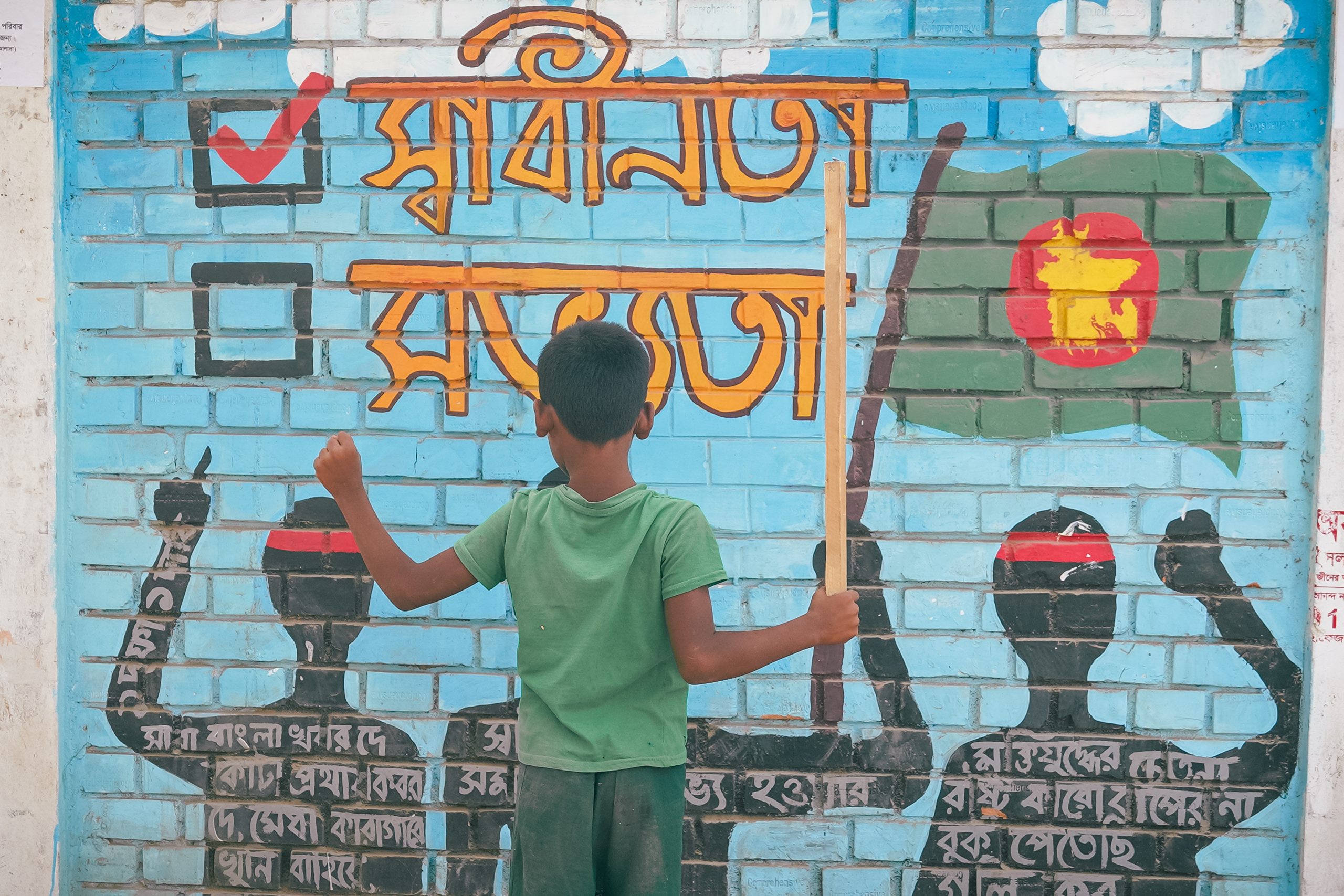
Gunfire would not cease that afternoon in Rampura, Dhaka. Street corners were shrouded in smoke, and students were running for cover. Tahzeeb Sporsho, a 24-year-old student at the University of Dhaka, stood shielding his friend Swadhin.
Within seconds, bullets struck his back and arm. No ambulance was available. Bleeding heavily, he climbed onto a truck himself and reached Dhaka Medical College Hospital with other injured students.
Sporsho has not since joined any political party or movement under any banner. In his words, “At that time it was not about politics, it was simply about trying to save people.”
In July 2024, protests by university students against the reinstatement of the quota system in government jobs rapidly turned into a nationwide mass uprising.
What began as campus-based demonstrations spread through coordination on social media, linking public anger over government crackdowns with parents and cross sections of the society. Under sustained pressure from the countrywide movement, the then prime minister Sheikh Hasina resigned.
The cost of the uprising was severe. A report published in August by the UN Human Rights Office stated that more than 600 people were killed in violence between 16 July and 11 August 2024. At least 32 children and four journalists were among the dead.
The report noted that the actual number of casualties could be higher. A draft government list included 708 people killed in July and August as “martyrs”.
Reacting to the BNP’s victory in 210 seats in the 13th parliamentary election, Sporsho said the result reflected “the people’s trust and the numerical strength of pro-Bangladesh voters”. He warned, however, that the winning party and its activists must now maintain law and order and avoid politics of revenge.
Expressing concern over reports of arson in various areas, he said, “What we need now is not grand declarations of development, but steady and planned progress, step by step.”
During the July movement, BRAC University became an important centre for organising students from private universities. One of the organisers there, Md Faisal Mahfuz, told Times of Bangladesh that although he does not support any political party, he backs specific candidates based on his own judgement.
He believes that the spread of misinformation on social media in recent times has fuelled mob tendencies in various places. “The lack of civic self-education is confusing people towards both left- and right-wing political extremism,” he said.
He hopes the new BNP government will create an environment for civic education through reform of social institutions.
On the question of the rule of law, Faisal spoke firmly: “In Bangladesh’s political structure, the law must not become a tool captured by any party. When in power, parties use it as their own instrument. Breaking away from this practice will be the new government’s greatest test.”
Sami Hossain, a student at the University of Liberal Arts Bangladesh, expressed similar concerns. He wants strict action against those who used the name of “July” for political gain to spread violence or misinformation. At the same time, he emphasised freedom of expression.
Mohammad Ferdous Islam, who took part in the July movement at Sadhur Mor in Rajshahi, told Times that people now want to see tangible results, not empty promises.
Development, he said, must not be confined to a single party or group, but ensured equally for all citizens. He, too, did not join any political banner after the July movement.
Rima Roy, who took part in the movement but is not affiliated with any political party, shared her expectations of the new government.
Having recently graduated from North South University in Dhaka and now working in the marketing department of a private firm, she said uncontrolled price rises in essential goods have become the greatest pressure on the middle class and young professionals.
She stressed the need for effective market oversight and visible, impartial action against corruption.
One of the most powerful symbolic moments of the movement came on 17 July. When students were ordered to vacate their halls, Nusrat Jahan Nisu questioned the provost of Bangladesh Kuwait Maitree Hall, asking, “Madam, is this 1971? Is this an independent country?”
Nisu insists that all those responsible for the killings during the July mass uprising and afterwards must be brought to justice. She urged moving the country forward on a secular and non-discriminatory path and emphasised recognising minorities, women and indigenous communities not as vote banks but as full citizens.
According to official statistics from 2022, around 28 per cent of Bangladesh’s population is aged between 15 and 29. This young demographic was the driving force behind the July movement. Analysts describe it as the world’s first successful “Gen Z revolution”, marking a fundamental shift in Bangladesh’s political landscape.
Most of the young people who took part in the movement are still not affiliated with any political party. They describe themselves as citizens who took to the streets not merely to change those in power, but to change the way the country is governed.
Recalling that afternoon in Rampura, Tahzeeb Sporsho said, “July taught us to overcome fear. Now it is the new government’s responsibility to prove that this country truly belongs to everyone, and that power does not mean impunity.”


