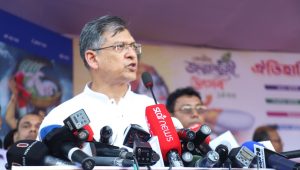
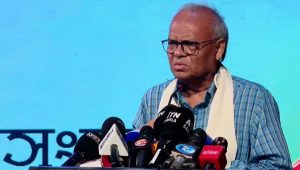
Jamaat-e-Islami Secretary General Mia Golam Parwar has strongly criticised the government’s decision to introduce online classes three days a week in schools and colleges across all metropolitan areas, calling it “unplanned and self-destructive”.
In a statement issued on Thursday, he said the decision, taken at a coordination meeting at the Secretariat on 31 March, was “unfortunate and short-sighted”.
He alleged that the government was using the energy crisis as an excuse to impose online classes on young students, describing it as part of a “deep conspiracy” to weaken the nation’s intellectual capacity.
Parwar said, “An online-based education system exposes students to multiple risks. High internet costs could force many poor students out of education. Easy access to smartphones during online classes may also lead to device addiction and moral degradation among young learners.”

He added that the lack of classroom-based learning disrupts students’ study habits.
“Introducing an online-dependent education system in such a situation means knowingly destroying students’ academic lives,” he said.
Referring to the Covid-19 period, Parwar said the impact of online education on Bangladeshi students had already been highlighted in the National Student Assessment 2022 report.




The report showed that primary students failed to achieve grade-appropriate competencies in Bangla and mathematics. Students from poorer and remote regions, such as Mymensingh, lagged far behind those from relatively affluent areas.
He also cited surveys by UNICEF and other organisations, which found that school dropout rates and child labour both increased during the period of online classes.
Parwar said “The education sector has yet to recover from the damage caused during the pandemic.”
He pointed to the attempt to implement a new curriculum in 2023 without proper planning, as well as uncertainty in educational institutions during and after the July movement, and the absence of meaningful reform efforts.
“At a time when comprehensive reforms are most needed, returning to online classes will not benefit students,” Parwar said.
He further argued that citing an energy crisis to justify such a decision is unacceptable.
“If there is truly an energy shortage, why is the burden placed on students while other sectors, including luxury consumption, continue as usual?” he questioned.
Parwar urged the government to prioritise the education sector and take effective and responsible measures.
He called for the immediate withdrawal of the decision and demanded the continuation of regular in-person classes for all students.