Israel’s Prime Minister Benjamin Netanyahu and Foreign Minister Gideon Sa’ar have signalled their inability to topple the Iranian regime of the Ayatollahs. Indicating the lack of a well-thought-out strategy, the US–Israeli camp has been changing its goals in quick succession. Shifting the goalposts in this manner is a sign of confusion and an impending defeat.
This is not an unusual scenario because America has the unenviable reputation of losing major wars, as in Korea, Vietnam and Afghanistan.
The initial goal of the US–Israel line-up was to crush Iran’s nuclear bomb ambitions. But when this was not achieved, the goal was changed to toppling the Ayatollahs’ regime by military force. Within two weeks of the military campaign, however, it became clear that the goal was unachievable, and the goalpost was shifted to motivating the Iranian people to overthrow the Ayatollahs themselves.
Though he promised to end the war successfully within two weeks, US President Donald Trump has now given himself four to six weeks. He has also initiated a call to Russian President Vladimir Putin to seek his cooperation and is due to travel to Beijing to persuade Xi Jinping not to support Iran.
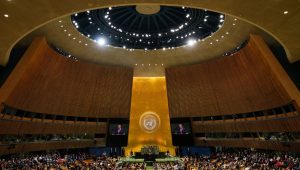
Even as Trump and Netanyahu began seeking outside support – which they had earlier thought they could do without – the Iranians appeared unfazed by the United Nations vote against them and have remained steadfast in refusing to surrender to what they describe as foreign bullies.
The new regime led by Ayatollah Khamenei’s son, Mojtaba Khamenei, has declared its resolve not to end the war on US–Israeli terms. It has stated its conditions: a cessation of hostilities, the closure of US bases in the neighbourhood, the payment of reparations for the damage caused, and firm guarantees of Iran’s security.

Statements of Sa’ar and Netanyahu
Foreign Minister Gideon Sa’ar admitted to The Times of Israel on Wednesday: “Ultimately, we cannot topple the regime; only the Iranian people can. But at the same time, we must say that without external assistance they have no chance of toppling the regime. Regime change may be a consequence of the operation; it does not necessarily have to be part of the military campaign itself.”
Netanyahu said that he did not know if the Iranian people would oust their regime. Sounding cautious, he told the media: “You can lead someone to water, but you cannot make him drink.”
“But we will create optimal conditions to do this, including air strikes as we did yesterday and as we are doing these days, to try to give the Iranian people the space needed to take to the streets. I cannot say for certain that the Iranian people will bring down the regime. We are all hoping for the result of this regime falling. Ultimately, a regime is ousted from within,” Netanyahu said.
However, Netanyahu drew comfort from the fact that Ayatollah Khamenei’s successor, Mojtaba Khamenei, had not been able to “show his face in public”. Israel, he added, had “many surprises” up its sleeve in the war, which he claimed was “going better than expected”. Several countries were uniting with Israel against Iran, both covertly and in “other ways that will become clear later”, Netanyahu said.




Asked whether Israel would go after Khamenei’s son and successor Mojtaba Khamenei, Netanyahu replied: “I wouldn’t take out a life insurance policy on any of the leaders of the terrorist organisations.” He dismissed the younger Khamenei as a “puppet” of Iran’s Revolutionary Guard Corps.
Foreign Minister Sa’ar claimed success in terms of “a dramatic weakening of the Iranian regime’s mechanisms of repression”. He said Israel was striking the Islamic Revolutionary Guard Corps’ bases, headquarters and command-and-control sites.
“By the end of the campaign they will be sufficiently weakened, and then perhaps it will be possible for the Iranian people to carry out a change of regime,” Sa’ar said.
Despite the rhetoric of Netanyahu and Sa’ar, it has been reported that Israeli government ministers, following a security briefing, believe the fall of Iran’s regime could take up to a year. Sa’ar himself said: “Usually such things as the fall of a regime happen after the military campaign, not during the war.”
Growing opposition in the US
Meanwhile, opposition to the war is gaining ground in the United States. Polls reveal that 75 per cent of Americans are not in favour of it. Even Senator Lindsey Graham, a hawkish Republican ally of Trump who had urged war on Iran for years, has called on Israel to be cautious about its targets.
American congressmen estimate that the first six days of the war have cost taxpayers at least US$8 billion, driven largely by expensive munitions. Daily operations in and around Iran for these major military systems are costing taxpayers an estimated US$59.39 million per day.
That US$59.39 million a day could instead cover the daily costs of Medicaid for more than four million Americans, or SNAP (food stamps) for more than 9.5 million Americans.
US rights groups protest
More than 250 organisations have signed a joint letter calling on the US Congress to cease funding for the war, arguing that billions of dollars are being diverted from urgent domestic needs, reports Al Jazeera. The coalition warned that further financial support for the military would only exacerbate the conflict.
“More money for the Pentagon will serve to extend and escalate an illegal, unpopular and devastating war – as well as pave the way for still more Pentagon funding requests,” said Robert Weissman, co-president of Public Citizen.
Highlighting the domestic impact of the military expenditure, Weissman noted that the US$11.3 billion spent during just the first six days of the war would have been sufficient to restore food benefits to four million people.
The signatories of the letter represent a broad range of interests, including the American Civil Liberties Union, Oxfam America, National Nurses United and the Council on American-Islamic Relations. Other prominent groups joining the call include the Union of Concerned Scientists, J Street, Greenpeace, Friends of the Earth, Indivisible and Jewish Voice for Peace.
Heavy US debt: RAND Corporation
Trump should be aware that the US has a national debt of US$38 trillion. The RAND Corporation says that to service this debt the US spends US$1.1 trillion each year on interest payments. This is more than what the US spends annually on defence or on the combined total of all non-defence discretionary spending such as education, law enforcement and scientific research.
“Nearly one-fourth of those interest payments flow to foreign countries, including China, to build their economies rather than our own,” RAND said.
Netanyahu faces internal crisis
In Israel, Netanyahu is currently on trial on charges of bribery, fraud and breach of trust in three separate cases involving the receipt of illicit gifts and trading political favours for positive media coverage.
Trump has repeatedly criticised President Isaac Herzog for not pardoning Netanyahu and used harsh language against the Israeli president, including calling him “weak and pathetic” in an interview on Wednesday.
But Herzog has rejected calls for clemency, saying Israel is a sovereign state whose internal affairs will not be decided by Washington. Netanyahu’s critics have accused him of getting Trump to pressure Herzog for a pardon.