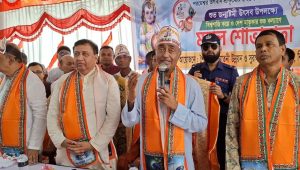
The swelling wave of public anger first swept through the island nation of Sri Lanka in 2022, ousting the president. Two years later, it erupted in Bangladesh, as protesters toppled the ruling government. On Monday, public fury exploded in Nepal, forcing its prime minister to resign the following day.
Each protest movement began with a specific grievance that flared up, ultimately resulting in the rejection of the government or its leaders, reports AP/UNB.
In many ways, these protest movements share a common feature: disillusioned populations’ resentment against the ruling elite and an entrenched political system, which they hold responsible for rampant corruption, deepening inequality, and economic disparities.
According to the Associated Press, often led by young people, the protests have sparked deadly violence and, at times, left a political vacuum filled by unelected leaders, worsening law and order.
“A perception of ruling elites as being both corrupt and ineffective at delivering a plausible path forward has created a structural basis for major crises,” said Paul Staniland, a politics professor specialising in South Asia at the University of Chicago.
Nepal’s public fury is largely against the political elite
The youth-led protests in Nepal began on Monday, igniting long-simmering discontent over years of grievances. The immediate trigger was the government’s ban on major social media platforms.

Many protesters were particularly angry that the children of political leaders seemed to enjoy a lavish lifestyle, while most of the population struggled with economic problems, rising unemployment, and widespread corruption.
The unrest has left at least 19 people dead.
Protesters – who have not clearly outlined their demands beyond rallying under an anti-corruption banner – burned the parliament building, the presidential palace, and residences of several ministers and other politicians.
Bowing to mounting public pressure, Prime Minister Khadga Prasad Oli reversed the social media ban and resigned. However, he will continue to lead a caretaker government until a new one is formed.
It is unclear what the new government will look like, or whether it will include the old political guard. Many Nepalis fear a familiar cycle of bargaining among the same political class they wish to overthrow.


Nepal has experienced frequent political instability, and each prime minister’s tenure has lasted just a year or two since the new constitution came into effect in 2015. The country abolished its monarchy in 2006, following a violent uprising that forced the former king to relinquish authoritarian rule.
Staniland said the violence could make it “much harder to determine who should be in charge or how they should proceed.”
“The big question now in Nepal will be whether order can be restored and a new, stable political dispensation forged,” he added.
Before Nepal, there was Bangladesh and Sri Lanka
Those in Nepal seeking answers about the country’s future will not find solace in Bangladesh and Sri Lanka.
A lack of consensus on basic reform demands, such as elections and anti-corruption mechanisms, along with an uncertain roadmap for the future, has dented democratic progress in both countries and exacerbated the problems they face.
In Bangladesh, student-led protests began as anger against rules limiting the number of civil service jobs based on merit. They escalated into a massive nationwide uprising in July last year, culminating in the ousting of Prime Minister Sheikh Hasina. Hundreds of people, mostly students, were killed in violent protests.
Hasina fled to India, and an unelected interim administration, headed by Nobel laureate Muhammad Yunus, was installed. He promised to restore order and hold a new election after necessary reforms.
One year on, Bangladesh remains mired in instability. Political parties continue to bicker over election dates. Mob violence, political attacks on rival parties and groups, and hostility towards vulnerable minority communities by religious hardliners have surged.
In Sri Lanka, then-Prime Minister Ranil Wickremesinghe took over the country after protesters forced the powerful Rajapaksa clan out in 2022. The country later experienced a democratic transition of power when Marxist lawmaker Anura Kumara Dissanayake was elected president last year. He promised to improve living standards, clean up government, and hold corrupt politicians accountable.
Almost a year later, Sri Lanka’s problems persist. Its people continue to face economic hardship, human rights concerns, and the threat of foreign-debt default.
“There is no sign of the ideals of change desired by the protesters,” said Veeragathy Thanabalasingham, a Colombo-based political expert.
Wider instability in the region
Recent popular revolts have also affected other nations in the region.
In Indonesia, deadly protests last week over lawmakers’ perks and the cost of living forced the country’s president to replace key economic and security ministers. The protests have resulted in at least seven deaths.
In Myanmar, the democratically elected government of imprisoned former leader Aung San Suu Kyi was ousted by the military in 2021. Resistance to the military government has grown, and the country is now in the midst of a brutal civil war.
Staniland noted that while “most protests come and go without such dramatic results” as those seen in Nepal, Sri Lanka, and Bangladesh, “the kindling is there for miscalculations and unexpected events to spiral.”
“I think Nepal represents the new politics of instability in South Asia,” he added.