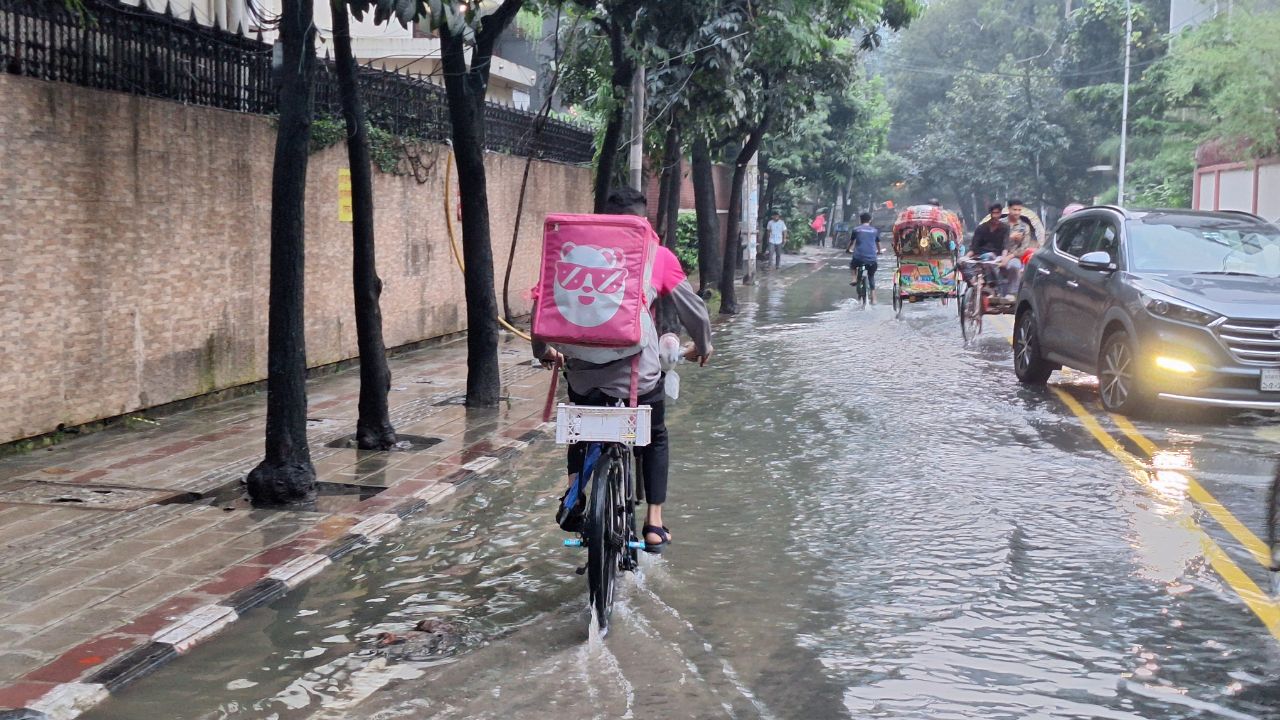



When monsoon rain floods Dhaka’s streets, most people stay indoors. Restaurants see online orders climb, grocery deliveries become more frequent and the familiar pink delivery bags weaving through traffic become more visible.
Behind every order accepted during a downpour is a decision by a delivery rider to log on.
For app-based delivery platforms, the rainy season is a balancing act. Customer demand typically rises as fewer people are willing to travel, but hazardous road conditions and waterlogging also mean fewer riders choose to work. The result is a marketplace where incentives, flexibility and safety become as important as speed.
foodpanda said it has sought to bridge that gap by allowing riders to decide when to work while offering additional incentives during periods of heavy rain.
For Mahedi Hasan, one of its delivery partners in Dhaka, bad weather changes neither the nature of the job nor his motivation.

“I don’t see bad weather as an obstacle. During difficult times, people depend on us more,” he said.
Cycling through rain-soaked streets, Mahedi said the flexibility of app-based work is what attracted him in the first place. He chooses his own working hours, takes breaks when needed and increases his time online when demand rises.
“Rainy days usually mean more delivery requests. If I decide to work, I can earn more while helping customers who cannot easily go outside,” he said.



That flexibility has become one of the defining features of Bangladesh’s rapidly expanding gig economy, where delivery work increasingly attracts students, part-time workers and people seeking supplementary income rather than traditional fixed-hour employment.
Enamul, a college student working in Mohammadpur, said the arrangement allows him to combine education with earning.
“I can organise my work around my class schedule,” he said. “When customers appreciate the effort after a difficult delivery, it makes the work worthwhile.”
For delivery companies, however, maintaining service during extreme weather requires more than simply attracting riders online.
foodpanda said it offers additional rain incentives during adverse weather, while riders receive the full value of customer tips paid through the platform. The company also distributes raincoats and waterproof phone covers and advises riders to prioritise safety over delivery speed.
Operational teams monitor weather conditions throughout the day, adjusting delivery operations as road conditions and rider availability change, according to the company.
The company said rider welfare extends beyond daily incentives. Through its pandahearts programme, foodpanda partners with various organisations throughout the year to provide riders with access to affordable insurance, healthcare packages, educational courses and exclusive discounts on essential gear. Following recent heavy rainfall in Cox’s Bazar, the company also provided assistance for prescribed medicines after medical consultations for affected riders.
The monsoon also highlights how delivery services have become embedded in urban life. During heavy rainfall, platforms typically record stronger demand for meals, groceries and household essentials as commuting becomes more difficult.
For riders, however, each delivery remains an individual choice.
Some decide the weather is too risky and stay offline. Others accept the trade-off between more difficult road conditions and stronger earning opportunities.
That calculation—balancing income, flexibility and personal safety—increasingly defines work in Bangladesh’s platform economy.
Every rainy-day delivery begins with a customer placing an order. Whether it reaches the doorstep depends on another decision made miles away: a rider choosing to head out into the rain.