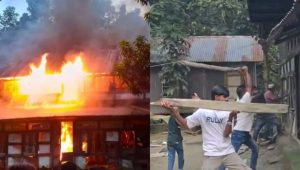
Three female teachers were beaten by parents and relatives of a student for disciplining him at Selim Reza Adarsha Bidyaniketan in Ishwardi, Pabna. One of them was dragged out of the school premises by a headscarf tied around her neck.
In a separate incident, a parent entered a classroom at Charbaria Government Primary School in Barishal and severely beat three Class V students and two teachers. He carried out the attack a few days after an argument had occurred between his child and their classmates. Meanwhile, at Dr Shawkat Ali Bhuiyan High School in Ghatail, Tangail, a Class IX student beat up a teacher during class.
A wave of assaults on teachers by parents, students and mob has turned classrooms into lawless spaces, exposing a collapse of order in the education system.
The trend of aggression against teachers in educational institutions, which escalated throughout the 18-month interim regime following the July 2024 uprising, has not yet stopped despite the elected government having been in power for four months.
Schools are increasingly targeted during class hours by students, parents, local residents, or vested interest groups. Because many of these incidents are isolated, they often fail to make the public debate.
Amid this alarming surge in schoolyard violence, the Bangladesh Primary School Assistant Teachers’ Association has voiced grave concerns over staff safety.
Professor Mohammad Mojibur Rahman of the Institute of Education and Research at Dhaka University told TIMES of Bangladesh, “The perspective from which society and the state view teachers has broken down. Everyone has witnessed how the state handles teachers to suppress their demands for better salaries and allowances. As a direct impact of this, students and parents are now also raising their hands against teachers.”
The educationist believes that this public recklessness is “not an isolated incident.”

“Unrest is spreading through every aspect of society. Social isolation, digital adaptation without prior preparation, and people creating their own bubbles in the virtual world, the impact of all this is bound to be damaging,” he added.
Teachers become easy targets
Locals attacked teachers at Jangal Government Primary School in Akhaura, Brahmanbaria, simply for prohibiting them from drying clothes on the school premises. A video of a female teacher being physically assaulted during the incident has since gone viral.
Khairul Islam Chowdhury, a professor in the Department of Sociology at Dhaka University, told TIMES, “The poor salary structure of primary and secondary teachers, combined with excessive bureaucratic vigilance, has eroded the respect teachers once held in society. That is why they have become easy targets for everyone.”
Amidst this unrest, there is a major push at the local level to reconstitute school managing committees. While there is a provision for three teachers to sit on these 15-member committees, teachers are now being targeted by locals over disputes regarding their formation.
Consequently, teachers’ organisations have long been demanding the enactment of a ‘Teacher Protection Act’ to ensure their safety.




Mohammad Shamsuddin Masud, president of the Bangladesh Primary School Assistant Teachers’ Association, told TIMES, “There has been criticism in parliament over the incident involving drying clothes in schools, yet no justice has been served for the teachers who were attacked merely for enforcing the rules.”
Impunity incites attacks
Following the July uprising, mob attacks on educational institutions surged, manifesting in forced resignations, teachers being bound with shoelaces, women teachers being dragged by their clothes, and physical assaults.
The ‘Unemployed Institutional Heads and Teachers’ Alliance’ reported that six teachers died from strokes or heart attacks following these incidents. In a memorandum to the Ministry of Education, the alliance said that at least 3,500 teachers have fallen victim to mob violence, with over 500 currently ill and living in destitute conditions.
However, the authorities have largely turned a blind eye.
While interim government’s education adviser Wahiduddin Mahmud initially promised action against those responsible, no decisive measures followed.
Eyan Rahman Emon, an associate psychologist at the Centre for Psychological Health, told TIMES, “The trend of youth violence is rising because the criminal justice system lacks fairness. When the surrounding environment is unstable, it inevitably has an impact.”
Questions have also been raised regarding the authorities’ inaction during post-uprising harassment at universities, where teachers faced verbal abuse, harassment, and humiliation. Incidents of teachers being banned from campuses via loudspeakers at Rajshahi University, or being publicly chased, beaten, and dragged at Dhaka and Chittagong universities, went viral online. These attacks were directly led by student union leaders.
Sociologist Khairul Islam Chowdhury told TIMES that along with many teachers accused of Awami League government ties, a number of others remain unable to resume classes. “The government could have resolved this by forming a commission. But there is still no initiative to restore academic stability,” he said.
Noting that the new government has redistributed university responsibilities, he warned. “Are those now appointed truly independent of the party? If not, will they face the same fate in the future? Will this vicious cycle ever end?”
Teachers also responsible
In some instances, evidence has emerged of teachers themselves orchestrating attacks on colleagues.
Under the interim government, certain staff members actively incited mobs and engineered the forced resignations of school and college principals.
Last month, a headteacher was implicated in the physical assault of a colleague.
A group of individuals beat up Akhter Hossain, an assistant teacher at Dakshin Char Aicha Government Primary School in Char Fassion, Bhola, as he walked home after school.
The victim alleged the ambush stemmed from a dispute with the headteacher, Zahidul Islam Yusuf.
TIMES was unable to reach Zahidul for comment. However, the Primary School Assistant Teachers’ Association issued a statement demanding a fair investigation.
The association’s president told TIMES, “Our preliminary investigation confirmed the validity of the claims. It is now up to law enforcement to investigate thoroughly; we can only learn so much from internal staff.”
Educationist Mojibur Rahman told TIMES, “The professional reputation of teachers has been tarnished by a lack of transparency in recruitment, personal irregularities, and a subservience to political factions.”
Similarly, following an assault by a student at Dr Shawkat Ali Bhuiyan High School in Ghatail, Tangail, the injured teacher chose not to return to class on 25 June. Rather than pursuing legal action, the incident was settled through local arbitration.
Alarmingly, it was also alleged that two colleagues threatened the victim on behalf of the attacking student’s guardian, warning her not to overreact.