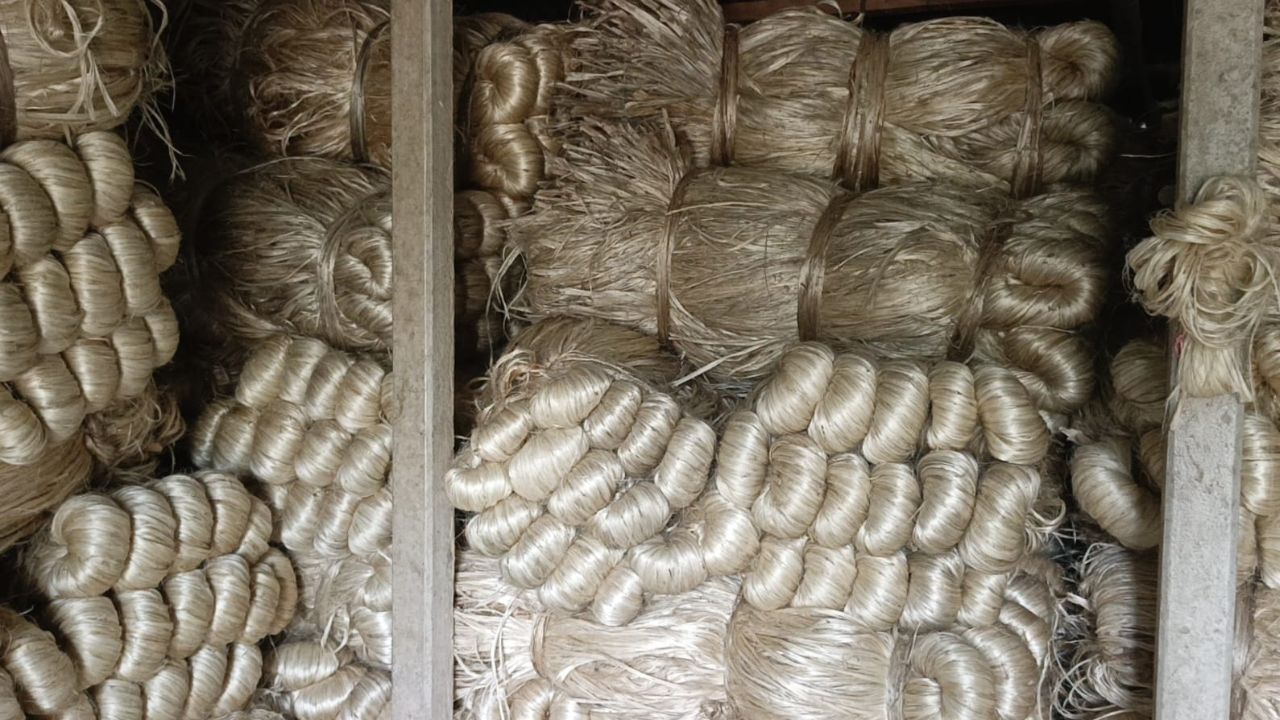



Jute is once again bringing hope to farmers in Sirajganj, where strong yields, high market prices and growing demand have revived interest in the crop after years of concerns over losses.
From fields to local markets, activity surrounding the country’s ‘golden fibre’ is now in full swing. Farmers who had previously turned away from jute cultivation because of low returns are seeing better prospects this season.
At dawn, farmers and workers begin washing and drying jute along canals, rivers and other water bodies across the district. In some places, fibres are being stripped on bamboo rafts, while elsewhere the golden fibre is spread out under the sun to dry. Farmers and labourers are also busy collecting jute sticks and sorting fibres.
Visits to different markets across the district found brisk trading in jute. Supplies are increasing at Porabari, Somospor, Sohagpur, Nalka and Ballampur markets, alongside other local markets. Traders are buying jute directly from farmers and sending it to mills across the country.
Traders said mesta jute is selling for Tk4,600 to Tk4,900 per maund, depending on quality, while tossa and white jute are fetching around Tk3,700 to Tk3,900. Good-quality jute is being sold almost as soon as it reaches the market.

Shah Alam, a jute trader from Porabari in Soydabad Union under Sirajganj Sadar Upazila, said demand for good-quality jute is particularly strong this year.
Whether mesta or tossa, jute arriving at the market is selling quickly, prompting traders to purchase larger quantities, he said.
Traders Md Sanowar Khandakar and Anwar Khandakar said Chaita Bain and Aggur varieties have produced better yields and quality than Namla or Irikata, allowing farmers to secure comparatively higher prices.


Farmers said many had abandoned jute cultivation several years ago because market prices failed to cover production costs. This year, however, better yields and higher prices have renewed their interest in the crop.
Solaiman, a farmer from Dukhiabari village in Sadar Upazila, said he had stopped growing jute after failing to secure reasonable prices but resumed cultivation this year following advice from the agriculture office.
“The plants grew 12 to 14 feet tall. I harvested around 15 maunds per bigha. We are happy with the income after covering production costs,” he said.
According to the Department of Agricultural Extension, different varieties of jute, including tossa, mesta, BARI-1 and Sabuj Sona, have been cultivated on around 14,610 hectares in Sirajganj this season.
Average yields range from 10 to 12 maunds per bigha, rising to as much as 15 maunds on better-quality land. Production costs stand at around Tk12,000 to Tk14,000 per bigha, while jute is currently selling for Tk3,700 to Tk4,900 per maund, depending on variety and quality.
The revival is not only boosting farmers’ incomes but also generating employment in rural areas. Labourers are engaged at every stage — cutting, retting, stripping, washing, drying, sorting and transporting jute. Women are also working in drying and sorting jute fibres and sticks.
Experts said growing global demand for environmentally friendly products offers further potential for the sector. Jute is increasingly used to make bags, carpets, geotextiles and other eco-friendly products, creating opportunities to expand demand both at home and abroad.
AKM Manjure Mawla, deputy director of the Department of Agricultural Extension in Sirajganj, said the use of modern technology, regular advice to farmers and support from the agriculture department had contributed to this year’s strong yields.
Relatively low production costs and good market prices are also increasing farmers’ interest, he said, adding that the department would continue providing the necessary support to sustain jute cultivation.
Farmers hope that fair prices, strong yields and stability in the market will encourage further expansion of jute cultivation in Sirajganj, reviving the district’s traditional golden fibre industry and improving the livelihoods of thousands of farming families.