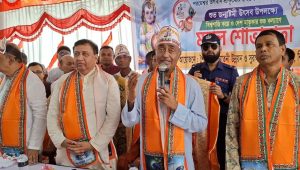
Despite the “realistic” promises made by Islami Chhatra Shibir-backed panel to win over students prior to the Jagannath University Central Students’ Union (JnUCSU) elections, there has been no significant progress in fulfilling them.
Although four months have passed since taking office, the JnUCSU General Secretary Abdul Alim Arif now claims that their work is hindered by a lack of sincerity and cooperation from the government and the university administration.
Before the elections held on 6 January this year, the Shibir-backed “Odommo Jobian Oikko” panel announced a 21-point manifesto. Four months into their term, visible student-friendly initiatives remain scarce, and the fulfilment of their pledges appears a distant prospect.
The manifesto included several commitments that fall outside the typical jurisdiction or capabilities of a students’ union.
These included coordinating with the Bangladesh Army to expedite the construction of the second campus and housing projects in Keraniganj, as well as fast-tracking work on halls in Old Dhaka.
Other pledges focused on improving education and research through the implementation of an international-standard OBE curriculum, modernising classrooms, installing Starlink internet, increasing research grants, enriching laboratories, and organising inter-university research fests and workshops.
The panel also promised to enhance library resources, healthcare, cafeteria facilities, transport, and sports infrastructure, alongside initiatives for a drug-free campus, the “Protect Jobians” app for female students, and biometric systems.

‘Not merely empty rhetoric’
During a press conference on 21 December to announce the manifesto, AGS candidate Masud Rana insisted their pledges were “realistic” and not merely empty rhetoric.
However, with a third of the year already gone, there is no progress on major promises. Regarding the second campus, JnUCSU’s activity has been limited to a courtesy meeting with the Army, while their role in the construction of Old Dhaka halls has not been prominent.
Similar stagnation is noted at Dhaka University, where Shibir leaders, having won on promises of hall seat allocations, now claim they cannot achieve these goals single-handedly.
Ariful Islam, a History student, told TIMES of Bangladesh that four months is a significant period, yet JnUCSU has failed to implement its pre-election pledges.


Tanzim Hossain, a Public Administration student, said JnUCSU is largely failing and losing the trust of students, having moved away from priority issues like housing.
JnUCSU GS Arif now argues that it is “foolish” to expect all campus problems to be solved within a year. He told TIMES that progress depends on the sincerity of the government and university administration, which JnUCSU currently lacks.
“At the end of the term, the students will decide how successful or unsuccessful JnUCSU has been,” he added.
While Shibir leaders have offered no explanation for why unachievable promises were made, Zahid Hassan, an independent executive member, noted that JnUCSU is “very weak” in policymaking and needs to be more active in student-related issues.
Mehedi Hasan Himel, convenor of the university unit of Chhatra Dal, stated that JnUCSU has failed the students’ expectations, suggesting that their identity as leaders of a “specific organisation” has prevented them from performing JnUCSU’s fundamental duties.
Evan Tahseev, President of the Socialist Students’ Front, observed that the primary role of a students’ union is to organise students during crises to realise their demands—an area where he believes JnUCSU has failed.
Despite these criticisms, JnUCSU has signed a memorandum of understanding (MoU) with “Brilliant Brains Valley” and initiated several projects over the last four months, including the “JnU Express” bus tracking app, a Global Alumni Network, online result viewing, a Current Affairs corner in the central library, DLR services in the Law Faculty, and free IELTS and graphics design courses.
Regarding the experimental Starlink setup, which did not function correctly, JnUCSU has taken steps to install new routers.
AKM Rakib, former president of the Student Rights Council, told TIMES that no visible change has occurred since the election, with cafeteria food quality, housing issues, and supplementary scholarships remaining unchanged.
Divisions among the elected
Internal friction has also emerged within the union. While the Shibir-backed panel won 16 out of 21 positions – including VP, GS, and AGS – conflicts have arisen with the five members elected from other backgrounds.
The four victorious members from the Chhatra Dal panel have reportedly protested against the 16 Shibir-backed members, even demanding exemptions.
Limon Islam, a Philosophy student, expressed concern that such divisions would harm general students, stating that JnUCSU must work above party lines to maintain a democratic environment.
Takrim Mia, the Cultural and Literary Secretary from the Chhatra Dal-backed “Oikko-boddho Jobian” panel, lamented that the original purpose of JnUCSU is not being fulfilled.
He attributed the division to the numerical dominance of the Shibir panel, which allows them to make one-sided decisions, forcing him to seek opportunities to work individually.
Foysal Murad, Convenor of Chhatra Shakti at the university, said JnUCSU has not yet become “universal” as elected members are working for party purposes.
However, JnUCSU GS Arif downplayed the rift, stating that while differences of opinion exist among many people, there is no room for division because everyone’s goal is to work for the students.