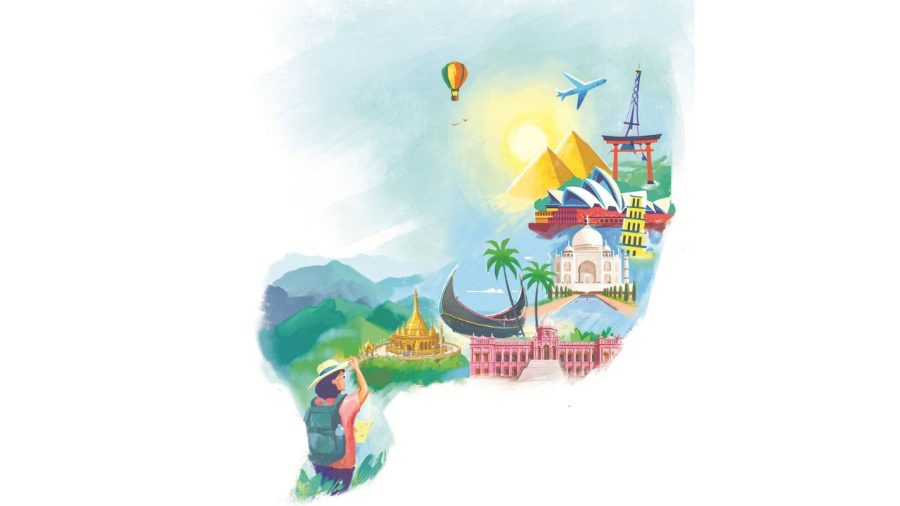



The Sundarbans, Cox’s Bazar, the hills of Bandarban and Rangamati, archaeological sites, rivers, wetlands, tea landscapes, village life, food and a deeply layered culture give Bangladesh a tourism story that is difficult to reproduce elsewhere.
Yet a destination is not created by attractions alone. It is created by the entire experience between the moment a traveller searches for Bangladesh and the moment that traveller returns home – and decides whether to recommend it.
That distinction is important because Bangladesh’s tourism challenge is no longer simply a question of promotion.
It is a question of conversion: converting natural and cultural assets into safe, accessible, memorable and economically productive experiences; converting domestic travel into local enterprise; and converting international curiosity into longer stays, higher visitor spending and repeat visits.
For a clean cross-country comparison, the latest World Bank/UN Tourism series available for Bangladesh in the World Development Indicators runs to 2019.
Bangladesh recorded 323,000 international tourist arrivals that year. In the same UN Tourism-based series, India recorded about 17.91 million, Sri Lanka 2.03 million, Maldives 1.70 million and Nepal 1.20 million.
These figures are not a verdict on destination quality; countries differ greatly in size, geography and market structure. But they reveal the scale of the international-arrival gap facing Bangladesh before COVID-19 disrupted global travel.
The lesson is not that Bangladesh should copy its neighbours. The lesson is that the country needs a clear competitive tourism proposition and the systems to deliver it.

WTTC’s latest global research estimates that Travel & Tourism contributed US$11.6 trillion to world GDP in 2025, equal to 9.8% of the global economy, while supporting 366 million jobs. International visitor spending reached US$2.02 trillion.
The World Bank likewise describes tourism as an inclusive engine of job creation that links global demand with local suppliers, including hospitality, transport, food, cultural services and small businesses.
For Bangladesh, this means tourism policy should be treated as economic policy, employment policy and local-development policy at the same time.
A visitor’s expenditure does not stop at a hotel. It can move to the driver, guide, restaurant worker, boat operator, photographer, farmer, handicraft producer, online entrepreneur and small retailer.
The important question is therefore not only ‘How many tourists came?’ but ‘How much local value was created, and how much of it stayed in the destination?’
A destination may be spectacular, but if the journey is uncertain, fragmented or expensive, the attraction loses commercial power.



Destination infrastructure: sanitation, waste management, signage, public transport, pedestrian facilities, emergency services, digital connectivity and visitor information are part of the tourism product, not cosmetic additions.
A modern tourism economy competes through reliability – cleanliness, punctuality, communication, safety, hospitality and problem resolution. Bangladesh often markets places when it should be packaging experiences.
‘Visit Cox’s Bazar’ is a location proposition. A three-day coastal itinerary combining food, local culture, responsible beach activities, crafts and community enterprise is a product proposition. Products create reasons to stay longer and spend more.
Bangladesh Tourism Board maintains a tourism data inventory and publishes annual reports, but tourism statistics need to become more frequent, integrated and decision-oriented. Arrival counts alone cannot tell policymakers whether a destination is succeeding.
We need destination-level data on occupancy, average length of stay, visitor expenditure, domestic versus international demand, seasonality, employment, repeat visitation, satisfaction, environmental pressure and the share of tourism spending captured by local businesses.
Tourism becomes meaningful when statistics become livelihoods. An ILO/UN Bangladesh feature in 2024 described a young guide in Bandarban whose tourism training enabled her to guide visitors while her family combined lodging and handicrafts to earn from the visitor economy.
That is the kind of tourism Bangladesh should pursue: not a model where visitors arrive, consume and leave, but one where communities become skilled participants, entrepreneurs and custodians of the places visitors come to experience.
This also makes tourism a youth opportunity. Guiding, digital marketing, photography, culinary services, event management, travel technology, language services, transport, wellness, content creation and hospitality can create pathways into income with relatively modest entry barriers – provided training, finance and market access are available.
Women and rural entrepreneurs can benefit particularly when tourism supply chains are designed to include them rather than treating them as an afterthought.
Bangladesh needs a shift from ‘tourism promotion’ to ‘destination management’. Promotion is necessary, but promotion without readiness can magnify dissatisfaction.
The country should build destination-management plans around carrying capacity, visitor flows, waste, conservation, safety, local enterprise and digital reputation.
A practical agenda could begin with five priorities: (1) establish a national tourism dashboard integrating immigration, accommodation, transport, attractions, expenditure and visitor-satisfaction data; (2) develop a small number of flagship destination clusters rather than spreading limited resources everywhere; (3) make tourism infrastructure measurable through service standards; (4) build professional skills through industry-linked training and certification; and (5) create stronger public-private-community partnerships so local businesses can supply hotels, tour operators and attractions.
There is a tendency to judge tourism success mainly through foreign arrivals. That misses Bangladesh’s enormous domestic market.
Domestic tourism can provide year-round demand, help businesses survive seasonality and allow destinations to improve before competing more aggressively for international visitors. A strong destination should work for its own citizens as well as for guests.
Bangladesh does not need to become another country. It needs to become a better version of its own destination proposition. Its competitive advantage lies in the combination of nature, culture, food, people, rivers, heritage and proximity to major Asian markets.
The weakness is not the absence of assets; it is the gap between assets and experience, between promotion and product, and between tourism spending and local value creation.
The real measure of success should therefore be bigger than a visitor-arrival headline.
It should be visible in a guide who earns with dignity, a village entrepreneur who finds a market, a young graduate who builds a tourism career, a cleaner beach that remains clean after peak season, a heritage site protected because visitors create value, and a traveller who leaves Bangladesh carrying a story worth telling.
Tourism is often called an industry of dreams. For Bangladesh, the next step is to make those dreams measurable: more value per visitor, longer stays, better jobs, stronger communities, protected destinations and reliable data.
The country already has the raw material. The strategic challenge is to turn that raw material into a world-class experience – and to ensure that the value created by tourism reaches the people and places that make Bangladesh worth visiting.
Author is the Assistant Professor & Head of Dept. of Tourism and Hospitality Management, Fareast International University.