The Supreme Court has temporarily dismissed four of its MLSS (Member of Lower Subordinate Staff) employees for protesting against being forced to work at judges’ private residences, a practice they likened to “slavery.”
The dismissed employees are Md. Asaduzzaman, Mosa. Rukshun Nisha, Md Miraj, and Md Mehedi Hasan. Their temporary dismissal was announced in a notification signed by Supreme Court Registrar General Muhammad Habibur Rahman Siddiqui on Tuesday, 5 May. Separate notifications cited violations of disciplinary rules as the grounds for the action.
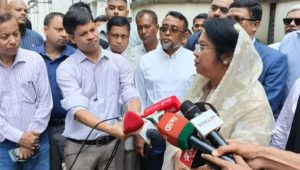
The dismissal order came just one day after several MLSS employees held a press briefing on 4 May in front of the Supreme Court Annex Building.
During that briefing, the employees alleged a stark disparity between their official job description and the duties they were being forced to perform. According to their recruitment circular, they were hired as office assistants with duties limited to the office. No mention of residential duty was made.

Despite this, they claimed, they had long been forced to work at judges’ residences. Following the mass uprising, then-Chief Justice Syed Refat Ahmed had withdrawn them from residential duties and reassigned them to official work at the Supreme Court. Recently, however, the employees say they were once again sent to work at judges’ homes.
Comparing their experience to slavery, the MLSS employees told journalists, “Because of our duty at judges’ residences, we do not get any weekly holidays. Even on Eid days, we have to work. We do not want to go to the residences anymore.”



The employees also claimed that complaints lodged with the Supreme Court administration went unheeded.
“In various ways, we are tortured and oppressed at judges’ residences,” they said. “We came here to do official work, but they are forcing us to do the work of cooks, security guards, washermen, gatekeepers, and cleaners. This is a form of slavery. We do not want to live under slavery.”
According to a 2014 notification from the Ministry of Public Administration, the MLSS post is officially designated as Office Assistant, with duties strictly limited to office work. A 1966 circular further specifies that office assistants are responsible for arranging office furniture and records, transferring files, moving light furniture, serving drinking water to officials, preserving stationery, depositing cheques, and arriving at the office 15 minutes early, among other clerical tasks.
However, the MLSS employees allege that those sent to judges’ residences are forced to perform the work of domestic servants – cooks, cleaners, washermen, and security personnel.
The employees further claimed that they face physical and mental abuse at judges’ residences. They alleged that they are made to work from dawn until late at night, are denied leave even on government holidays, and are subjected to intimidation.
Specific allegations include being forced to clean toilets, cut fish, wash clothes, and perform all household chores. There have also been allegations of being forced to raise hands, being kept hungry, and being compelled to purchase various items with their own pocket money.
No immediate comment was available from the Supreme Court administration regarding the allegations or the dismissals. Efforts to reach the Registrar General for a response were unsuccessful by the time of filing this report.